China's economy remains resilient and holds significant growth potential in spite of the widespread impact of the Middle East conflict, Managing Director of the International Monetary Fund (IMF) Kristalina Georgieva said on Wednesday, adding that China's strong performance will continue to deliver "positive spillovers" for the world economy.
Despite the global economic turmoil brought by the U.S.-Israeli war on Iran, data from China's National Bureau of Statistics (NBS) on Thursday showed the country's gross domestic product (GDP) grew 5 percent year on year in the first quarter of 2026, 0.5 percentage points faster than that of the fourth quarter of 2025.
The latest figures offer an encouraging sign the country is on the right track and comes after Chinese lawmakers last month set an economic growth target of 4.5 to 5 percent for the year.
Speaking at a press conference during the ongoing IMF Spring Meetings in Washington, D.C., Georgieva emphasized that the Chinese economy has demonstrated clear resilience amid the current global turbulence and said it continues to offer enormous potential as a driving force for other markets.
"We do see resilience in the economy. China has great potential. As it moves to change its growth model from one that is mostly dependent on exports to one that is primarily oriented towards domestic consumption, moving from goods to services, that can give a big boost to China. And, of course, China's size means that when China does well, there are positive spillovers for the rest of the world," she said.
During the press conference, Georgieva noted the war in the Middle East has already delivered a severe blow to the global economy with energy markets and supply chains badly hit, particularly as a result of the disruption along the Strait of Hormuz, a vital shipping passageway which has become a focal point for the conflict.
Some economies heavily reliant on imports from the Gulf region are already facing supply shortages, including oil, natural gas and related raw materials which are typically transported through the Strait of Hormuz, the IMF chief warned.
Georgieva also pointed to the potential long-term pain which lies ahead, saying that even if the conflict ended immediately, supply chains would not recover at once.
As a result of these uncertainties, the IMF has lowered its 2026 global growth forecast in its latest World Economic Outlook. It now projects growth will slow to 3.1 percent this year, down from the 3.4 percent seen in 2025.
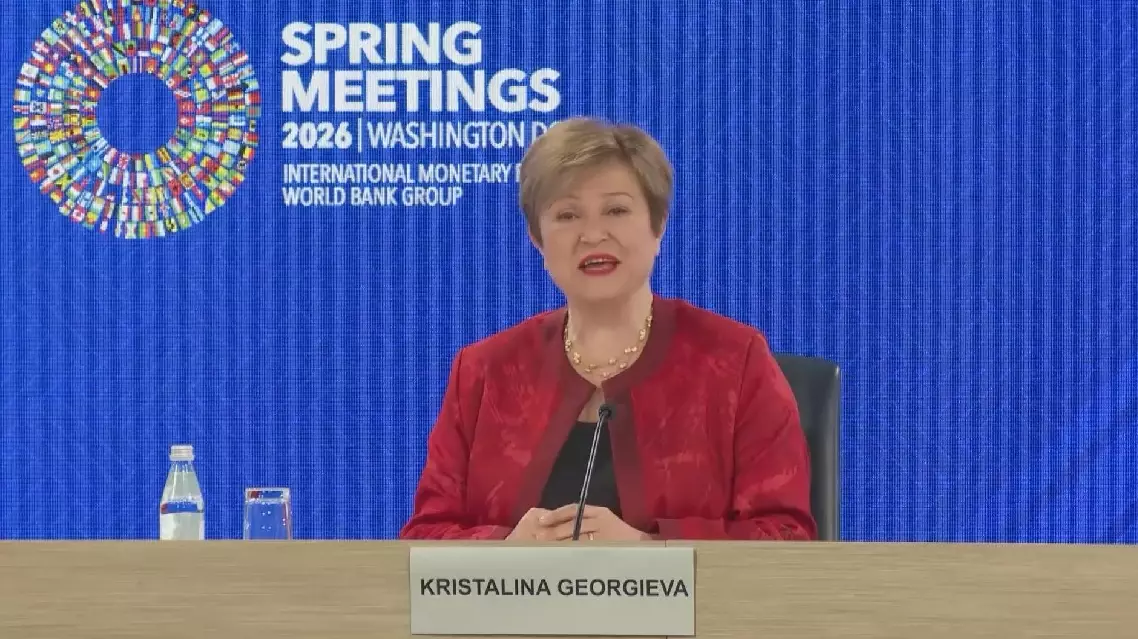
China's resilient economy offers "positive spillovers" for rest of world amid global shocks: IMF chief