Skip to Content Facebook Feature Image

Canva Announces Anthropic Collaboration to Bring AI-Powered Design to Millions

News

Canva Announces Anthropic Collaboration to Bring AI-Powered Design to Millions
News

News

Canva Announces Anthropic Collaboration to Bring AI-Powered Design to Millions

2026-04-17 23:52 Last Updated At:04-18 00:10

SYDNEY--(BUSINESS WIRE)--Apr 17, 2026--

Canva, the world’s leading all-in-one visual communication platform, today announced the next chapter in its two-year strategic collaboration with Anthropic, bringing Canva directly into the newly launched Claude Design by Anthropic Labs, one day after unveiling Canva AI 2.0 to a crowd of 6,500 people at Canva Create in Los Angeles..

This press release features multimedia. View the full release here: https://www.businesswire.com/news/home/20260410843169/en/

Canva and Claude

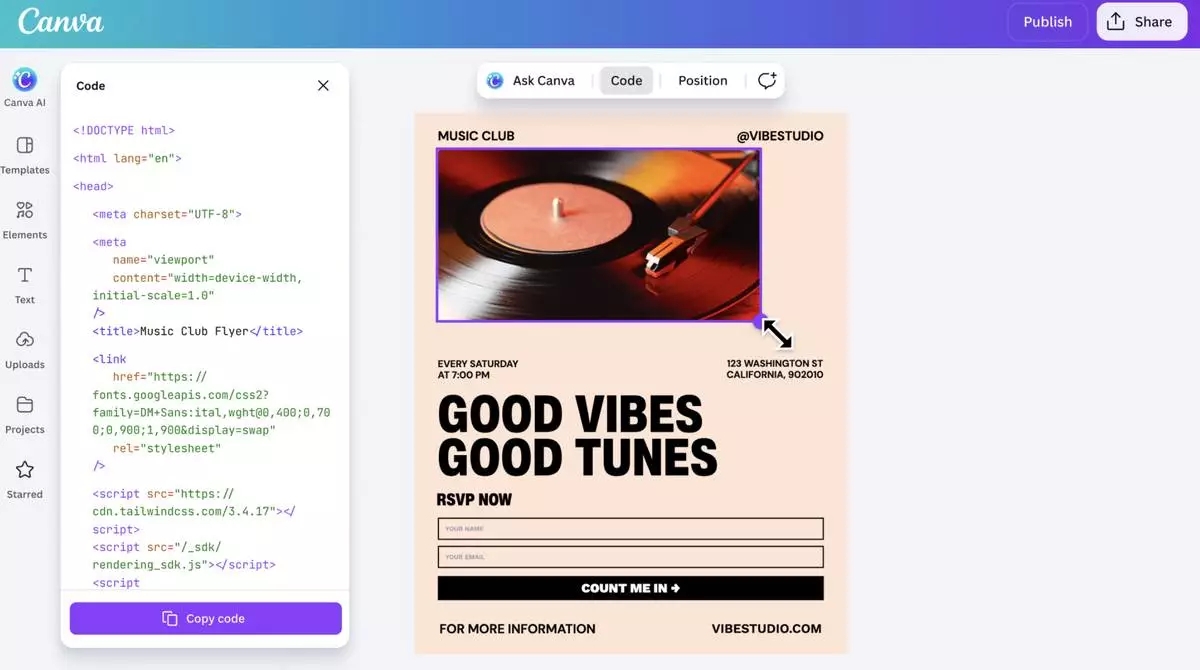
Canva is also today introducing HTML importing, a new capability that makes it easy to bring interactive content generated in tools like Claude into the Canva editor for drag-and-drop collaboration, refinement, and publishing.

The collaboration makes it easier for Claude Design users to turn AI-generated drafts and ideas into fully editable designs in Canva, where they become collaborative, on-brand, and ready to scale and publish. It helps address one of the biggest gaps in today’s AI landscape: turning AI-generated content into real, usable work.

From AI-Generated Drafts to Fully Editable Designs

Since launching the Canva MCP in Claude last July, millions of people have used Canva through Claude to create, resize, and summarise content using simple text prompts. Today’s announcement builds on this momentum, making it even easier to move from drafts and ideas to presentations, documents, social posts, infographics, and more in Canva.

Powered by Canva’s Foundation Design Model, content exported from Claude Design is instantly turned into structured, fully editable designs in the Canva Editor, built for collaboration, iteration, and scale. Unlike traditional AI outputs that are static and fragmented, each design is ready to refine, share, and build on.

Introducing HTML and Artifact Editing in Canva


From landing pages to widgets and interactive experiences, AI tools are making it easier than ever to generate complex content using HTML. But these outputs are often locked in code, making them difficult to edit, refine, or adapt without starting over.

To solve this, Canva is also launching HTML importing and editing, expanding its platform to support code and AI-generated artifacts within its simple drag-and-drop editor. This makes Canva the first platform to unify visual, document, and interactive content creation in a single collaborative editor.

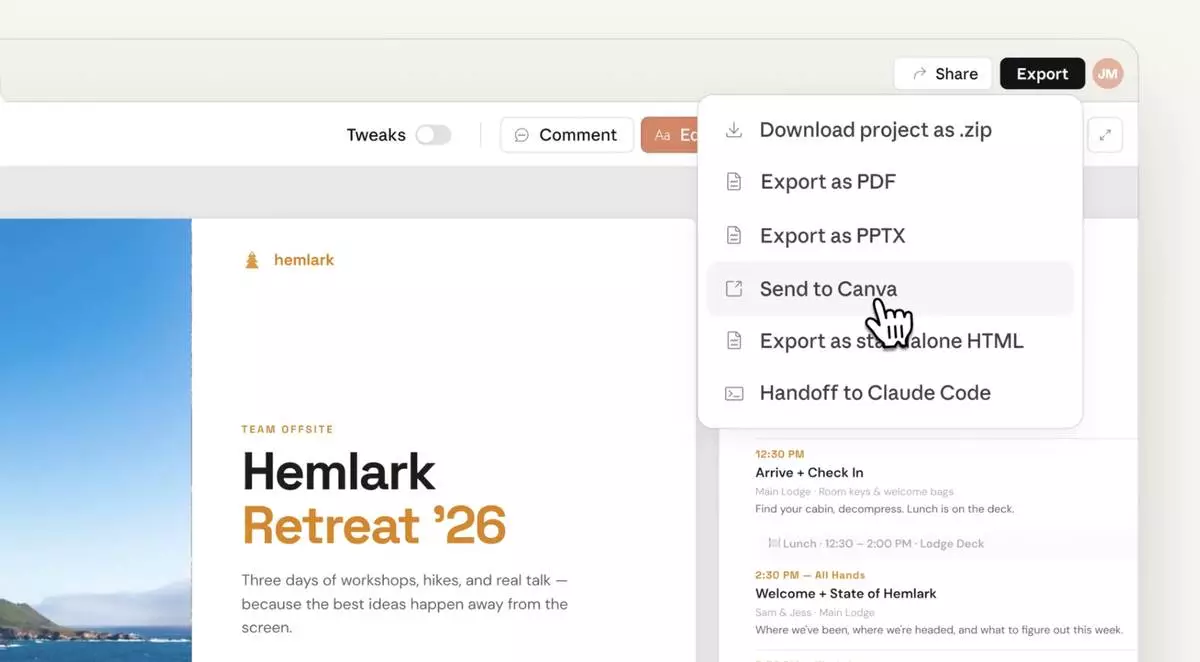
Now, Claude Artifacts can be brought directly into Canva and edited like any other design. Swap colours, layouts, and elements without regenerating code with each change. Then collect data with Canva Forms into Sheets, or publish your creation as an interactive website with a custom domain, all without leaving Canva.

Expanding Canva’s Role in the AI Ecosystem

Today’s announcement marks the latest step in Canva’s rapid expansion across the AI ecosystem, where the company is fast becoming the default destination for design.

As AI accelerates the pace of content creation, millions of people are looking for ways to move beyond ideas and static outputs, turning generated content into real, usable designs. Since launching in March 2026, Canva’s Magic Layers product, which breaks static images into fully editable components, has been used more than nine million times, highlighting strong demand to turn AI-generated content into adaptable, scalable work.

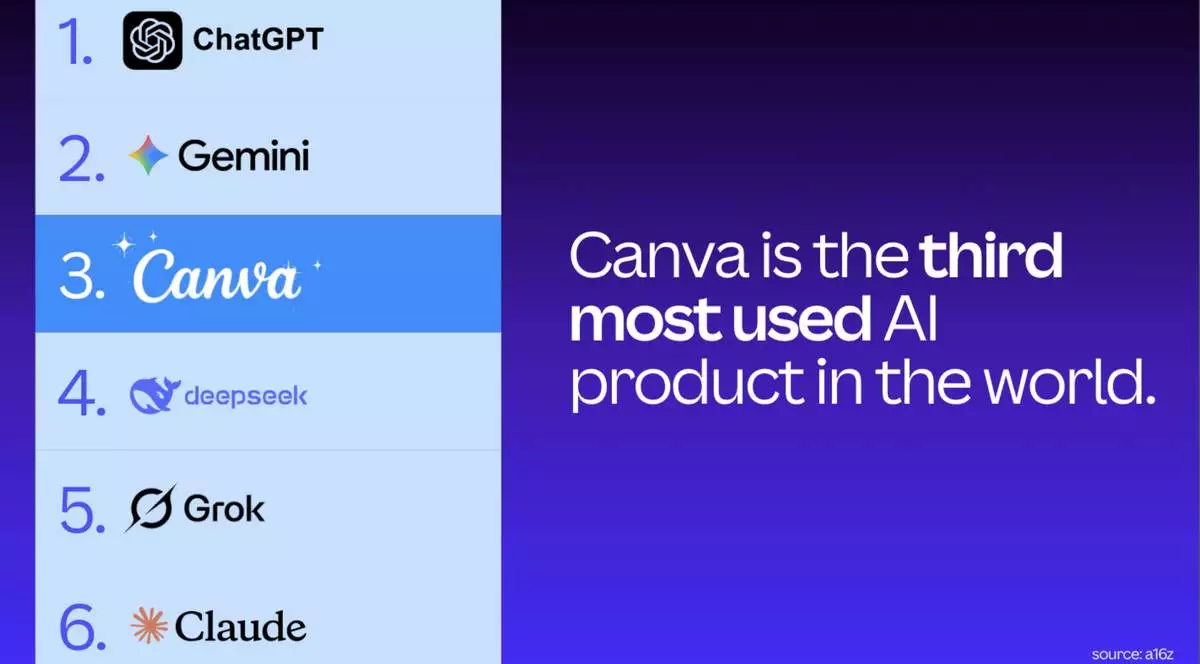
This growing demand has helped make Canva the third most-used AI platform in the world, and the fastest growing in customer spend on AI products among leading software companies, according to new research from venture capital firm Andreessen Horowitz.

Canva now powers design for more than a quarter of a billion people every month, bringing more than 420 designs to life every second. The company’s AI products and foundation models have been used more than 27 billion times to date.


A New Era for Creativity

Today’s announcement builds on a momentous week for Canva. Yesterday, the company unveiled Canva AI 2.0, the most significant evolution of its platform since launching more than a decade ago.

Announced at Canva Create in Los Angeles in front of more than 6,500 attendees and millions tuning in globally, this week marks a new era for Canva as the company expands beyond design generation to become the system at the centre of how work gets done.
HTML importing
HTML importing

Canva is the third most used AI product in the world.
Canva is the third most used AI product in the world.

Send to Canva

Send to Canva

JACKSON, Miss. (AP) — Brandi Carter needs her wine.

As the owner of Levure Bottle Shop in Jackson, Mississippi, she sells natural wine delivered to her business by a state agency responsible for distributing alcoholic beverages to liquor stores, bars and restaurants. But delays caused by problems in a state warehouse have led Carter and many other retailers to see their inventory dwindle and their business drop as they wait for new shipments.

Carter, who also handles the beverage program for a restaurant in Jackson, said she has been dealing with delays since February, and she's feeling helpless as traffic in her store goes down.

“I’ve just reached acceptance that this is our new normal, and it’s awful,” Carter said Wednesday.

In Mississippi, the state's Alcoholic Beverage Control department — an arm of the Mississippi Department of Revenue — is responsible for distributing wine and liquor to businesses that sell it. That's different than other states, where individual companies handle alcohol distribution, Carter said.

During the week ending April 12, there were more than 172,000 cases that were pending delivery, and it was taking an average of 17 days for businesses to receive their orders, according to the Mississippi Department of Revenue.

Those numbers are down from the week ending March 1, when the backup appeared to be at its peak for the year. At that time, there were more than 220,000 cases pending delivery, and it was taking an average of 25 days for the process to be completed.

In contrast, the number of cases pending delivery was more than 51,000 and the wait time was three days for the week ending Jan. 11., the department said.

Carter said the backlog has resulted in a wait of four to five weeks, as opposed to a few days to two weeks before the delays began.

Shipping delays from the state's 40-year-old warehouse emerged in January as it went away from an “obsolete” conveyor belt system to one where pallets were used to move cases, according to a statement from the Mississippi Department of Revenue. A new warehouse management system experienced technical issues, leading to delays, the department said.

“The computer program that they implemented for the warehouse wasn’t working effectively with the ordering side,” Carter said. “So the first big chunk was the biggest problem, because things were being marked as shipped, but they weren’t shipped.”

The department said technical issues have been resolved and the warehouse is operating at full capacity, with pending orders being shipped as retail orders increase.

“While capacity at the existing facility has been a challenge for well over five years, there is not an alcohol shortage,” the department said. “As retail ordering stabilizes, we anticipate shipments returning to normal volume within the coming weeks.”

The Mississippi legislature debated temporarily allowing out-of-state distributors to sell and ship alcohol directly to retailers. The law would have been repealed after two years, but it did not pass. The state’s legislative session has since ended.

A new warehouse set to be completed by the end of this year will be able to store and ship over twice as many cases as the current facility, the revenue department said.

Josh Sorrell, owner of Spillway Wine and Spirits in Brandon, said he used to order 600 cases in a day, but he is now limited to 100 cases per day. About 30% to 40% of the items he usually orders on a daily basis have been unavailable, he said.

Sorrell believes restoring the conveyor belt system would fix the problem. He has asked Mississippi Gov. Tate Reeves to declare a state of emergency.

If delays continue, Sorrell's concerned that business will suffer into the end of the year, when he makes a lot of his sales.

“As it gets busier, we’re gonna crumble,” he said. “I mean, it’s going to be really hard at 100 cases a day to stock up for a full October, November, December.”

Meanwhile, customers are going to three or four stores looking for their specific bottle, and they sometimes can’t find it, Sorrell said.

“It’s frustrating to lose people at the door who are looking for a specific product that I can’t even get from the state,” he said.

On Thursday, Lauren Roberts went to Sorrell's store looking for Soda Jerk's orange cream shots, but he was out, just like the supermarket where she usually buys it. So, she bought another type of drink for an upcoming celebration with her family.

“We’re having a little get-together this weekend because it’s my daughter’s prom and her boyfriend’s family’s coming,” Roberts said. “So everybody has their drink of choice, but me.”

Sainz reported from Memphis, Tennessee.

A shelf stands partially empty at Spillway Wine and Spirits in Brandon, Miss, on Thursday, April 16, 2026. (AP Photo/Sophie Bates)

A shelf stands partially empty at Spillway Wine and Spirits in Brandon, Miss, on Thursday, April 16, 2026. (AP Photo/Sophie Bates)

Recommended Articles