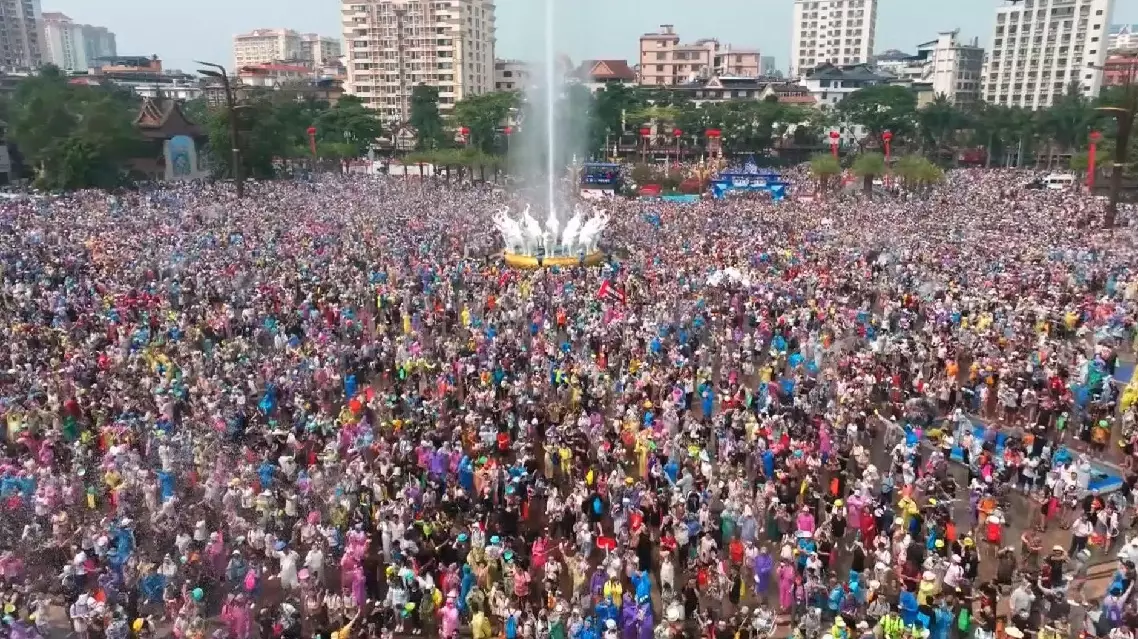
A variety of Water-splashing Festival celebrations have been held across southwest China's Yunnan Province to mark the grand annual folk event, drawing large crowds and boosting the local cultural tourism market.
During Water-splashing Festival, water is considered an auspicious symbol and people splash water on one another,wishing happiness and good fortune. This festival is regarded as one of the most important festivals of ethnic groups in southwest China.
In Jinghong City of Xishuangbanna Dai Autonomous Prefecture, the festival was marked at a center square. Revelers packed the site as water splashed through the air, turning the square into a sea of joy.
In addition to the signature water-splashing festivities, dragon boat races and other cultural events were also staged.
In Lincang City, people from different ethnic groups gathered to join the celebration, splashing water on one another to convey blessings and good wishes.
For Yingjiang County, the festival not only enriched local cultural life but also helped heat up the tourism market, attracting visitors from across the country.
In Yuanyang County, a series of activities including ethnic parades and cultural performances were held one after another, adding to the festive atmosphere.
"This is my first time coming to Yuanyang to celebrate the Water-splashing Festival. Even though I got completely soaked, I really felt the enthusiasm of the people here. They are incredibly welcoming. It's a lot of fun," said Liu Bai, a tourist from north China's Hebei Province.
Vibrant folk activities unfold to mark Water-splashing Festival across China's Yunnan
American Nobel laureate James Heckman said he remains positive and optimistic about China's development, as the Chinese have always been pragmatic and realistic.
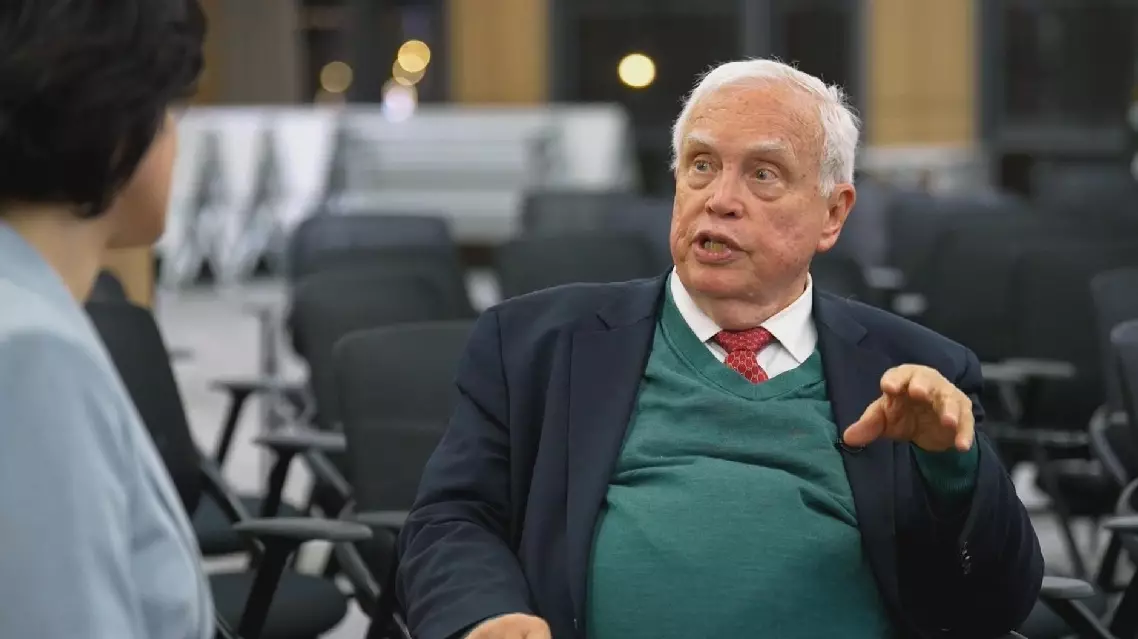
Heckman, an American economist who won the Nobel Prize in Economics in 2000, shared his views on China and the Chinese people in an exclusive interview with China Media Group (CMG) in Beijing, which was released on Friday.
"I think it comes from several forces, dealing with the Chinese and seeing the vitality in the society. And I think there is a fundamental energy there. The elements are there, the vitality is there in terms of the industries, the universities. The country's vital, the people are intelligent, the society is rich in a fundamental way. The Chinese have always been very pragmatic, and they are very realistic," he said.
Heckman said what makes him admire about the Chinese people is their virtues and values.
"Look at China as a place that has a deep sense of values. Hard work and the values that I think are truly virtues, character values. But, see, China also has a chip on its shoulder, it does. It had a chip on its shoulder since the 1840s, the Opium War, right? And so there's a sense that you can see it, and I don't mind, that's kind of good. Because they're getting stronger and stronger and you can't help but admire it in the sense that, yes, they are stronger, and they're doing things much more wisely in many ways than what we're doing," Heckman said.
"So there's a sense in which there's more of a sense of purpose in China. Most of the Chinese students that I deal with and people I deal with, even though they may disagree on details, have this sense of unity and pride in China. And I think that's lacking with a lot of Americans," he said.
U.S. Nobel laureate optimistic about China's development