France has recently approved a draft law to simplify the restitution of foreign artifacts acquired illegally between 1815 and 1972, a move that experts said was the result of sustained efforts from all sides.
The French National Assembly passed the draft law with 170 votes in favor and none against on April 13. Those covered in the bill are artworks and artifacts "illicitly acquired" between 1815 and 1972 through theft, looting, transfers or gifts obtained by force, violence, or from someone without the right to dispose of them.
The bill, aiming to simplify the procedures of restitution in France, will now be examined by a joint committee to harmonize the position between senators and deputies.
Items in national collections are considered inalienable and cannot be transferred under France's current legislation, and the restitution requires case-by-case legislation, a complicated process that has drawn attention from all sides.
"There are a lot of very complex issues in France's museum system. French law traditionally prohibits the restitution of items from national collections. This has had a certain political and even diplomatic impact and has drawn attention from the French museums authorities. So there has been a renewed interest in these questions of restitution," said Dominique Poulot, emeritus professor at the University of Paris 1 Pantheon-Sorbonne.
Momentum for change has been built over several years. In 2017, President Emmanuel Macron pledged during a visit to Burkina Faso to push for legislation on restitution. He appointed experts to study the matter and propose recommendations in the following year. This helped pave the way for the draft law.

Concerted efforts behind France’s approval of bill on returning looted artifacts: expert

Concerted efforts behind France’s approval of bill on returning looted artifacts: expert
India, home to one of the world's youngest populations, is witnessing a growing number of students heading to China in search of quality education and stronger career prospects.
Fields such as artificial intelligence, robotics and engineering are seeing a notable rise in enrollments.
Naresh Patra, a researcher in astrophysics at the Chinese University of Hong Kong, chose to study in China for what he describes as the excellent value for the potential boost to his career.
"First thing, the education system is very good and expenses are too low. And second point [is that] you will get good exposure about machine learning and AI, and third point you will get jobs immediately after passing from these universities," said Naresh Patra, a student from India.
There has been a noticeable surge in inquiries from Indian students for courses in engineering and artificial intelligence. To attract more international applicants, Chinese universities have ramped up investment in world-class infrastructure, including advanced laboratories, while expanding scholarship offerings across a wide range of disciplines.
Akshay Bhambri is among those who secured such a scholarship, supporting his research in traditional medicine. He describes his academic experience in China as highly professional and well-structured.
"In different departments, there are enough resources to do that, and even in libraries, whatever you need is provided immediately to you. So this kind of environment for a researcher, for a student, be it undergrad or PhD student, is very helpful when they want to do some kind of research or some kind of understanding to get what they want immediately, so that they can excel in their work," said the researcher.
Cross-border studies are also foundational to forming academic partnerships between China and India, but experts say that even greater outreach and engagement are needed.
"It will be more possible if there is a higher level, not just the people-to-people level, but (if) we see the authorities from both sides interact, and university-to-university interactions, in that case, there would be a lot of confidence building," said Nishith Shah, principal of India China Academy.
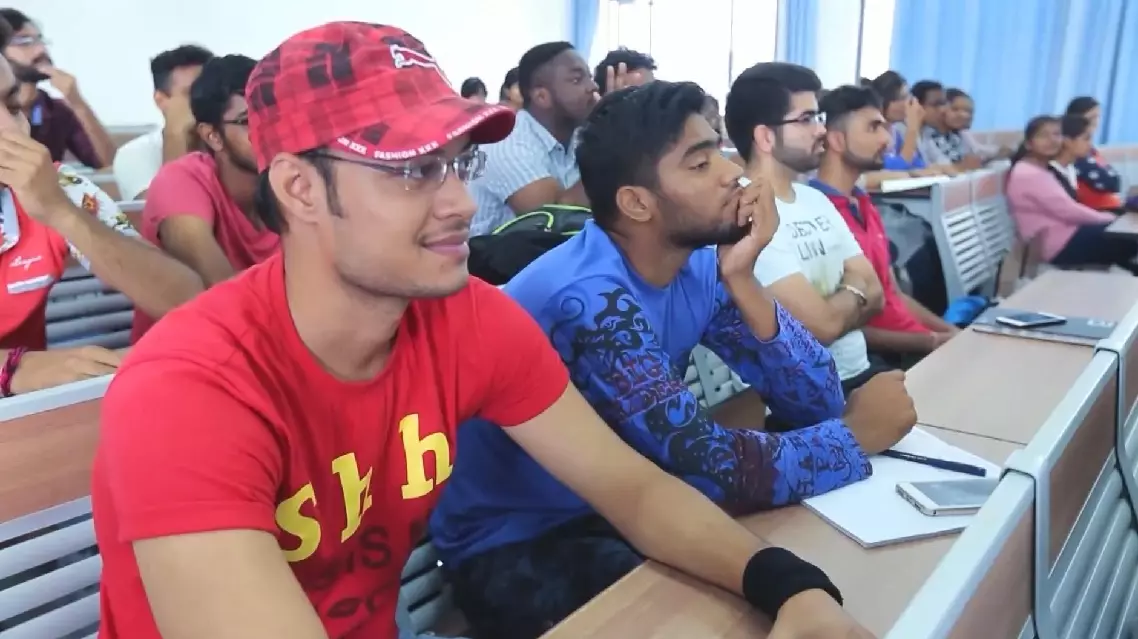
More Indian students choose Chinese universities for quality education