WASHINGTON--(BUSINESS WIRE)--Apr 20, 2026--
Accelsius, the leader in two-phase, direct-to-chip liquid cooling technology for AI and high-performance computing, today announced the general availability of the NeuCool® IR150, the industry’s first fully integrated rack-level cooling solution that combines a two-phase Coolant Distribution Unit (CDU), 42U of IT rack space, and built-in liquid and vapor manifolds in a single 800mm-wide enclosure, offering up to 150kW of capacity.
This press release features multimedia. View the full release here: https://www.businesswire.com/news/home/20260420391618/en/
Reimagined from the ground up for the liquid cooling era, the IR150 is a true plug-and-play system designed to move through established IT infrastructure channels, making two-phase liquid cooling accessible not just to hyperscalers but to enterprises and smaller operators for the first time. Its fully integrated form factor is perfect for edge deployments and the small language model workloads that will proliferate across the market as AI matures. The company also unveiled the NeuCool HyperStart program, a new initiative created to support hyperscale operators, neocloud providers, and key partners in validating two-phase direct-to-chip liquid cooling solutions and accelerating their readiness for high-density, large-scale deployments.
The announcements come at a pivotal moment for the data center industry. Hyperscale and neocloud operators are moving at unprecedented speed to bring gigawatt-class AI facilities online, and with that velocity has come increasing public scrutiny of power and water use in host communities. Billions of dollars in planned data center projects have already been delayed or blocked amid concerns about strain on local resources. Accelsius believes the industry can, and should, continue to move quickly—but responsible planning for more efficient AI factories also requires a hard look at waterless and more energy-efficient liquid cooling architectures from day one.
“Hyperscalers and neoclouds are under enormous pressure to deliver AI capacity faster than ever, and that urgency is understandable,” said Josh Claman, CEO of Accelsius. “Our message at Data Center World is simple: moving fast and planning responsibly are not mutually exclusive. With the general availability of the IR150 and the launch of NeuCool HyperStart, we’re giving operators a practical path to bring two-phase, direct-to-chip cooling into their reference designs today. That way AI factories can avoid the mistake of scaling without considering their host communities’ water and energy supplies.”
Traditional single-phase liquid cooling was the industry’s first attempt to move beyond air, but it was the wrong bet. These systems rely on treated water circulated directly to the chip, introducing leak risk, corrosion concerns, and continuous water-quality maintenance, and their complexity makes them nearly impossible to distribute through standard IT channels, keeping liquid cooling out of reach for all but the largest operators.
In contrast, Accelsius’ two-phase approach uses a non-conductive dielectric refrigerant with an A1 safety rating and low global warming potential. No water enters the IT rack, meaning leak events pose minimal risk to GPUs or server electronics. Industry studies have shown that two-phase cooling systems can reduce cooling energy consumption by up to 90 percent and eliminate millions of gallons of annual water use compared to air-cooled alternatives, while independent analysis by Jacobs Engineering has demonstrated that Accelsius’ two-phase solutions deliver 35–44 percent annual OpEx savings and 8–17 percent five-year total cost of ownership savings over single-phase direct-to-chip systems.
Introducing the NeuCool HyperStart Program
The NeuCool HyperStart program gives hyperscale operators, neocloud providers, and key partners a structured path to validate two-phase direct-to-chip liquid cooling—alongside complementary single-phase water cooling approaches—and bring these technologies into their data center reference designs and product roadmaps. Participants receive early engineering support, deployment planning, and technical validation to accelerate their readiness for high-density, large-scale AI deployments. Several hyperscale AI cloud providers have already engaged with Accelsius under the program as they build out cooling roadmaps for next-generation AI infrastructure.
See the NeuCool IR150 and NeuCool HyperStart at Data Center World 2026
Learn more about the NeuCool IR150 and the NeuCool HyperStart program at Data Center World 2026, April 20–23 at the Walter E. Washington Convention Center in Washington, D.C. To schedule a meeting or demo, contact info@accelsius.com.
The IR150 joins the NeuCool MR250, Accelsius’ row-based CDU delivering up to 250kW+ of cooling capacity per rack, and the NeuCool Thermal Simulation Rack (TSR), a first-of-its-kind thermal test platform. Together, the NeuCool product family offers operators a complete suite of two-phase, direct-to-chip cooling solutions that scale from evaluation through full data center deployment.
Accelsius Speaking Sessions at Data Center World 2026
Accelsius leaders will participate in three sessions during the event:
About Accelsius
Founded by Innventure, Inc. (NASDAQ:INV), Accelsius empowers data center and AI neoclouds to achieve their business, financial and sustainability goals through advanced cooling solutions. The proprietary NeuCool® platform provides best-in-class thermal efficiencies through a safe, two-phase, direct-to-chip liquid cooling system that scales from single racks to entire data centers. For more information, visit accelsius.com or follow us on LinkedIn.
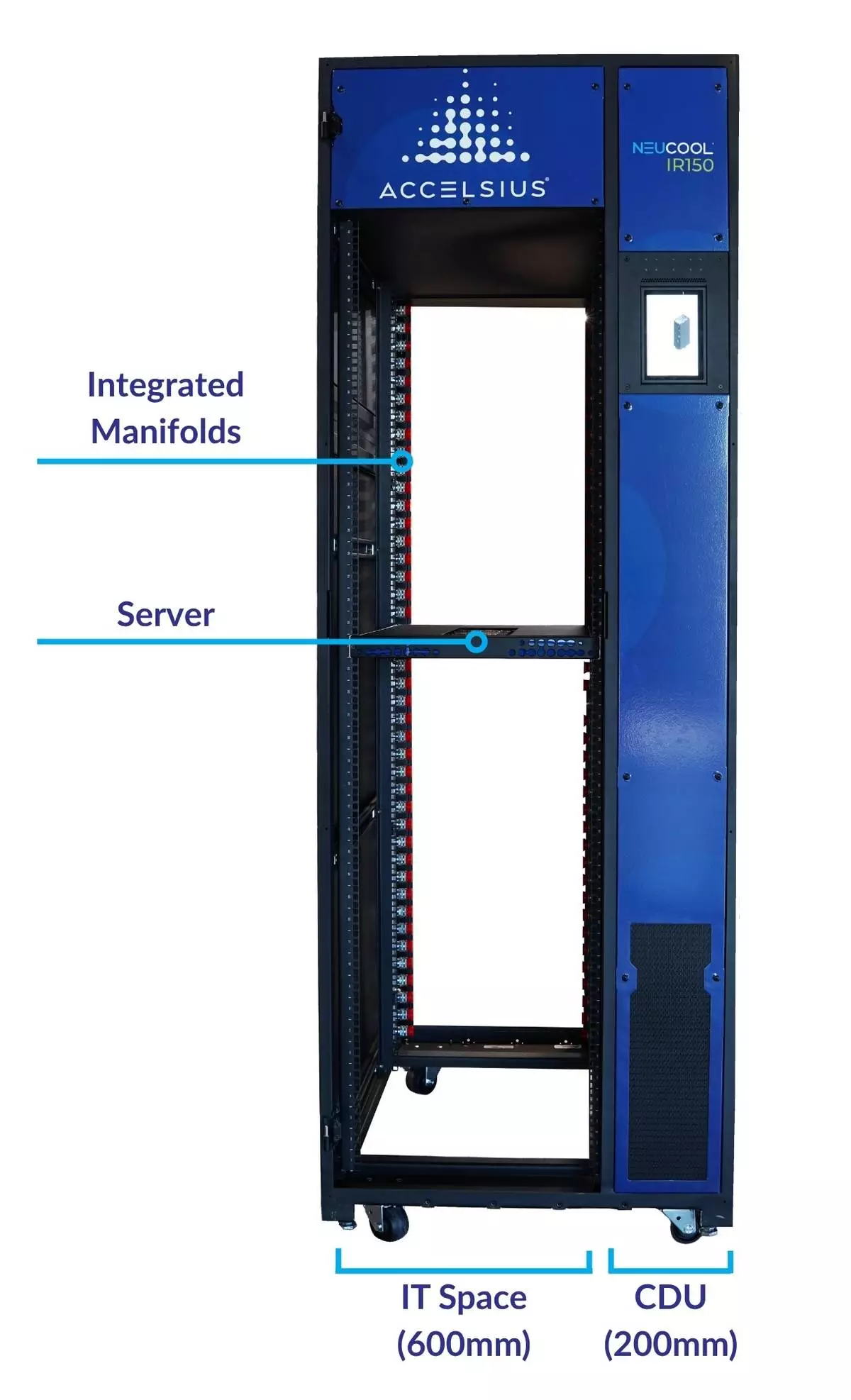
IR150 depicted with labels detail IT and cooling space.