Celebrations marking the 2026 United Nations Chinese Language Day were held in Poland and Zambia on Friday, showcasing a series of cultural activities to promote the Chinese language and culture.
Chinese Language Day, established by the United Nations in 2010, is celebrated annually on Guyu, or Grain Rain, the sixth of the 24 traditional Chinese solar terms, to highlight the global significance of the Chinese language.
The date was chosen to honor Cangjie, a legendary figure believed to have invented Chinese characters.
A celebration event, jointly organized by the Chinese Embassy in Poland and the Warsaw University of Science and Humanities, was held in Warsaw on Friday, attracting nearly 200 teachers, students and Chinese language lovers.
The event featured a diverse range of activities, including Chinese folk dances, themed lectures, and student crosstalk performances. In an interactive area, the organizers set up miniature calligraphy and painting exhibitions, Hanfu (traditional Han clothing) try-on and photo opportunities, tea ceremony experiences, calligraphy and painting workshops, and fan dance demonstrations.
"There are more and more people learning Chinese. I think China is becoming interesting for a lot of young people as far as technology is concerned, as far as Chinese soft power. So I think having an International Chinese Language Day is a useful event to bring about Chinese events, Chinese cultural events, so that young people feel learning Chinese is very attractive, not only as far as learning the language is concerned, but also as far as understanding the culture is concerned," said Marcin Jacoby, dean of the Faculty of Humanities at the Warsaw University of Science and Humanities.
"It opens a door to a whole country that is so big and has so much to offer by the culture, by the history that is incomparable to any other language learning experience," said Lidia Witter, a student of Warsaw University of Science and Humanities.
Meanwhile, in Zambia, a celebration was held on the same day at the Confucius Institute at the University of Zambia (UNZA). More than 120 people, including faculty and students, and representatives of the Chinese communities in Zambia, participated in the event.
During the event, teachers and students from the Confucius Institute performed wonderful programs including dance, martial arts, Chinese songs and poetry recitations. The attendees also participated in interactive activities such as calligraphy, paper cutting and Hanfu (traditional Han clothing) try-ons at an outdoor Chinese traditional culture exhibition zone, experiencing the charm of Chinese culture firsthand.
"Different traditional clothing, like what I am wearing, for instance, it is a type of a traditional clothing. And I really enjoy it because it is so diverse, which reminds me about Zambian culture. So I see a very huge bridge, there is a very huge link between us. That is how much I enjoy Chinese culture," said Kachego Lizubuho, a student of the Confucius Institute at UNZA.
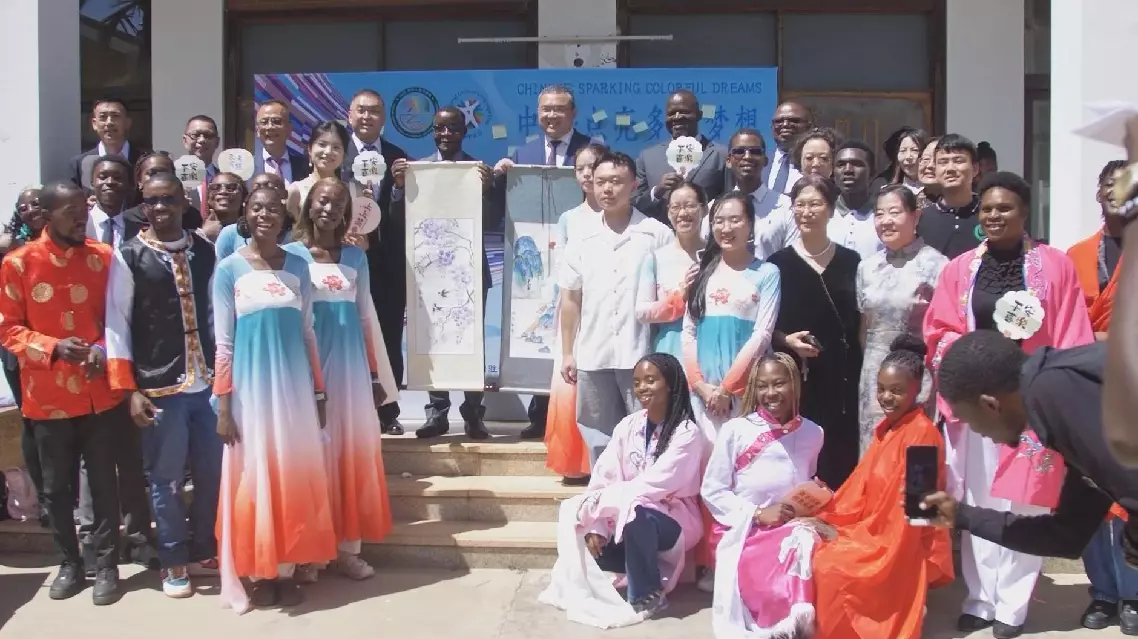
Celebrations held in Poland, Zambia to mark 2026 UN Chinese Language Day