Israel has wiped out entire villages and destroyed crucial infrastructure in southern Lebanon during conflicts with Hezbollah.
According to local media reports, the Israeli military has bombed every bridge over the Litani River last week. It means that major cities like Tyre are now isolated. Vehicles have no way to get through to deliver urgent medicine, supplies, or food. Even the United Nations Interim Force in Lebanon (UNIFIL), which monitors the violations and attacks happening in south Lebanon, can no longer have a direct connection of supply to its forces.
Hassan Dbouk, president of the Union of Tyre Region Municipalities, condemned Israel's destruction, saying it has been wholly disregarding international law and following the same calamitous pattern seen in the Gaza Strip.
"Israel doesn't respect international law. It's destroying everything, mosques, religious places, schools, clinics, the vicinity of hospitals -- even when it doesn't directly hit a hospital, it targets its vicinity, which puts it out of service. As for the infrastructure, last time, it bombarded the central water facility, and electricity always gets affected. To me, the situation in Lebanon is following the same pattern as in Gaza," he said.
He further noted that Israel is destroying villages along the Blue Line, a border demarcation line between Lebanon and Israel established by the United Nations in 2000.
"They said that they are destroying the Blue Line, which is the first line of villages on the border, and the second line, and they're calling for the occupation of the third line and therefore its destruction. They want it to be a buffer zone, which means an uninhabitable place with no population or houses, and this is getting implemented," he said.
Ali Khreis, a Lebanese parliament member, said that Israel is trying to prevent people from returning home as a form of political pressure, but Lebanon will not surrender.
"They want to prevent people from going back home. This is a type of political pressure. Israel is doing this so that Lebanon will yield to its demands. Despite what is happening, we can't give in to the Israeli pressure, whatever the cost. There is no crossing point between Tyre and the rest of the territories now. The main bridge was destroyed, and before that, another bridge was destroyed. This was the only remaining crossing," he said.
A 10-day ceasefire between Israel and Lebanon took effect at midnight between Thursday and Friday local time, following an earlier announcement by U.S. President Donald Trump.
However, the Israel Defense Forces said in a statement on Saturday that it had struck militants approaching a "Yellow Line," which marks the northern edge of the "security zone" established by Israel in southern Lebanon, over the past day.
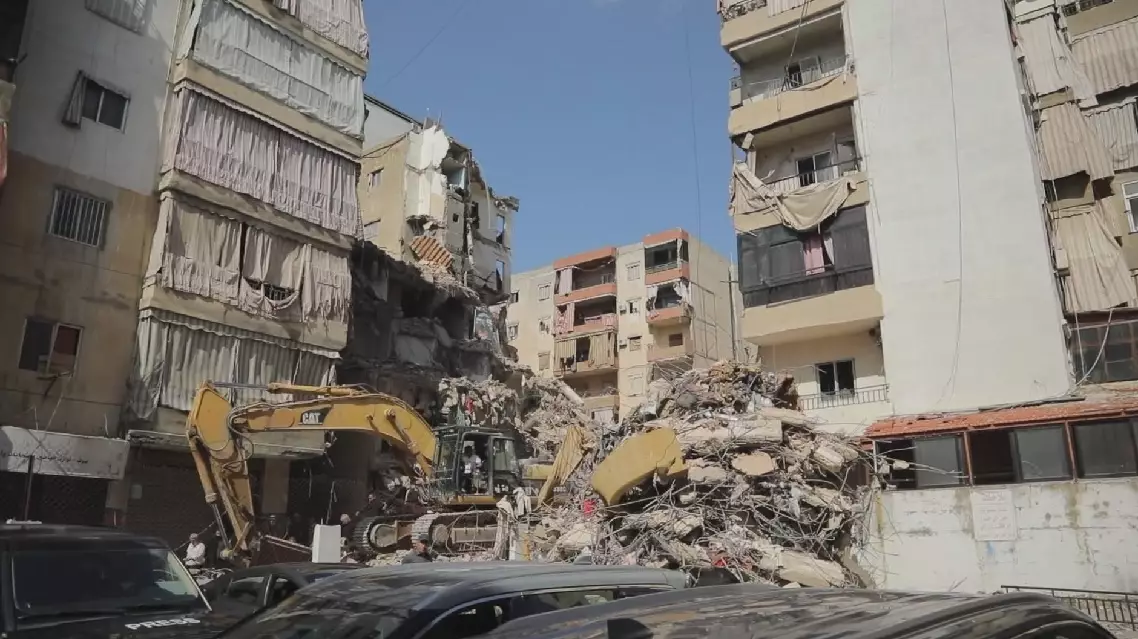
Israeli attacks destroy infrastructure in southern Lebanon
Israeli attacks destroy infrastructure in southern Lebanon
China's top diplomat Wang Yi met with Ali Mohammed Hammed AI Shamsi, secretary-general of the Supreme National Security Council of the United Arab Emirates (UAE), in New Delhi, India, on Tuesday.
Wang, a member of the Political Bureau of the Communist Party of China Central Committee and director of the Office of the Central Commission for Foreign Affairs, said China and the UAE are comprehensive strategic partners.
China is ready to work with the UAE to strengthen confidence, make joint efforts, maintain high-level exchanges, unlock the full potential of bilateral cooperation, promote people-to-people ties, and push bilateral relations to a higher level, Wang said.
Since the outbreak of the U.S.-Israel-Iran conflict, China and the UAE have maintained close communication, Wang said, adding that the conflict has recently turned toward dialogue, but whether lasting peace can truly be achieved still depends on joint efforts from all parties.
Wang said three priorities should be upheld at present. First, relevant parties should commit to a permanent and comprehensive ceasefire and effectively implement the recently signed memorandum of understanding. Second, normal navigation through the Strait of Hormuz should be restored as soon as possible to keep the "lifeline" of regional development unimpeded. Third, countries in the region should draw lessons from repeated turmoil in the Middle East, rebuild mutual trust and explore a new regional security architecture suited to the evolving situation.
China is ready to continue supporting the UAE in playing a constructive role in promoting long-term peace and stability in the region, Wang said.
Shamsi said UAE-China relations enjoy a long history and are of historical and strategic significance. The UAE regards China as its most important partner and sincere friend, and is willing to strengthen high-level exchanges with China, expand cooperation in various fields and achieve mutual benefit and win-win results.
The UAE highly appreciates China's image as a responsible major country, Shamsi said, expressing sincere thanks to China for its positive role in promoting a political settlement of the Middle East conflict.
The UAE is willing to maintain coordination with China, support efforts to realize lasting regional peace through diplomatic channels, and safeguard the security of international shipping as well as the industrial and supply chain, he said.
Wang, a member of the Political Bureau of the Communist Party of China Central Committee and director of the Office of the Central Commission for Foreign Affairs, said China and the UAE are comprehensive strategic partners.
China is ready to work with the UAE to strengthen confidence, make joint efforts, maintain high-level exchanges, unlock the full potential of bilateral cooperation, promote people-to-people ties, and push bilateral relations to a higher level, Wang said.
Since the outbreak of the U.S.-Israel-Iran conflict, China and the UAE have maintained close communication, Wang said, adding that the conflict has recently turned toward dialogue, but whether lasting peace can truly be achieved still depends on joint efforts from all parties.
Wang said three priorities should be upheld at present. First, relevant parties should commit to a permanent and comprehensive ceasefire and effectively implement the recently signed memorandum of understanding. Second, normal navigation through the Strait of Hormuz should be restored as soon as possible to keep the "lifeline" of regional development unimpeded. Third, countries in the region should draw lessons from repeated turmoil in the Middle East, rebuild mutual trust and explore a new regional security architecture suited to the evolving situation.
China is ready to continue supporting the UAE in playing a constructive role in promoting long-term peace and stability in the region, Wang said.
Shamsi said UAE-China relations enjoy a long history and are of historical and strategic significance. The UAE regards China as its most important partner and sincere friend, and is willing to strengthen high-level exchanges with China, expand cooperation in various fields and achieve mutual benefit and win-win results.
The UAE highly appreciates China's image as a responsible major country, Shamsi said, expressing sincere thanks to China for its positive role in promoting a political settlement of the Middle East conflict.
The UAE is willing to maintain coordination with China, support efforts to realize lasting regional peace through diplomatic channels, and safeguard the security of international shipping as well as the industrial and supply chain, he said
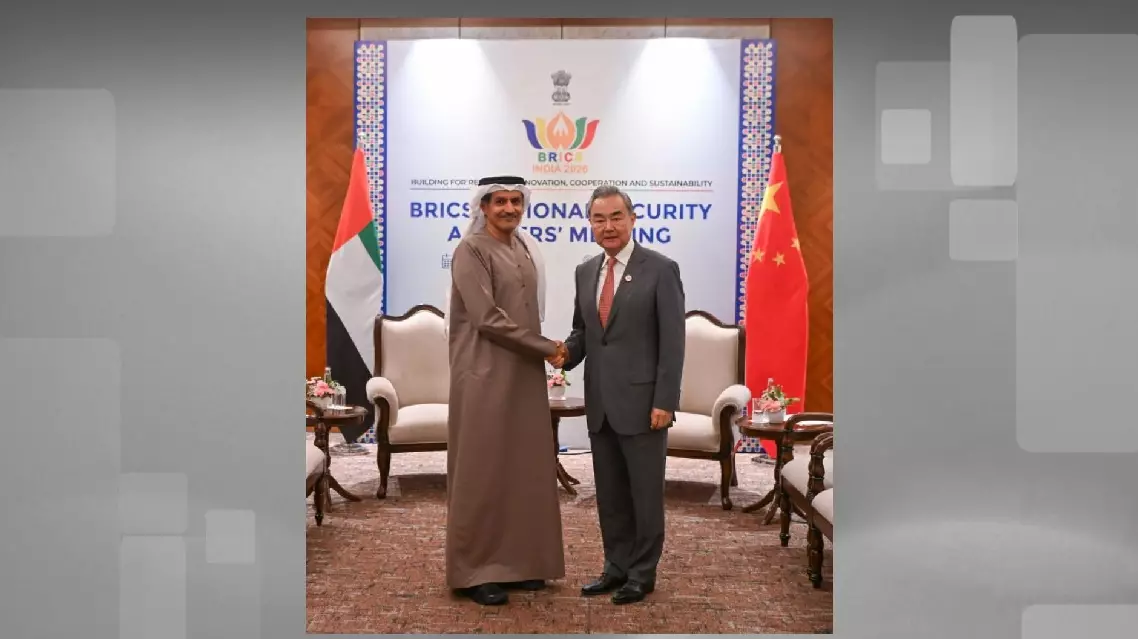
China's top diplomat meets UAE supreme national security council secretary-general