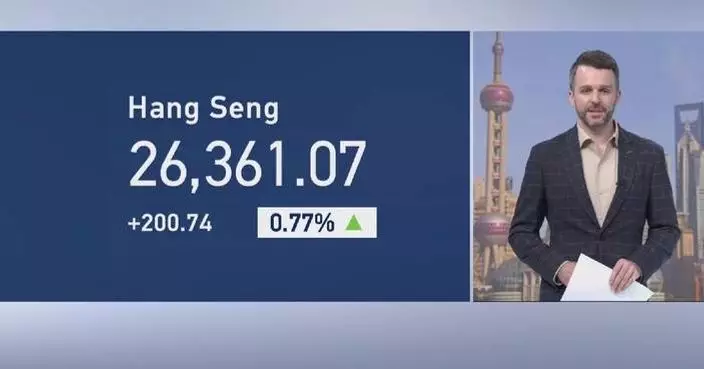
Chinese mainland stock markets, and Asian markets more generally, showed resilience on Monday despite the continued economic fallout from tensions in the Middle East, according to Timothy Pope, a market analyst for China Global Television Network (CGTN).
Chinese stocks closed higher on Monday, with the benchmark Shanghai Composite Index up 0.76 percent to 4,082.13 points. The Shenzhen Component Index closed 0.55 percent higher at 14,966.75 points.
"The Chinese mainland markets, and Asia as a whole really, are showing considerable resilience this Monday after we saw actions by both the U.S. and Iranian forces in the Middle East really put in doubt hopes for the current ceasefire to be extended. But of course, the Shanghai Composite Index was up three quarters of one percent today, while the Shenzhen Component ended the day up more than half of one percent to its highest level since December 2021 - just a whisker below 15,000 points. Today Chinese mainland investors were also looking at the PBOC's decision to hold the benchmark lending rate steady. But this was very much expected. The central bank is a lot keener on some more targeted measures, rather than these sweeping changes to the Loan Prime Rate at the moment,” Pope said.
Tech news was also in focus on Monday as Chinese AI company Deepseek announced it was looking to raise a significant amount of funding and a Chinese-made robot raced into the record books in Beijing.
"There were also a few stories on the tech front which were moving those sectors forward today. First, AI stocks gained some ground after reports in The Information that Deepseek is looking to raise 300 million U.S. dollars from private investors which would value the company at 10 billion U.S. dollars. That's pretty big as a milestone for a two-year-old company on its first external funding round. And while 10 billion dollars as a valuation looks like small change compared to some of the big, global players like OpenAI and Anthropic, the technology gap looks a lot smaller than the valuation gap. And the other bit of tech news was smartphone maker Honor's humanoid robot beating a human world record for the half marathon at the weekend in Beijing -- good news for robotics stocks there,” Pope said.
Another market mover was Chinese drinks maker Kweichow Moutai, which edged up on Monday after a torrid week last week.
"One thing though that robots won't be reviving at the moment is demand at Chinese liquor makers. Kweichow Moutai stocks crept a little bit higher today after slumping on Friday when the company reported its first ever fall in annual profit and revenue. There is however some hope for first quarter data that's due out at the end of this week. Moutai has made a few changes to its pricing structure and other things in the first quarter of this year, in the hope to get that revenue stream flowing again, and it won't be long before we find out if that's made much of an impact,” he said.

Chinese shares maintain stable due to stimulation from tech sector