Pakistan's Interior Minister Mohsin Naqvi informed Iran's Ambassador to Pakistan Reza Amiri Moghadam on Monday that preparations for the second phase of talks in Islamabad have been completed, said the Interior Ministry. According to a statement, the minister met with the ambassador to discuss arrangements for the second round of talks, saying that foolproof security arrangements have been in place for visiting foreign delegations.
Yet the prospect of a second round of U.S.-Iran negotiations remains unclear. U.S. forces intercepted and seized an Iranian-flagged cargo ship in the Gulf of Oman, while Tehran has said it currently has no decision to send a negotiating delegation.
Despite the tensions, Pakistan, as a main mediator, continues its efforts to bring the two sides to the table, with other regional countries. On Sunday, U.S. President Donald Trump announced that U.S. negotiators would travel to Islamabad for possible talks with Iran.
He also threatened to"knock out every power plant and every bridge" in Iran if his deal is rejected.
U.S. media reported that Vice President JD Vance would lead the delegation, joined by Trump's special envoy Steve Witkoff and son-in-law Jared Kushner.
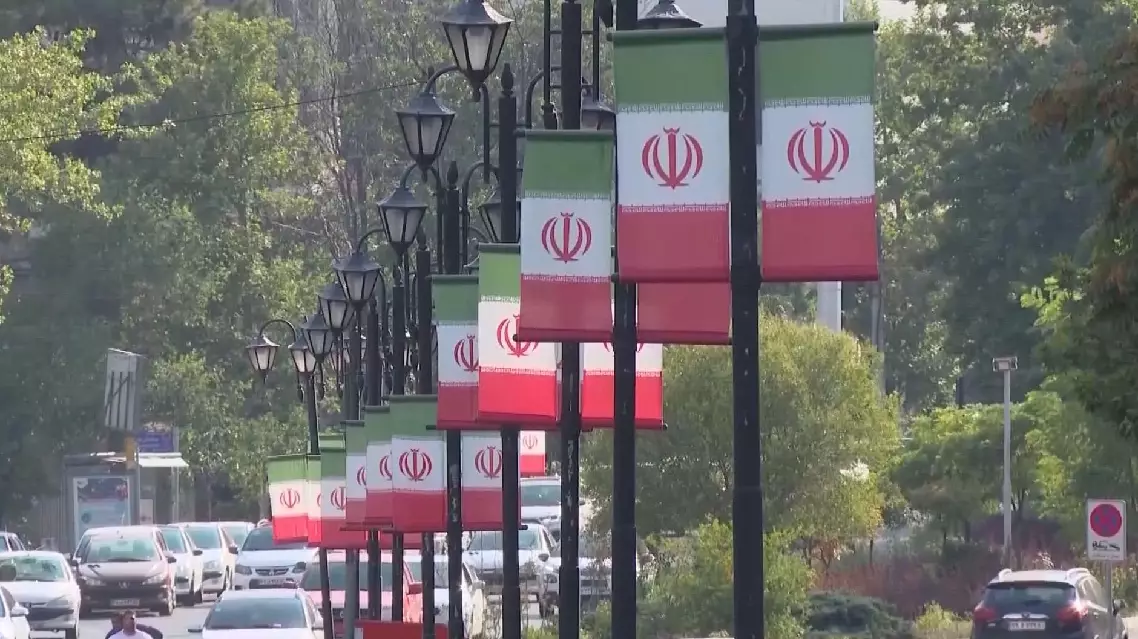
However, the Iranian side denied the potential talks in Islamabad. Iran's semi-official Tasnim news agency said Sunday that Iran currently has no decision to send a negotiating delegation, stressing that as long as the U.S. "anti-Iran" naval blockade remains in place, there will be no negotiation with Washington.
Iran's official news agency IRNA said on Sunday that the country has rejected taking part in the second round of peace talks with the United States.
Iranian Foreign Ministry spokesperson Esmaeil Baghaei said Monday that Iran currently has no plan for the second round of peace negotiations with the United States.
The United States takes actions that are in no way indicative of its seriousness in pursuing a diplomatic process, Baghaei told a weekly press conference, noting that since the ceasefire took effect on April 8, "we have been faced with the breaking of promises and nagging by the United States."
For Hanan Hussein from the global think tank Initiate Futures in Islamabad, despite the heightened tensions, the possibility of the second round of U.S.-Iran talks has not been ruled out, and he believes the negotiations are likely to move forward, though both sides face challenges in aligning expectations.
"I think the talks are going to go ahead. It's just a matter of time until we see them materializing. So, a couple of considerations lead me to that conclusion. First of all, the U.S. naval blockade is meant as a pressure tactic for Iran to come forward for a deal. Whether the deal is acceptable or not would likely be a challenge between compromises on what each side sees as doable concessions. But I think the signaling from the U.S. front, and we see the lead-up in the preparations as well, is something that the U.S. is willing to dial up the pressure, but they want to negotiate from a position of strength. From the U.S. perspective, the naval blockade will kind of suggest or add to that being a position of strength. But I think a key weakness over there is that unless Iran and the U.S. make tangible efforts to coordinate their expectations about what qualifies as a doable, workable, executable deal, any of these pressure tactics can risk upending the kind of trust surplus which both sides need in order to proceed forward, including through Pakistan's mediation," he said.
The two sides held their first round of talks in Islamabad on April 11 and 12 but failed to reach an agreement.
Hussein emphasized Pakistan's critical role as mediator, saying its proximity to both parties allows it to bridge differences and manage external shocks.
"It's critical. So for example, when you talk about a mediator, he has to have favorable proximity to both adverse parties when their positions are polarized. You need to have a country, for example, Pakistan fits the bill on many occasions, for example, when we talk about coordinating expectations with Iran, to have a strategic channel open with Washington allows you to kind of see where the constraints lie from each side's perspective. And I think, on the other front, mediation becomes critical because when we talk about tampering some of the external shocks which rise out of this conflict, it's something which the U.S. and the Iranians themselves cannot necessarily negotiate or bring to the table. I think that's where mediating parties such as Pakistan -- we've seen Egypt and Türkiye hit from the sidelines -- can create this atmosphere of shuttle diplomacy where both sides can communicate proposals, push back and forth without exactly being seen as weak in terms of public diplomacy, because obviously the temperature within the U.S. and Iran is to maintain a strong-arm posture," he said.
"So, I think from that point of view, mediation becomes critical because what happens behind closed doors is this incremental consensus-building process, which keeps diplomacy on the table. And I think, from that point forward, Pakistan's role has been demonstrated as effective over the past couple of weeks. Building on that will require regional consensus, something which allows Pakistan to also filter in the feedback from Gulf powers who've been disproportionately affected into this process. So, it remains a very multivector, and I think the mediation effort fits the bill on that front," he added.
Uncertainty clouds US-Iran talks as Pakistan prepares mediation