Cutting-edge technologies deployed in the clothing production sector are taking center stage at the ongoing Quanzhou Fashion Week in east China's Fujian Province, with supply chain representatives from around the world keen to see how these developments can transform the entire industry.
The event opened on Friday in Wulin, an ancient village known for its rich heritage and distinctive architecture, and though dubbed as a fashion 'week', it is set to run through until the end of May. It is expected to draw over 10,000 guests, designers and buyers worldwide, with over 60 fashion and trade events scheduled during the coming six weeks.
The coastal city of Quanzhou is known as a historic trading port and UNESCO World Heritage site and the nearby Jinjiang, a county-level city under Quanzhou, is the home to many successful Chinese fashion brands. Among them are the sportswear firms Anta, Xtep, and Peak, as well as the menswear labels Septwolves and Lilanz.
At the Quanzhou Fashion Industry (Global) Supply Chain Conference, supply chain heads from these leading brands joined over 300 suppliers from the apparel chain to demonstrate their advanced technologies and innovative materials, and show off their core production capacities, such as AI technology.
A special humanoid robot designed to operate in garment factories drew considerable attention among attendees for its precision in handling fabrics, its adaptability at rapid style changeovers, and its stable and reliable all-round performance. It is capable of automating the entire process of cutting and separating materials, and placing and aligning them to the specific design requirements.
"What sets us apart from traditional automation, is that we use large language models, part of the top AI tech available today, to handle complex actions and replace some manual labor tasks," said Li Haiwei, a supplier at the event.
Away from these advanced production processes, the final clothing products themselves are also garnering wide interest at the supply chain conference, with the smart features of several wearable technology items likely to prove a hit with consumers.
Chen Baomei, an employee of the YUPIN Intelligent Clothing Production company, introduced some of the unique selling points of a newly-developed high-tech jacket.
"This item of smart clothing has built-in heating and massage functions. You can press here to activate the heating function, and press here to start the massage. It can be connected to a power bank. This little icon is to display [the wearer's] mood. The pattern inside can be changed freely. If you're feeling happy or anxious today, you can change the emoji to reflect your personal mood. You can also put your own photo or a customized image in it," she said.
The events also give the key decision-makers of brands and suppliers a platform to conduct face-to-face communications on research and development collaboration and the chance to strike some deals for long-term cooperation.
Representatives say the opportunity to conduct such direct dialogue removes supply-demand bottlenecks and promotes greater integration across the upstream and downstream of the entire industrial chain.
"Our company is specializing in bonding (seam-sealing) technology, mainly serving the outdoor apparel sector, and we primarily work with high-end brands. I have been coming to Fujian for many years, because many of the men's wear brands here are very attractive to us. Big names like Anta, 361 Degrees, Lilanz, and Septwolves, are all our prospective partners," said Han Chuqi, general manager of the Chinese branch of South Korean firm Nawon Machinery.
While the events bring brands and suppliers together for exchanges, many international attendees are keen to explore new partnership opportunities.
"I want to learn about the latest technologies, as well as new materials and the latest information related to shoes. Then, when I return to Mongolia, I can share these with the members of our association to promote cooperation between Mongolian businesses and Jinjiang," said Erdenebileg Urikhan, president of Mongolia's Cultural and Creative Industries Cooperation Association.
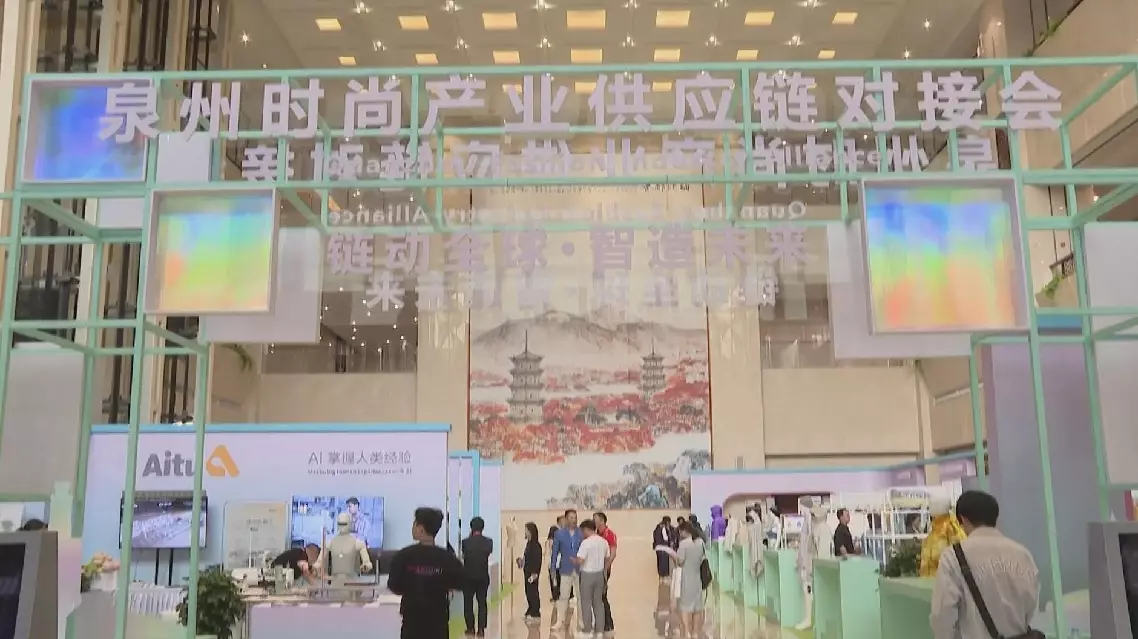
Quanzhou Fashion Week showcases how high-tech trends transforms clothing sector