BOSTON (AP) — Maybe the Boston Marathon isn’t that hard after all.
After a second straight year of blistering times, a course record on the men’s side, and a pair of repeat winners, back-to-back champion Sharon Lokedi said it won’t be the last time that runners ignore the hype and the hills and attack the historic Boston course.
Click to Gallery
Boston Marathon winner John Korir of Kenya, celebrates while approaching the finish line, Monday, April 20, 2026, in Boston. (AP Photo/Charles Krupa)
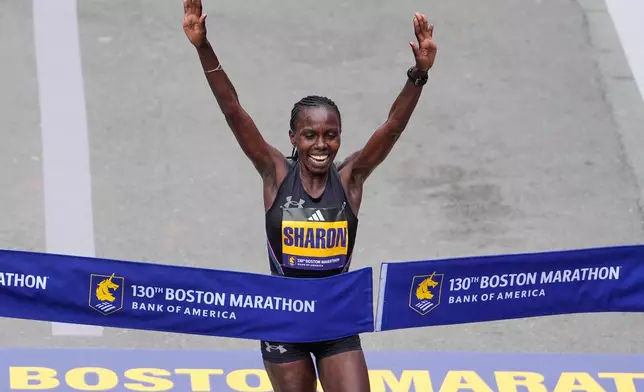
Sharon Lokedi of Kenya, celebrates after winning the women's division of the Boston Marathon, Monday, April 20, 2026, in Boston. (AP Photo/Charles Krupa)
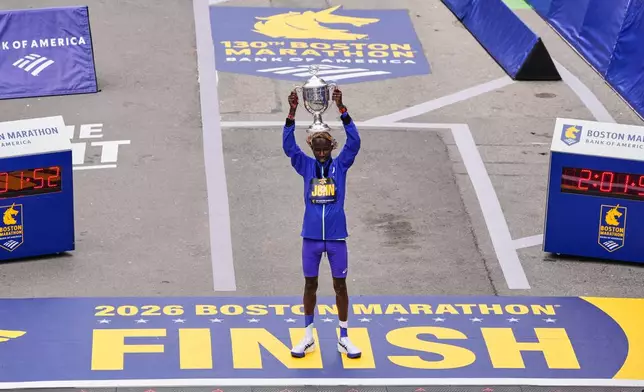
John Korir of Kenya, hoist the trophy after winning the Boston Marathon, Monday, April 20, 2026, in Boston. (AP Photo/Charles Krupa)
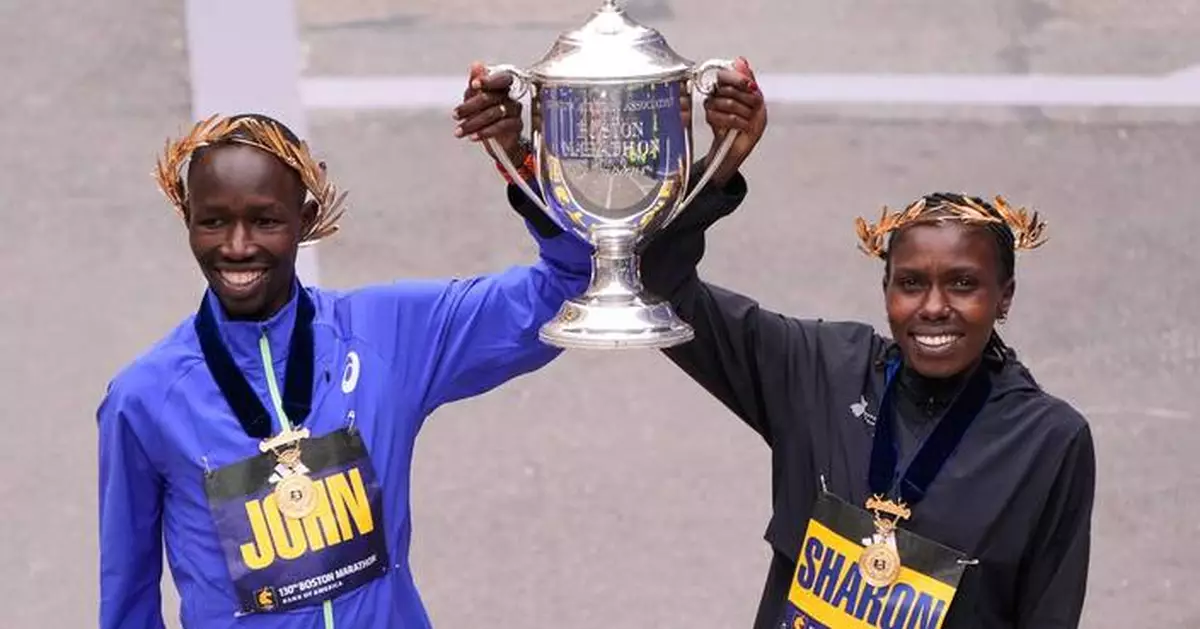
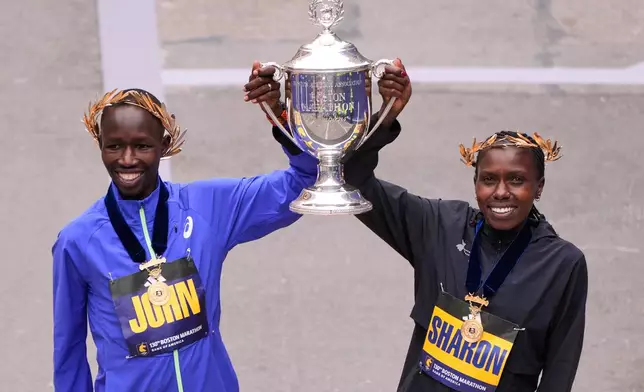
Boston Marathon winner John Korir of Kenya, left, hoists the trophy with women's division winner Sharon Lokedi also of Kenya, at the finish line of the Boston Marathon, Monday, April 20, 2026, in Boston. (AP Photo/Charles Krupa)
“Honestly, it is hard,” she insisted Tuesday, a day after running the second-fastest time ever in the women’s race to win for the second year in a row. “But I think it’s also people are starting to realize that if (you get good conditions), it just makes for a really good day. And even, you know, a fast one.”
Defending men's champion John Korir took advantage of cool weather and a tailwind on Monday to outrun the strongest field in race history and win in a course record 2 hours, 1 minute, 52 seconds. That was 70 seconds faster than Geoffrey Mutai’s then-world best in 2011, and the fifth-fastest marathon of all time.
Korir, who ran alone for the last 5 miles, said Tuesday that he could have gone even faster if another runner had been out front with him.
“I think we will run even under 2:01,” he said. “Because if someone were to push me, we would have tried to run away from each other, and that is why I think it will be faster.”
With its hills and unpredictable weather, Boston has always been known as a course that rewards strategy more than outright footspeed. Eliud Kipchoge, the world record holder at the time and considered the greatest marathoner ever, flopped in his only Boston attempt, in 2023; Korir’s brother, Wesley, won Boston in 2012 on a hot day with a time that was 10 minutes slower than John ran on Monday.
“In Boston, I don’t care that much about the time,” John Korir said Tuesday. “But now I think from today I will be caring about the times when I come back.”
Lokedi, who lowered the women’s course record by more than 2 1/2 minutes last year, finished in 2:18:51 on Monday — the second-fastest time ever in the Boston women’s race. Runner-up Loice Chemnung was 44 seconds back — a performance that would have been a course record before Lokedi’s 2:17:22 last year.
The top three men all finished faster than Mutai’s 2:03:02.
Runners looking for fast times will likely still prefer the flatter courses in Chicago and Berlin. (Kelvin Kiptum ran 2:00:35 in Chicago in 2023 and Ruth Chepngetich set the women’s mark there at 2:09:56 in ’24.)
Still, the assault on the record books may encourage future Boston runners to go for it.
“You put it in your head, ‘Oh, it’s going to be hard, it’s going to hard,’ and then you come in here and you have everything that you need: You get really good competitors, you have people that want to push, and people that want to race, and you get good conditions,” Lokedi said. “And it just makes it for a really good day and even, you know, a fast one.”
Korir, who dedicated last year’s win to the Transcend Talent Academy in his native Kenya, said the school will again get 10% or his winnings, which this year include a $50,000 bonus for the course record. Korir said he received videos of the students cheering him on.
“(It’s) to help them to go to school, and study, and have a better future,” he said. “And one day, one time to become a champion like me.”
AP sports: https://apnews.com/hub/sports

Boston Marathon winner John Korir of Kenya, celebrates while approaching the finish line, Monday, April 20, 2026, in Boston. (AP Photo/Charles Krupa)

Sharon Lokedi of Kenya, celebrates after winning the women's division of the Boston Marathon, Monday, April 20, 2026, in Boston. (AP Photo/Charles Krupa)
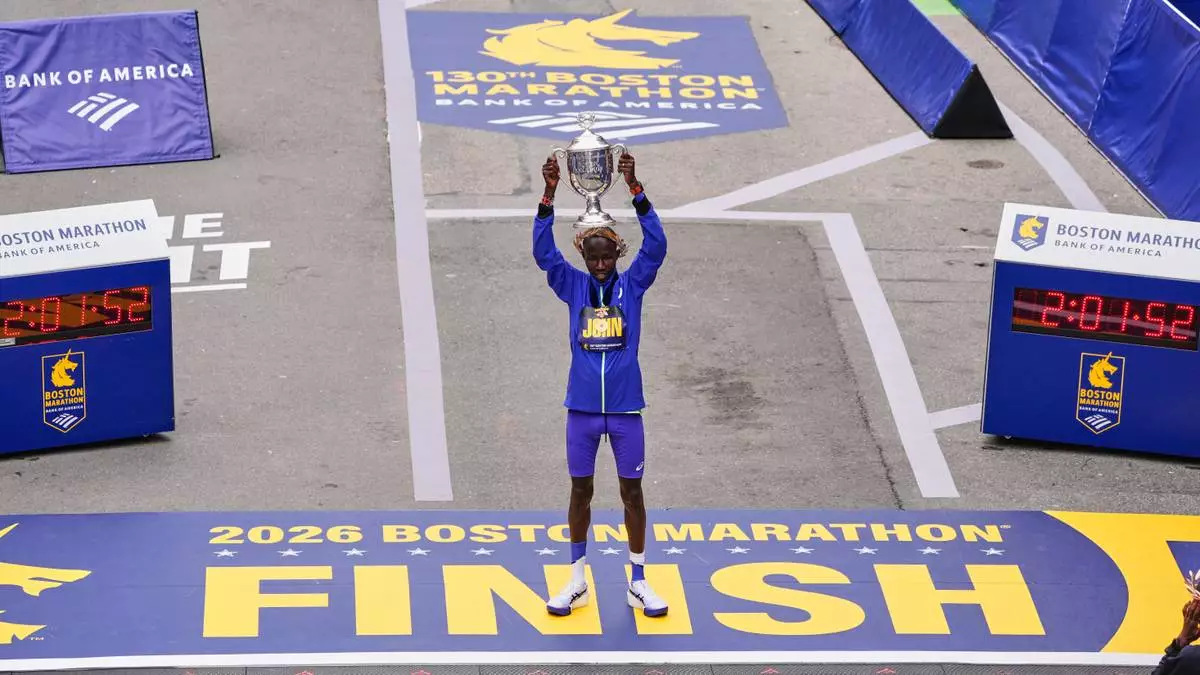
John Korir of Kenya, hoist the trophy after winning the Boston Marathon, Monday, April 20, 2026, in Boston. (AP Photo/Charles Krupa)

Boston Marathon winner John Korir of Kenya, left, hoists the trophy with women's division winner Sharon Lokedi also of Kenya, at the finish line of the Boston Marathon, Monday, April 20, 2026, in Boston. (AP Photo/Charles Krupa)
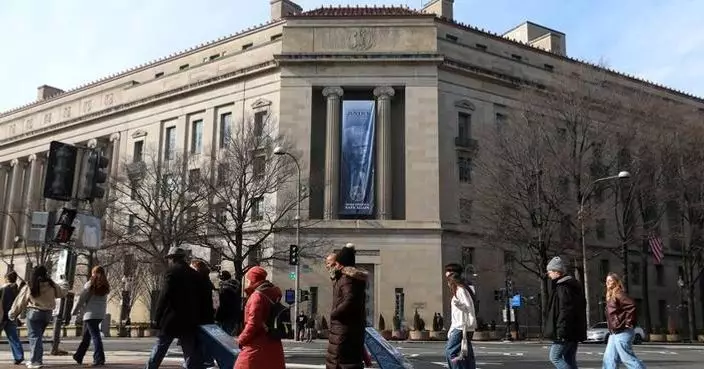
The Southern Poverty Law Center was indicted Tuesday on federal fraud charges alleging it improperly paid informants to infiltrate extremist groups without disclosing the payments to donors, acting Attorney General Todd Blanche said.
The center's CEO Bryan Fair said the payments went to confidential informants in order to monitor threats of violence from the extremist groups — and that the information the center received was frequently shared with the FBI and other law enforcement agencies. The information gathered by the informants helped save lives, Fair said Tuesday.
“We are outraged by the false allegations levied against SPLC,” Fair said.
The Justice Department alleged that the civil rights group defrauded donors by using their money to fund the same extremism that it claimed to be fighting. The indictment says payments of at least $3 million went to informants affiliated with the Ku Klux Klan, the Aryan Nations, the National Socialist Party of America and other groups between 2014 and 2023.
The charges, filed in Alabama where the center is based, include wire fraud, bank fraud and conspiracy to commit money laundering.
Here are some things to know about the Southern Poverty Law Center's history and controversies:
Alabama lawyer Morris Dees founded the organization in 1971, starting a civil rights-focused law practice for people who were poor or disenfranchised. At the time, federal laws and U.S. Supreme Court rulings designed to end Jim Crow-era segregation were still fairly new, and widespread resistance to desegregation persisted in the South.
People who faced continued discrimination often struggled to find attorneys who were willing to represent them in court; lawyers were reluctant to bring the first lawsuits to test the civil rights laws.
Dees and another attorney, Joe Levin, took on some of those cases, representing their clients for free. Some of those earliest cases resulted in the desegregation of recreational facilities, the integration of the Alabama state trooper force and other reforms, according to the center's website.
By the 1980s, the civil rights group was monitoring white supremacist organizations in the U.S. The effort, initially called “Klanwatch” and focused on the Ku Klux Klan, was later renamed the “Intelligence Project,” and expanded to include other extremist groups.
Many of the groups did not appreciate being called out, monitored and sometimes sued by the center. Members of the KKK tried to burn down the center's Montgomery offices on July 28, 1983, in retaliation for lawsuits filed against Klan groups.
The fire damaged the building, office equipment, the center's law library and files. More than a year later, three KKK members were arrested in connection with the blaze, and all three plead guilty and were sentenced to prison.
The center previously used paid informants to infiltrate extremist groups and gather information on their activities, often sharing it with local and federal law enforcement, Fair said. They were used to monitor threats of violence, he said, adding that the program was kept quiet to protect the safety of informants.
The nonprofit organization gets most of its funding from donor contributions, and those contributions have added up. Its endowment had just under $732 million in hand as of last October, according to the center.
The center's “Intelligence Project” has grown over the years, and the organization has faced criticism for some of the groups it has added to the tracker. Conservatives have said adding some groups unfairly maligns them because of their viewpoints. The conservative religious organization Focus on the Family was added in part because of its anti LGBTQ+ rhetoric, for instance.
That criticism escalated after the September 2025 assassination of conservative activist Charlie Kirk at a college campus in Utah. That brought renewed attention to the center's inclusion of Kirk's group, Turning Point USA.
The center included a section on Turning Point in a report titled “The Year in Hate and Extremism 2024” that described the group as “A Case Study of the Hard Right in 2024.”
A month after Kirk's death, FBI Director Kash Patel announced that the bureau would sever its relationship with the center, asserting that the organization had been turned into a “partisan smear machine” and criticizing it for its use of a “hate map.”
That move marked a dramatic rethinking of longstanding FBI partnerships with prominent civil rights groups.
The indictment says the center told donors the money would be used to help dismantle violent extremist groups, but did not disclose that some of the funds would actually be used to pay members of those groups. Some legal experts say it's an unusual legal approach.
“That's a new way of going after a charity — I'm somewhat surprised," said Phil Hackney, a law professor at the University of Pittsburgh. Typically, when a nonprofit group is charged with fraud, it's because someone is accused of pilfering donated funds to line their own pockets, Hackney said.
But in this case, the government is targeting the method and intent in which a nonprofit used its money, he said.
The government is looking at the informant payments “as an intent to further hate — and I doubt Southern Poverty Law Center had that intent,” Hackney said.
The law has never required nonprofit groups to hand donors a line-item receipt for every sensitive operation, said Todd Spodek, a federal criminal defense attorney with Spodek Law Group P.C. in Manhattan.
“From a defense perspective, this isn’t a fraud case. It is a political attack on standard investigative tradecraft,” said Spodek. “We are talking about high stakes intelligence work where discretion isn’t a form of deception, it is a matter of survival.”
In order to win a conviction, the government will have to prove the center engaged in a deliberate scheme to lie, Spodek said.
“They simply cannot. Silence of tactical details is not a crime, and you don’t get to call it fraud just because the government dislikes the methods used to get results,” he said. He later continued, “The prosecution is trying to turn operational discretion into a felony, which is a massive overreach.”
Other nonprofit groups also have sent people undercover or used confidential informants to get information. For instance, the nonprofit conservative group Project Veritas, founded in 2010, is best known for conducting hidden camera stings that have embarrassed news outlets, labor organizations and Democratic politicians.
The anti-abortion organization Center for Medical Progress was behind secretly recorded videos of Planned Parenthood executives in California. The videos were then edited in a way to falsely suggest that the executives were selling fetal remains. The videos triggered several investigations, and Planned Parenthood was cleared of any wrongdoing but two of the activists with Center for Medical Progress were ultimately convicted of illegally recording someone without consent.
Fair says the organization began working with informants to monitor threats of violence during a time of increased risk, and the program was kept quiet to protect informants' safety.
“When we began working with informants, we were living in the shadow of the height of the Civil Rights Movement, which had seen bombings at churches, state-sponsored violence against demonstrators, and the murders of activists that went unanswered by the justice system,” Fair said. “There is no question that what we learned from informants saved lives.”
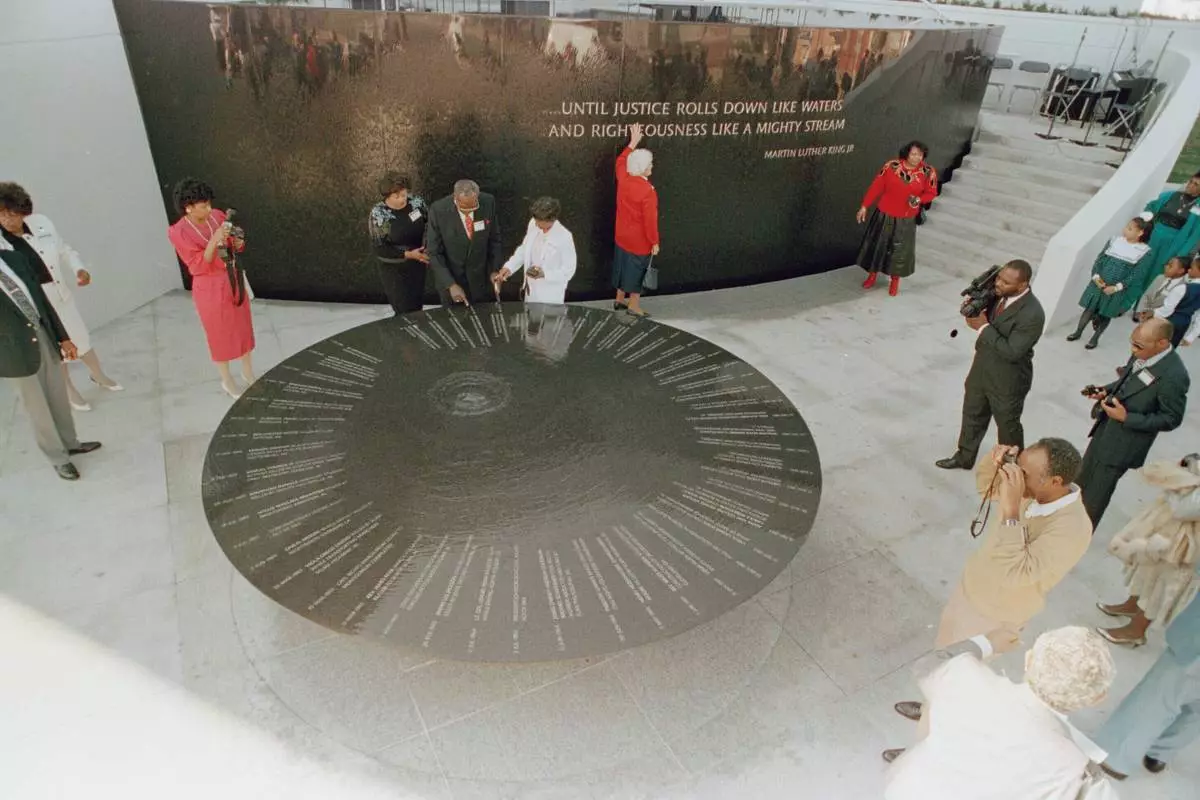
FILE - Family members of fallen civil rights activists view the Civil Rights Memorial at the Southern Poverty Law Center during a private family viewing, Nov. 5, 1989, in Montgomery, Ala. (AP Photo/Dave Martin, File)
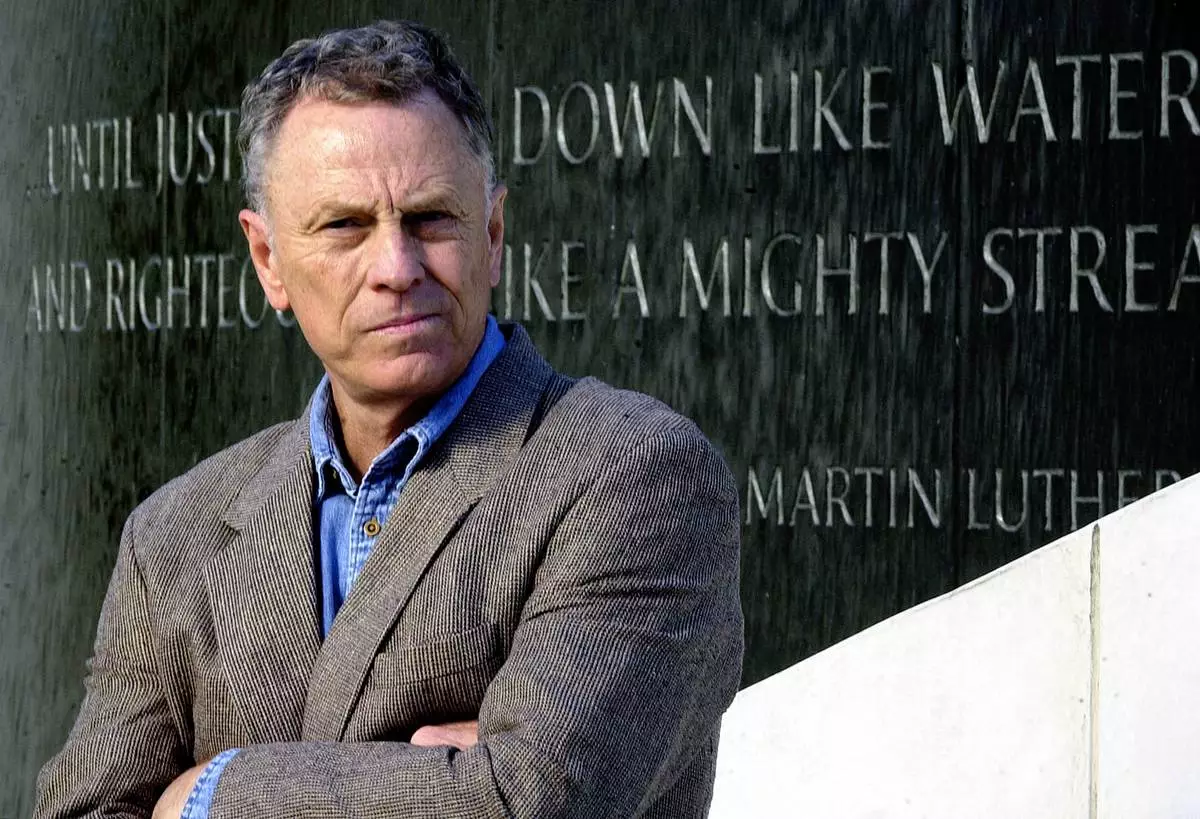
FILE - Southern Poverty Law Center Director Morris Dees attends a news conference Nov. 18, 2002, at the Civil Rights Memorial at the Southern Poverty Law Center in Montgomery, Ala. (AP Photo/Dave Martin, File)