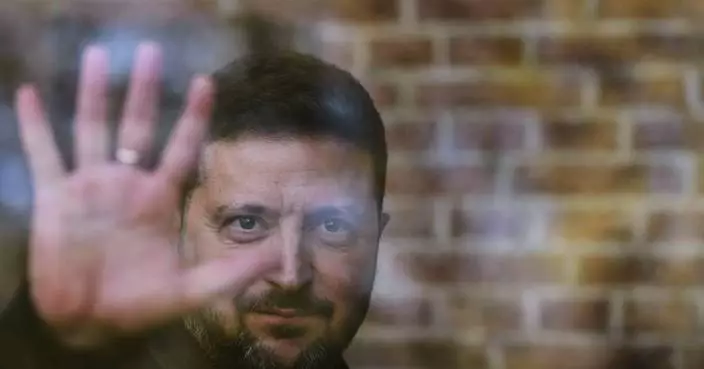
KYIV, Ukraine (AP) — Ukraine is pushing for face-to-face talks between President Volodymyr Zelenskyy and Russian President Vladimir Putin, Kyiv’s top diplomat said, presenting a potential summit as a way of injecting new momentum into U.S.-led efforts to end Russia’s more than four-year invasion of its neighbor.
Meanwhile, a Ukrainian drone attack deep inside Russia struck a residential building, killing a woman and a child, Russian officials said Wednesday.
Kyiv has asked Turkey to help facilitate top-level talks and has reached out to other capitals as potential hosts, Ukrainian Foreign Minister Andrii Sybiha said, adding that Ukraine would consider any venue outside Russia and Belarus.
“We are … advocating for a (summit) meeting now to bring new momentum to diplomacy,” Sybiha told reporters on Tuesday. His remarks were embargoed until Wednesday.
U.S.-mediated talks over the past year between delegations from Moscow and Kyiv have made little or no headway on key issues, such as the future of four Ukrainian regions Moscow is trying to capture but doesn’t fully control. With Washington’s attention now gripped by the Iran war, the talks are on ice.
Zelenskyy has accepted an unconditional ceasefire demanded by U.S. President Donald Trump but Putin has refused. Putin thinks that time is on his side, that Western military and financial support will fade and that Ukraine’s resistance will eventually collapse, analysts say.
Meanwhile, a grim war of attrition continues along the about 1,250-kilometer (800-mile) front line that snakes along eastern and southern areas of Ukraine. Western officials and analysts claim Russia is suffering several tens of thousands of battlefield casualties each month, drawing comparisons to the carnage of World War I.
Independent verification of battlefield casualties and which side has the upper hand is not possible.
Ukraine has developed a domestic arms industry which is increasingly producing long-range drones and missiles capable of striking deep inside Russia. It has taken aim at Russia’s oil production and manufacturing plants that supply the Russian military.
In Syzran, a city in Russia’s Samara region that is about 800 kilometers (500 miles) east of the border with Ukraine, a drone attack caused the collapse of a section of a residential building, local authorities said.
The bodies of a woman and a child were pulled out from under the rubble and 12 others were injured, local officials said.
Images from the scene showed a part of a four-story building reduced to a massive pile of rubble, with emergency workers on top of it.
Russian media reports said a Rosneft oil refinery — a frequent target of Ukrainian drone attacks — is located on the same street as the damaged building.
Ukraine’s aerial attacks on Russia increased by nearly four times last year, from 6,200 in 2024 to more than 23,000 in 2025, Sergei Shoigu, the secretary of Russia’s Security Council, said last month.
Follow AP’s coverage of the war in Ukraine at https://apnews.com/hub/russia-ukraine

In this photo provided by the Russian Emergency Ministry Press Service, Russian Emergency Ministry employees work at the side of the damaged multi-storey apartment building hit by a Ukrainian drone in Syzran in Russia's Samara Region Wednesday, April 22, 2026. (Russian Emergency Ministry Press Service via AP)

In this photo provided by the Russian Emergency Ministry Press Service, Russian Emergency Ministry employees work at the side of the damaged multi-storey apartment building hit by a Ukrainian drone in Syzran in Russia's Samara Region Wednesday, April 22, 2026. (Russian Emergency Ministry Press Service via AP)

In this photo provided by the Russian Emergency Ministry Press Service, Russian Emergency Ministry employees work at the side of the damaged multi-storey apartment building hit by a Ukrainian drone in Syzran in Russia's Samara Region Wednesday, April 22, 2026. (Russian Emergency Ministry Press Service via AP)
When Marlin Klein left Germany to play football in the United States, he entered a whole new world.
The teenager walked away from the sports he loved as a youngster — soccer and basketball — and opted to work in the Georgia mountains with a high school coach who held Klein to the same standards as everyone else on the team. And because the relative football newcomer wasn't fluent in English, just learning the proper terminology was challenging, too.
Yet, Klein managed to overcome those initial hardships, earn a college scholarship at Michigan and appears to be on the cusp of achieving his ultimate dream — playing in the NFL.
“I think it was harder on my family than it was for me," he said during the NFL scouting combine in Indianapolis. “I was looking forward to something. I was getting myself into something new and chasing my dream of playing football. But, obviously, having your son at 15 years old come up to you and say, ‘I want to come to the U.S.,’ it was tough. I left my entire life behind, my entire family, my friends to chase this dream.”
Klein is likely to find out his next stop Friday or Saturday when he's expected to become the third Wolverines tight end drafted in three years. A.J. Barner was a fourth-round pick in 2024 and Colston Loveland went at No. 10 overall last year. Klein would be the unlikeliest of the three given his trek to this point and his numbers — 12 career starts, 38 career receptions, 364 career yards and just one touchdown catch in college.
While the long, arduous journey from international prospect to professional player seems increasingly more plausible today than previous years thanks to the success of players such as Australian offensive tackle Jordan Mailata, the European recruitment efforts of former NFL players such as Bjorn Werner and the league's International Player Pathway Program, it's still not easy.
Just ask Klein.
“It was my best friend for the first year,” he said when asked about relying on Google Translate to help him overcome the language barrier. ”It was quite the relationship."
The NFL's investment in finding international players makes sense, given its desire to continue growing its overseas fan base. The Indianapolis Colts, who drafted Werner, have played in Germany twice in the past three seasons and next season's schedule features three games in London along with games in Madrid, Melbourne, Mexico City, Munich, Paris and Rio de Janeiro.
So having players who can serve as de facto ambassadors and help sell tickets in those locales certainly makes sense. Not surprisingly, this year's draft class, like others in recent years, includes a group of intriguing prospects who crisscrossed the planet.
Defensive tackle Uar Bernard and edge rusher Joshua Weru both turned heads with their strong performances at this year's HBCU Showcase. Bernard grew up in a Nigerian village hoping to dabble in real estate. Weru is from Kenya. Both now hope to hear their names called, likely on Day 3 of the draft.
Kicker Kansei Matsuzawa was born in Ichikawa, Japan, and earned three letters in soccer before playing two seasons at tiny Hocking College in Nelsonville, Ohio, and then landing at Hawaii and emerging as a Lou Groza Award finalist.
Brett Thorson of Georgia looks like the next in the long line of Australian punters who attended ProKick Australia, where he was rated the top positional prospect in the nation. He won last season's Ray Guy Award and is a two-time second team Associated Press All-American.
And although former Stanford tight end Sam Roush is an American with deep athletic roots, including a family tie to Pro Football Hall of Famer Merlin Olsen, his family moved seven times during his childhood.
Roush lived in cities ranging from Kuala Lumpur and Jakarta to Atlanta and Nashville, and his storyline sounds remarkably similar to so many international hopefuls — right down to his introduction to rugby and the early morning wakeup calls to watch pro and college football games.
“I would wake up at like three in the morning to watch Duke football and basketball games," Roush said, noting his father was a safety for the Blue Devils. “I played rugby, basketball, a little bit of soccer and baseball. I think the physicality of rugby helped me prepare when I was younger to just kind of step into that role as a physical football player. Those are memories I’ll never forget.”
The weekend could provide Roush — and the others — with a moment they won't forget.
But to Klein, it would also prove he did the right thing by leaving Europe to pursue a goal many thought may not be possible.
“The main thing for me is that if you have a dream, you should full on pursue it, no matter what anybody tells you,” Klein said. “I mean so many people told me, from Germany, how many American kids are out there, they can play tight end, they can run fast, catch balls. But if you believe in yourself that’s all you need.”
AP NFL: https://apnews.com/NFL

FILE - Michigan tight end Marlin Klein (14) runs a drill at the NFL football scouting combine in Indianapolis, Friday, Feb. 27, 2026. (AP Photo/Michael Conroy, File)

FILE - Michigan tight end Marlin Klein (14) runs a drill at the NFL football scouting combine in Indianapolis, Friday, Feb. 27, 2026. (AP Photo/Michael Conroy, File)