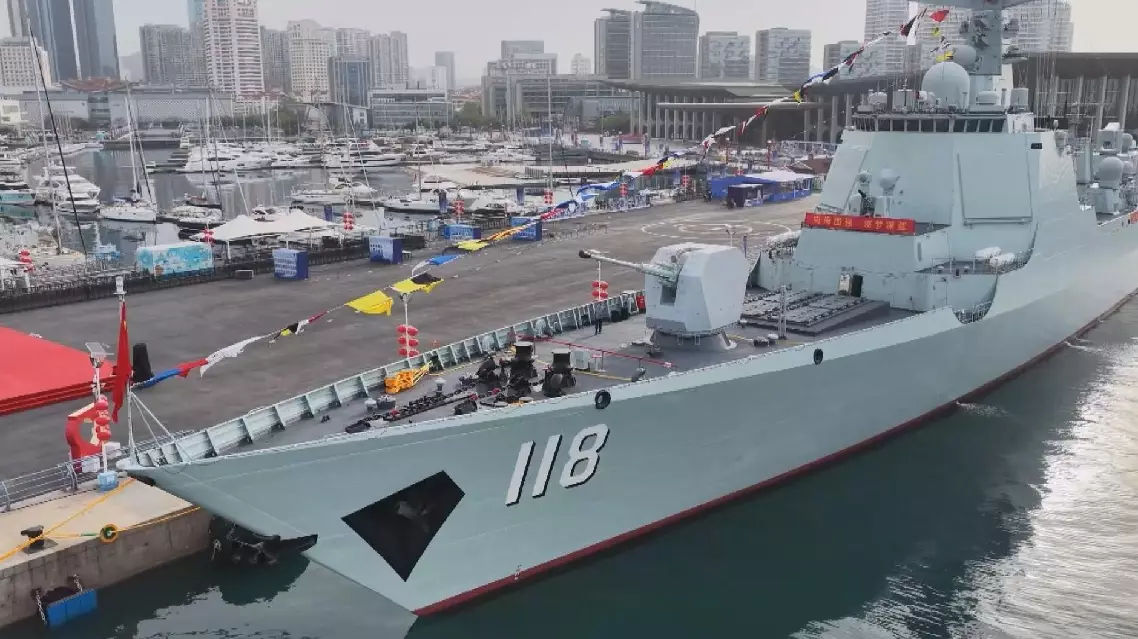
In celebration of the 77th anniversary of the People's Liberation Army Navy (PLAN) which falls on Thursday, the guided-missile destroyer Urumqi (Hull 118) made its public debut on Wednesday at the Qingdao Olympic Sailing Center marina in east China's Shandong Province, offering citizens a rare opportunity to explore its advanced weaponry and deep-sea prowess.
The Urumqi, a domestically developed and built Type 052D destroyer, measures over 150 meters in length, approximately 18 meters in width, and boasts a maximum displacement of nearly 7,000 tons. Powered by a combined diesel and gas propulsion system, the ship is noted for its extensive range, formidable firepower, and extensive use of information systems.
Highlighting the vessel's strategic importance, Chi Leipeng, an officer on the Urumqi, explained the destroyer's multi-role design.
"As we serve as the main force of the naval fleet, our weapon systems must balance four core functions: anti-ship, anti-submarine, air defense, and command. First, let's look at the foredeck, which is the 'heart' of the ship's firepower. This 130mm naval gun is the largest caliber currently in service with the People's Liberation Army Navy. It features a high rate of fire, long range, and significant destructive power. It can deliver precision strikes against surface targets and provide fire support for coastal operations. Moreover, when facing fast-emerging targets, its rapid response capability and striking precision represent our immediate power on the battlefield," said Chi.
The Urumqi's offensive and defensive capabilities are further bolstered by its vertical launching systems, according to Chi. "Now, what we see here, these areas that look like chocolate squares, are our general-purpose vertical launching systems. We have 32 launch cells on our foredeck and another 32 launch cells on our mid-deck, totaling 64 launch cells. They can carry various anti-ship and anti-air missiles, able to not only effectively intercept incoming enemy missiles to form an aerial protective barrier, but also precisely strike enemy surface vessels to create all-range firepower coverage -- long, medium, and short," he said.
For close-range threats, the destroyer is equipped with a rapid-fire defense system, said Chi.
"Above the bridge, in front of the pilothouse, is our Type 730 CIWS (close-in weapon system), which is a 7-barrel 30mm naval gun, commonly referred to as a secondary gun. Its rate of fire can reach several thousand rounds per minute. It is primarily responsible for terminal defense, such as engaging fast-moving small boats attacking at close range or low-altitude drones attacking from the air," he said.
According to the naval officer, anti-submarine warfare is another key feature of the ship, facilitated by its torpedo systems.
"Now, what we see here is our triple torpedo launcher. We have one on our port side and one on our starboard side. These three long tubes are our torpedo tubes, each capable of loading one torpedo. As we all know, torpedoes are one of the important weapons for surface combatants. They can effectively strike underwater submarines, earning them the title of 'deep-sea sharp sword.' They also enable our destroyers to launch precise attacks during anti-submarine operations in distant waters, establishing a multi-dimensional anti-submarine defense line," said Chi.
The Urumqi's operational reach is significantly extended by its aviation capabilities, Chi added.
"Now, we are on the aft deck of our ship, also known as the flight deck. Behind this large door is our hangar. This entire area can be described as the 'aerial tentacles' of our formation. Why do I say that? Because we can carry various types of helicopters and unmanned aerial vehicles, allowing us to conduct forward anti-ship, anti-submarine, search and rescue, transport, and early warning and detection missions, among many others. This truly achieves integrated sea-air operations, greatly extending our operational radius," he said.
The Urumqi has a distinguished operational record, having traversed two continents and two oceans, visiting nine countries and nine ports. Its deployments have included operations in the Sea of Japan, patrols in the Pacific, and missions in the Gulf of Aden. The vessel is recognized for its continuous readiness, actively participating in escort missions and joint exercises, demonstrating its robust capabilities and commitment to safeguarding maritime interests.
PLA Navy's cutting-edge guided-missile destroyer makes public debut in Shandong