An international team led by Chinese scientists on Thursday released the largest-ever cosmological simulation, named "HyperMillennium", offering a powerful digital tool to explore cosmic evolution.
This simulation covers a vast cube with a side size of 12 billion light-years and uses 4.2 trillion virtual dark matter particles. By applying a technique called N-body numerical simulation, the team accurately recreated how large-scale structures in the universe evolved over 10 billion years.
In simple terms, they built a virtual universe inside a supercomputer, starting from just after the Big Bang and following the pull of gravity step by step.
This virtual cosmos allows researchers to "rewind time" and study how galaxies and other cosmic features formed.
By adding physical models of galaxy formation, the simulation produces a detailed catalog of galaxy positions, brightness and other key traits. This provides theoretical support for research into dark matter and dark energy, and also offers strong support for new-generation galaxy survey programs, such as the China Space Station Telescope and the European Space Agency's Euclid mission.
"We know that the universe began with the Big Bang. Since then, its structure has gradually evolved from a highly uniform state, forming increasingly complex structures and eventually taking the shape of a cosmic web. In the past, these structures could only be studied through computer simulations. This time, we used 4.2 trillion virtual dark matter particles to simulate evolving process of the large-scale structure of the universe, achieving sufficient precision and scope for practical applications,"said Wang Qiao, a researcher at National Astronomical Observatories of the Chinese Academy of Sciences.
Such large-scale simulations demand enormous computing resources, and the research team used self-developed software called PhotoNs, designed specifically for China's domestic supercomputers.
After more than 10 years of work on algorithms and optimization, the team achieved efficient calculations using over 10,000 accelerator cards.
The project consumed more than 100 million CPU core-hours and 10 million accelerator-card hours, and produced approximately 13 petabytes of raw and processed data.
"The success of this project marks another step forward for China in the field of computational cosmology, showing that China is now internationally competitive in this area," said Wang.
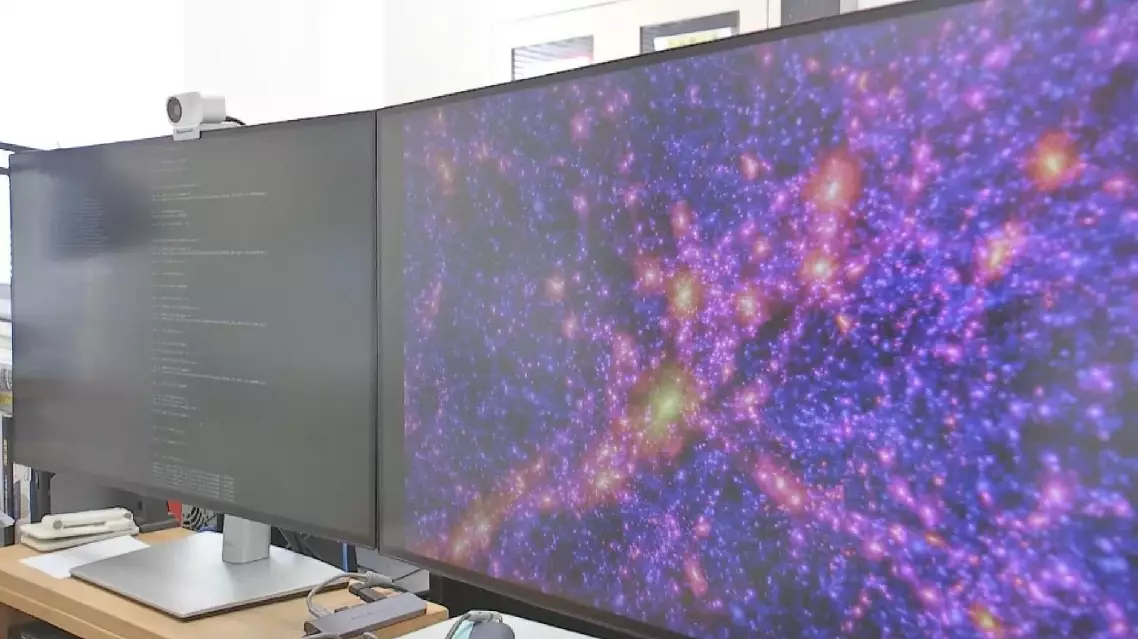
Scientists unveil largest cosmological simulation "HyperMillennium" to map universe evolution