LINKÖPING, Sweden--(BUSINESS WIRE)--Apr 23, 2026--
AMRA Medical researchers recently set out to answer the question: what is the relationship between adverse muscle composition (AMC) and mortality in kidney disease? Recent findings demonstrate that AMC, characterized by low muscle volume z-score and high muscle fat infiltration, is an independent and strong predictor of all-cause mortality in individuals with chronic kidney disease (CKD). The findings, published in Clinical Journal of the American Society of Nephrology, were based on data from the UK Biobank imaging study and further reinforce the clinical relevance of MRI-derived muscle biomarkers in identifying high-risk populations across chronic diseases.
This press release features multimedia. View the full release here: https://www.businesswire.com/news/home/20260423198497/en/
Researchers from AMRA, alongside our collaborators at Linköping University (LiU), analyzed 894 participants with CKD using AMRA’s MRI-based body composition analysis to quantify thigh fat-free muscle volume and muscle fat infiltration (MFI). AMC was identified in approximately 30% of the cohort, highlighting a substantial at-risk population. Over a mean follow-up period of 3.6 years, individuals with AMC showed a markedly increased risk of all-cause mortality, with an unadjusted hazard ratio of 6.17. Importantly, this association remained significant even after adjusting for demographic, lifestyle, and clinical factors, with a hazard ratio of 4.21.
These findings demonstrate the strength of AMC as a clinically meaningful phenotype, capturing a large proportion of participants while maintaining a strong association with adverse outcomes. Unlike traditional risk markers that often isolate smaller subgroups, AMC enables broader stratification of high-risk individuals, offering valuable insights into population heterogeneity within clinical trials. The publication underscores the value of MRI-based muscle composition assessments to support clinical trials evaluating risk and interventions in CKD.
This study adds to a growing body of evidence supporting the role of muscle composition as a critical factor in chronic disease. By applying standardized MRI-based assessments across diverse populations including recent work in MASLD, heart failure and advanced disease states such as end-stage liver disease (ESLD), AMRA supports the generation of consistent, high-quality data that can be compared across studies and indications.
This publication also builds on prior investigations into muscle composition in CKD, including a study of hemodialysis patients, further underscoring the relevance of AMC across different stages of disease severity. Together, this research highlights the potential of targeting muscle composition as part of future therapeutic strategies and trial design in chronic disease management.
You can read more about the study, titled “Adverse muscle composition is associated with all-cause mortality in CKD: a UK Biobank Imaging Study”, here.
Want to know more about how AMRA’s MRI-based fat and muscle biomarkers can help transform your trials in metabolic disease and beyond? Reach out at info@amramedical.com to set up a meeting with one of our expert scientists and explore how AMRA can support your next study.
About AMRA Medical
AMRA Medical is a global leader in health informatics, pioneering the field of fat and muscle analysis with proprietary, MRI-based technologies. Our gold-standard platform delivers highly precise and standardized biomarkers, providing an advanced understanding of metabolic and musculoskeletal health that surpasses conventional body composition metrics. These insights play a critical role in optimizing clinical trial design, improving endpoint selection, and supporting data-driven decision-making in both research and clinical practice.
Built on rigorous science and driven by continuous innovation, AMRA’s solutions are designed to meet the complex demands of modern healthcare and pharmaceutical development. Through standardized, cloud-based workflows and strategic collaboration, we enable partners to access actionable data with clarity and confidence–accelerating progress from early-stage discovery to impactful clinical outcomes.

AMRA's MRI-based muscle biomarkers in clinical trials
WASHINGTON (AP) — Many of the groups that helped elect Donald Trump as president again are deeply unhappy with his performance, according to a new AP-NORC poll.
Trump’s return to the presidency was fueled by a wide-ranging coalition that built on his loyal base of supporters. Now that Trump has been in the White House for more than a year, the survey of more than 2,500 U.S. adults from The Associated Press-NORC Center for Public Affairs Research finds that many key groups — including Hispanic adults, younger adults and men — are increasingly dissatisfied with his presidency.
The poll was conducted from April 16 through Monday, as oil prices fluctuated and Americans spent more at the gas pump.
It’s a particularly bad moment for Trump, a Republican whose economic approval slumped over the past month as the Iran war drives prices higher. But AP-NORC polls show that discontent has been building among critical segments of the population over the past year.
Trump's overall approval among Hispanic adults has fallen 16 percentage points since March 2025, and his support has declined by 9 percentage points among men.
And while Trump’s base is still largely behind him — most Republicans approve of his performance — there are signs that his second term may not be living up to their expectations.
Here’s what polling shows about Trump’s current status with four important groups:
Hispanic Americans have grown increasingly discontented with Trump over the past year.
About one-quarter of Hispanic adults approve of how he’s handling the presidency in the new poll, down from about 4 in 10 in March 2025.
That decline has been visible since late last year — suggesting that it’s not just the war in Iran or recent spikes in gas prices that are leaving this group unhappy.
Trump’s restrictive immigration approach may be playing a role. Only about one-quarter of Hispanics approve of his handling of immigration, down from 36% at the beginning of his term.
His immigration tactics appear to be particularly unpopular among younger Hispanics — a group with which he made gains in 2024. Only 18% of younger Hispanic adults approve of his performance on immigration, compared with 40% of Americans overall.
There is also broad discontent about the state of the U.S. economy among Hispanics. Only about one-quarter of Hispanic adults approve of how Trump is handling that issue, and about 2 in 10 say they approve of his approach to the cost of living. Few Hispanic adults, about 2 in 10, describe the nation’s economy as “good.”
Trump’s overall approval with Americans under age 45 has slid over the past year, falling from 39% in March 2025 to 28% in the latest poll.
Younger women have a particularly dim view of Trump’s handling of the economy.
Only about 2 in 10 women under age 45 approve of how Trump is handling the economy, including only 7% of younger Hispanic women who approve of his economic approach. More young men, about 3 in 10, approve of him on this issue.
Trump’s struggles among young adults extend to other groups, too. Only about one-third of white adults under age 45 approve of his overall performance, compared with 45% of white adults age 45 or older.
Trump made broad appeals to men throughout his 2024 campaign, and most male voters backed Trump in the presidential election over Democrat Kamala Harris. In particular, he made slight but significant gains with Black and Hispanic men, who were drawn by his vows to revitalize the economy.
Since he reentered office, though, American men have become slightly less likely to approve of his performance, declining from 47% at the start of his second term to 38% in the most recent poll.
There are signs that Black men, in particular, aren’t seeing Trump’s economic promises pan out. Black men are more likely than white or Hispanic men to disapprove of Trump’s approach to the presidency, as well as his approach to the economy, the cost of living and Iran. Only about 1 in 10 Black men say they approve of how Trump is handling the cost of living, and roughly 2 in 10 approve of how he’s handling the economy.
Hispanic men, too, have a relatively dim view of Trump’s overall performance. About 3 in 10 approve of how Trump is handling the presidency, regardless of their age. That support is stronger among white men, with about half approving of Trump.
Trump has benefited from Republicans’ loyalty for years, but there are recent signs of frustration even within his base.
Roughly two-thirds of Republicans approve of Trump’s job performance. That is down slightly from 82% near the start of his second term and is generally in line with the GOP low point from his first term.
But only about half of Republicans overall approve of Trump’s approach to the cost of living, and a majority of Republicans under age 45 disapprove of him on that issue.
Trump is still buoyed by the support of his MAGA base, even as he faces backlash from conservative media figures on some of his recent actions in Iran.
About 9 in 10 MAGA Republicans — those who consider themselves supporters of the “Make America Great Again” movement — approve of Trump’s job performance, and a similar share approve of his handling of Iran.
It's a good sign for Trump that his most robust supporters are still in his corner, but not all Republicans identify with MAGA. About half of Republicans, 54%, say they consider themselves MAGA supporters.
Among non-MAGA Republicans, Trump's approval is much lower, at 44%.
The AP-NORC poll of 2,596 adults was conducted April 16-20 using a sample drawn from NORC’s probability-based AmeriSpeak Panel, which is designed to be representative of the U.S. population. The margin of sampling error for adults overall is plus or minus 2.6 percentage points.

FILE - Supporters of Republican presidential candidate Donald Trump wait for the start of a rally in Westfield, Ind., July 12, 2016. (AP Photo/Michael Conroy, File)
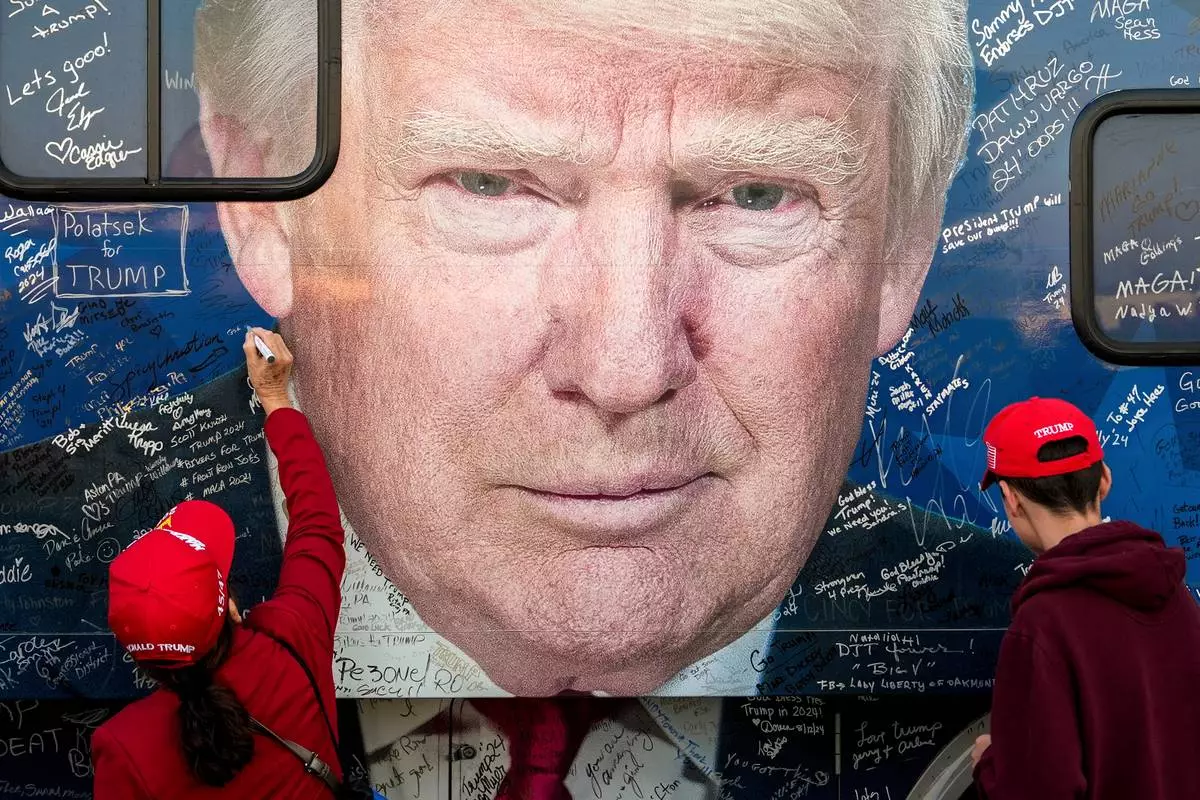
FILE - Supporters of Republican presidential nominee former President Donald Trump sign a bus before a campaign rally at the Butler Farm Show, Oct. 5, 2024, in Butler, Pa. (AP Photo/Julia Demaree Nikhinson, File)

FILE - Attendees gather as the "Latino Americans for Trump" office opens in Reading, Pa., Wednesday, June 12, 2024. (AP Photo/Joe Lamberti)

FILE - Alicia DeVinney of Phoenixville, Pa., shows off her MAGA rings ahead of the 60th Presidential Inauguration, Jan. 19, 2025, in Washington. (AP Photo/Mike Stewart, File)
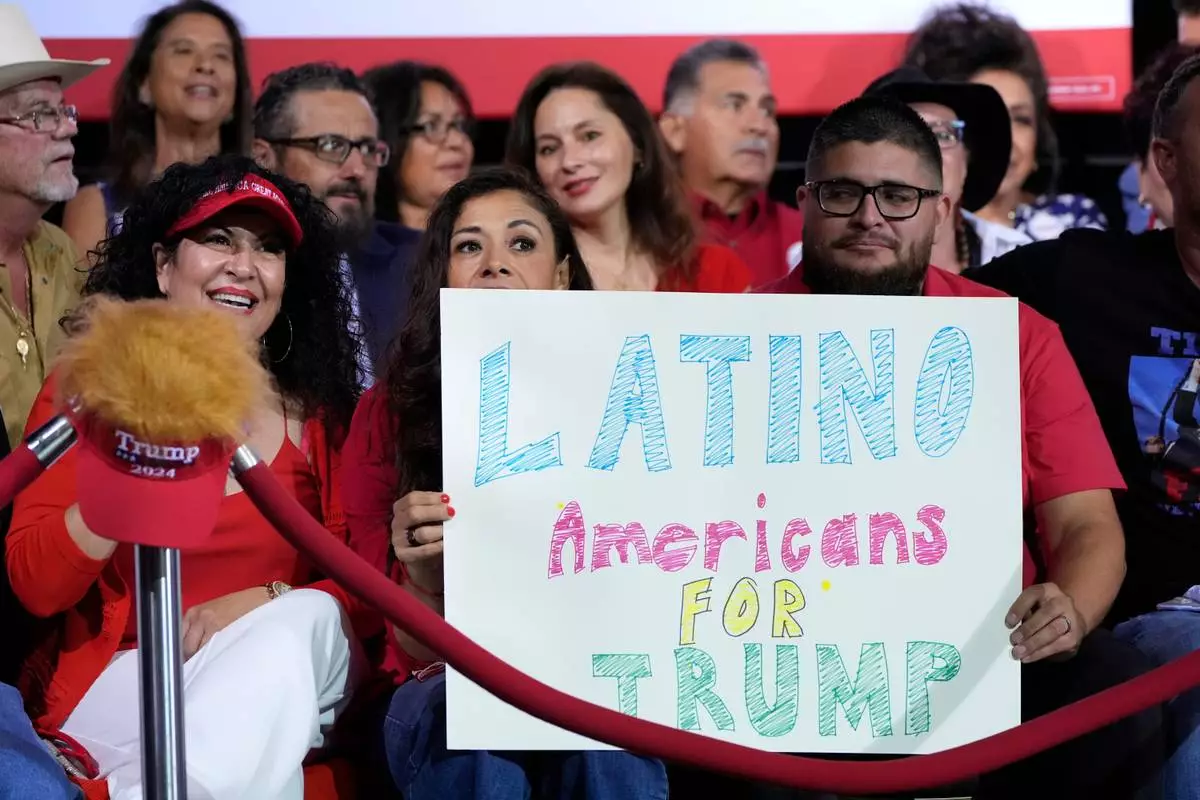
FILE - Supporters hold a sign before Republican presidential nominee former President Donald Trump arrives to speak during a campaign event, Sept.12, 2024, in Tucson, Ariz. (AP Photo/Alex Brandon, File)