DETROIT (AP) — The state of Michigan was cleared of liability Thursday in a disastrous 2020 dam failure that flooded communities, destroyed more than 100 homes and drained a popular lake.
Court of Claims Judge James Redford acknowledged the “real and lasting damages” of the Edenville Dam failure. But he said days of relentless rain and an unprecedented 100-year flood triggered the calamity in the Midland area, not the state-authorized level of Wixom Lake.
Redford cited experts who said a lower lake level before the disaster was unlikely to have prevented the catastrophe. He also said state regulators had “received by default” a dam with inadequate spillway capacity after a federal hydropower license was yanked in 2018.
“This does not mean that what plaintiffs suffered and continue to suffer is not an immensely difficult and heavy burden,” the judge said in a 100-page opinion that followed a January trial in Grand Rapids.
Lawyers representing thousands of people sued the state, claiming decisions by environmental regulators contributed to the dam collapse and ruined property values and their enjoyment of Wixom Lake, 150 miles (241 kilometers) northwest of Detroit.
If Redford had ruled in favor of property owners, the case would have moved next to financial recovery.
“It's very disappointing. I know our clients are devastated,” attorney Ven Johnson said. “That's why God created appellate courts.”
The judge said the dam failure could not be likened, as lawyers for the plaintiffs argued, to the 2014-2015 Flint water crisis in which key decisions by the state caused lead to leach from old pipes and spoil the system.
The privately owned dam on the Tittabawassee River produced hydroelectricity until a federal license was revoked. A reservoir behind the dam is known as Wixom Lake. The dam was in the process of being turned over to area residents when the failure occurred, releasing a torrent that also overtopped the downstream Sanford Dam and flooded the city of Midland.
The lake rose more than 5 feet (1.5 meters) above its normal level and 3 feet (0.9 meters) higher than the highest level recorded in 1929. The east side of the dam's soil embankment was overwhelmed and became unstable. Since the failure, Wixom Lake is being slowly restored.
The Federal Energy Regulatory Commission asked experts to study what happened at the Edenville and Sanford dams. The 2022 report said failure was “foreseeable and preventable” but could not be “attributed to any one individual, group or organization.”
The former owner, Boyce Hydro, filed for bankruptcy protection after the disaster. In 2023, a federal judge granted the state’s request for a $120 million judgment against Lee Mueller, who controlled Boyce Hydro, for damage to fisheries and the ecosystem for mussels. But he, too, filed for bankruptcy protection.
“The Edenville Dam failure was tragic, and while the evidence has always shown the state was not responsible, we have taken decisive action against those who were,” Attorney General Dana Nessel said Thursday.
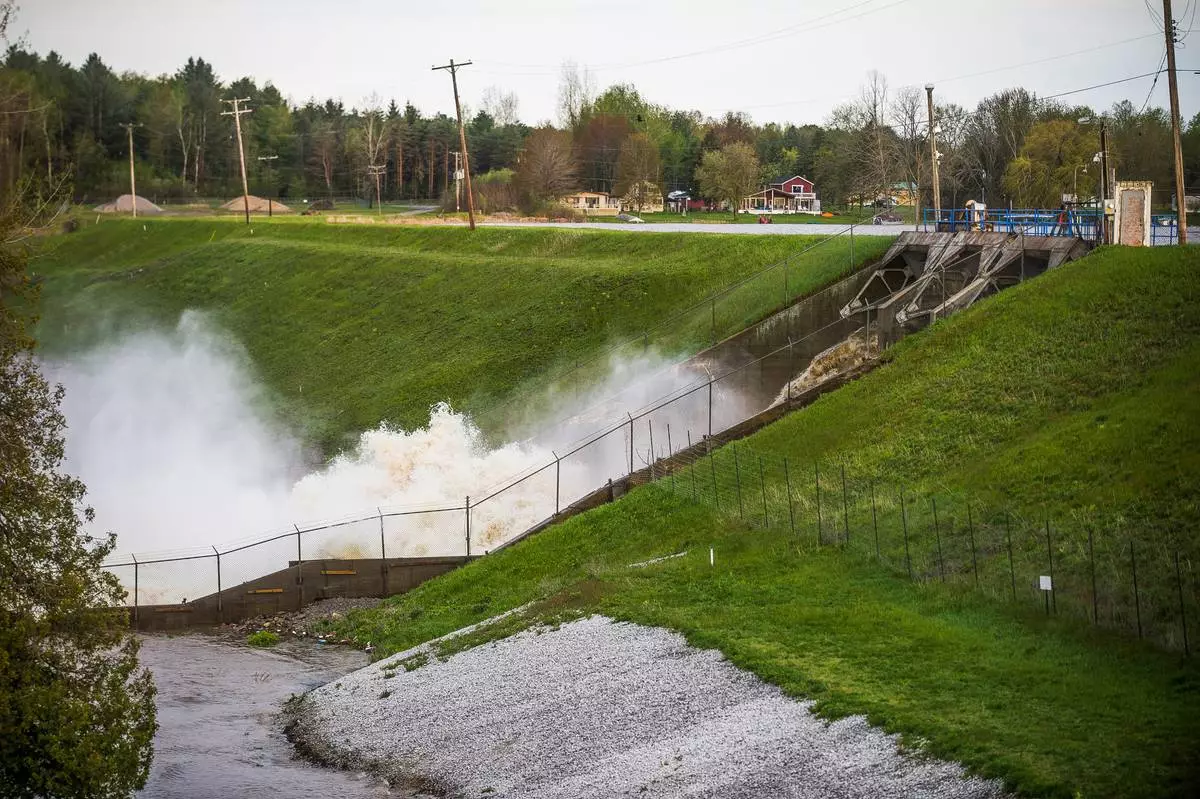
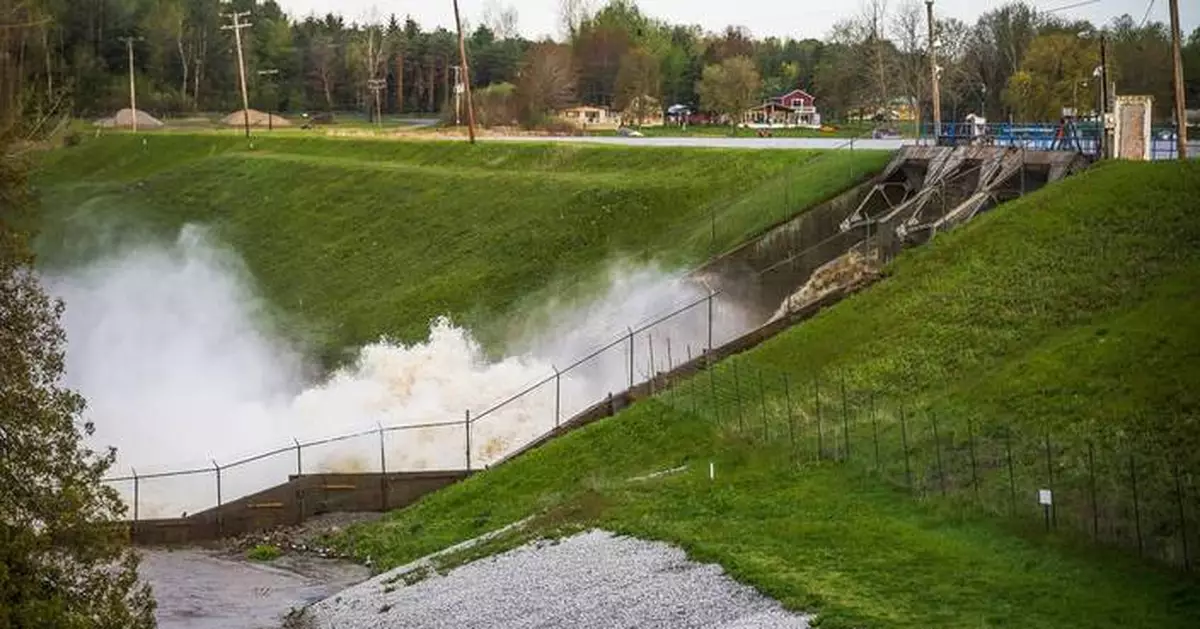
FILE - Water rushes through the Edenville Dam, May 19, 2020, in Edenville, Mich. (Katy Kildee/Midland Daily News via AP, File)
SIOUX FALLS, S.D. (AP) — Millions more Americans might qualify for dual Canadian citizenship under a recent change to Canada's requirements that has led to a surge in applications from its southern neighbor.
For people like Zack Loud of Farmington, Minnesota, it was a surprise to learn that under a new law, Canada already considered him and his siblings citizens because their grandmother is Canadian.
“My wife and I were already talking about potentially looking at jobs outside the country, but citizenship pushed Canada way up on our list,” he said.
Since the new law took effect Dec. 15, immigration lawyers in the United States and Canada say they have been overwhelmed by clients seeking help submitting proof of citizenship applications. Driven by politics, family heritage, job opportunities and other factors, thousands of Americans are exploring whether the easier process makes now the right time to gain dual citizenship.
Nicholas Berning, an immigration attorney at Boundary Bay Law in Bellingham, Washington, said his practice is “pretty much flooded with this.”
“We’ve kind of shifted a lot of other work away in order to push these cases through,” he said.
Immigration attorney Amandeep Hayer said his Vancouver, British Columbia-area practice went from about 200 citizenship cases a year to more than 20 consultations per day.
Canada has been changing its citizenship laws for decades, whether to update historic interpretations of law or to address discrimination issues.
Previously, Canadian citizenship by descent could only be passed down to one generation, from a parent to a child. But the new law opened up citizenship to anyone born before that date who could prove they have a direct Canadian ancestor — a grandparent, great-grandparent or even more distant ancestor.
Those born on or after Dec. 15 need to show that their Canadian parent lived in Canada for 1,095 days.
Under the new law, descendants of Canadians are already considered citizens but must provide proof to obtain a certificate of citizenship. Hayer estimated that there are millions of Americans who are Canadian descendants.
“You are Canadian, and you’re considered to be one your whole life,” said Hayer, who advocated for the new law in parliament. “That’s really what you’re applying for, the recognition of a right you already have vested.”
“The best way I can put it is like, if a baby’s born tomorrow in Canada, the baby’s Canadian even though they don’t have the birth certificate,” he said.
American applicants have different motivations, but many say President Donald Trump's immigration crackdown and other topics have led them to seek dual citizenship.
Michelle Cunha, of Bedford, Massachusetts, said she decided to move to Canada after reflecting on decades of political activism and deciding she had “nothing left to give.”
“I put in my best effort for 30 years. I have done everything that I possibly can to make the United States what it promises the world to be, a place of freedom, a place of equality,” Cunha said. “But clearly we’re not there and we’re not going to get there anytime soon.”
Troy Hicks, who had a great-grandfather born in Canada, said he was spurred by an international trip.
“I recently went to Australia and you know, first words out of the first person I talked to in Australia was basically an expletive about Trump and the U.S.,” said Hicks, of Pahrump, Nevada. “It was just like, whoa, I walked off a 20-hour flight and literally the first words of somebody’s mouth to me were that. ... So the idea of doing that with a Canadian passport just seemed easier, better, more palatable.”
Maureen Sullivan, of Naples, Florida, said she was motivated by the immigration crackdown in Minnesota, which hit home when her teenage nephew encountered federal officers near his high school in St. Paul. Sullivan, whose grandmother was Canadian, said she sees citizenship in Canada as an option in case things in the U.S. “really go south.”
“When I first heard about the bill, I couldn’t believe it. It was like this little gift that fell in my lap,” Sullivan said. “There was kind of this collective excitement amongst the (family) who just felt like, we wanted to feel like we were doing something to take care of our security in the future if needed.”
For those with documentation ready at hand, the proof of citizenship application fee is a relatively inexpensive 75 Canadian dollars ($55).
But costs will climb for those seeking help from an attorney or genealogist to locate records like birth, death and marriage certificates that can establish the lineage to a Canadian ancestor.
Cunha said she used an attorney and estimates the cost will be about $6,500.
However, Mary Mangan, of Somerville, Massachusetts, filed her application in January using advice from online forums.
“There are some situations where a lawyer might be the right thing, but for many people, I would guess 90% of people can probably do this on their own,” Mangan said.
The website for the Immigration, Refugees and Citizenship Canada office, which processes applications, says processing times for a certificate is around 10 months, with more 56,000 people awaiting a decision.
The agency said that from Dec. 15 to Jan. 31, it confirmed citizenship by descent for 1,480 people, though not all were Americans. Last year, 24,500 Americans gained dual U.S.-Canada citizenship.
Fen Hampson, professor of international affairs at Carleton University in Ottawa, said Canadians are generally a “welcoming people.”
Hampson said some also worry a surge of interest from Americans could delay efforts by refugees and asylum-seekers fleeing vulnerable situations.
“I think where people start looking askance is someone who’s never been to Canada, who has very thin ties. They can get a passport, becoming Canadians of convenience. People don’t like that,” he said.
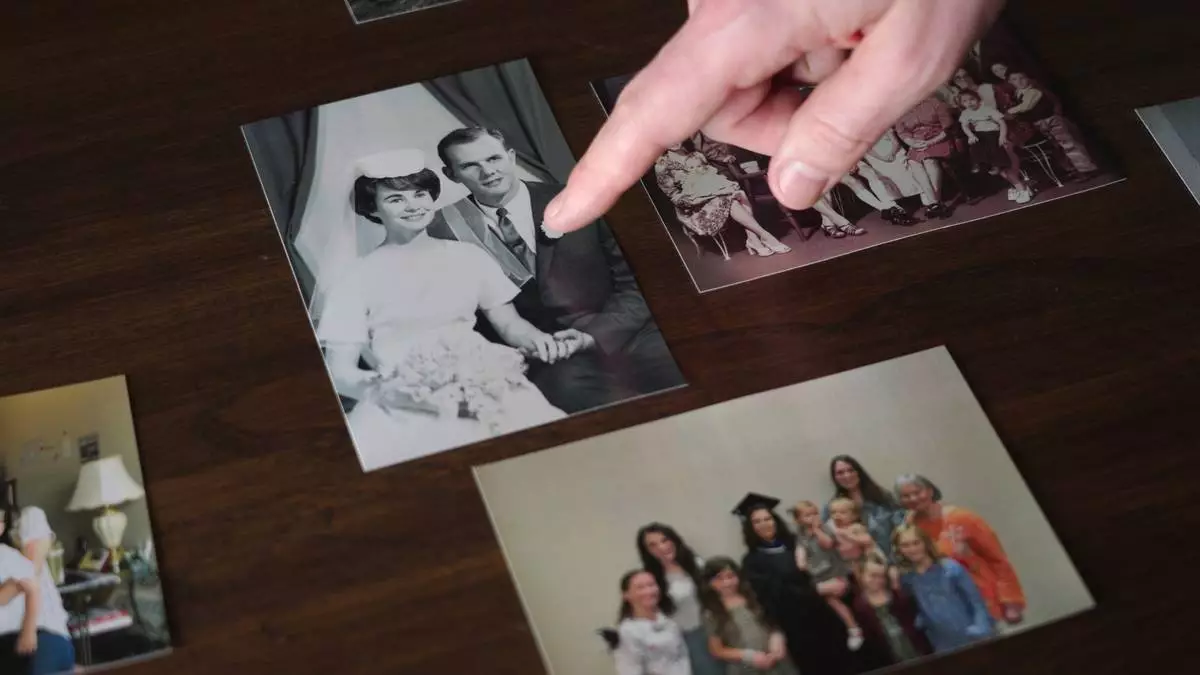
This image made from video shows Zach Loud pointing at a photo of his Canadian grandmother at his family's home in Farmington, Minn., April 17, 2026. (AP Photo/Mark Vancleave)
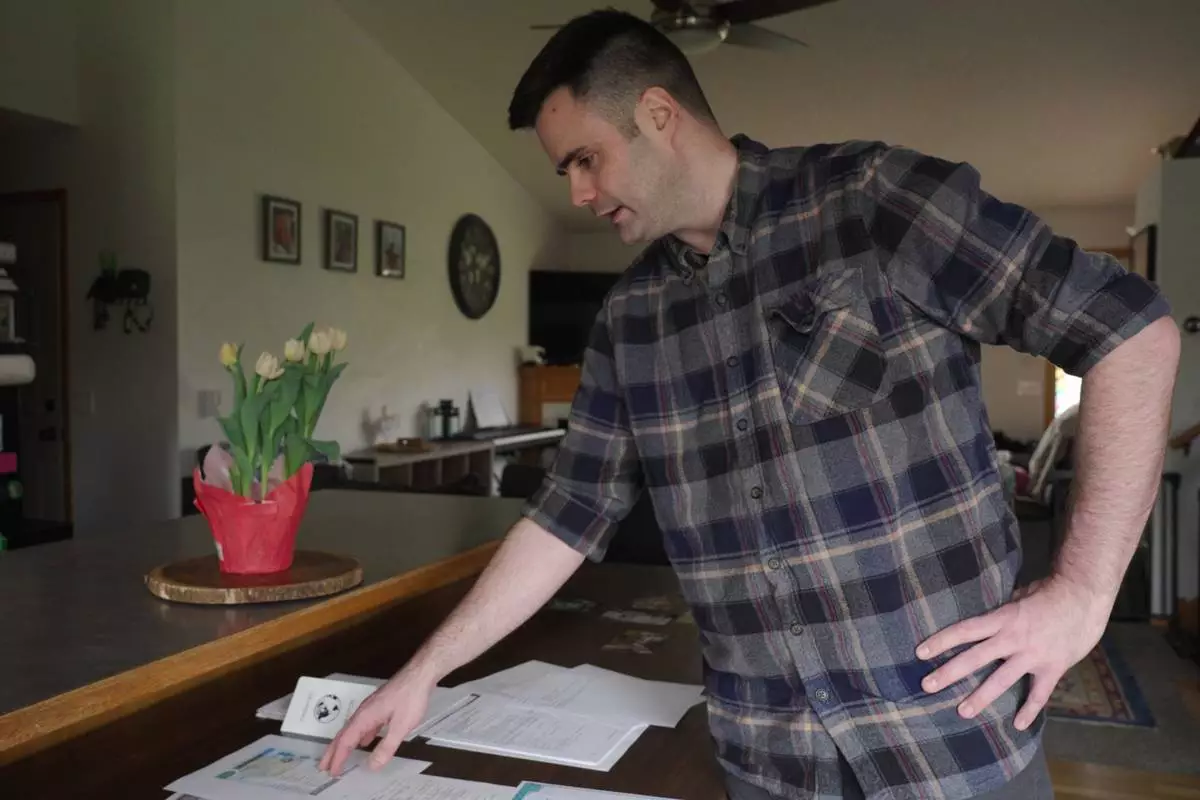
This image made from video shows Zach Loud looking through his application for Canadian citizenship at his family's home in Farmington, Minn., April 17, 2026. (AP Photo/Mark Vancleave)
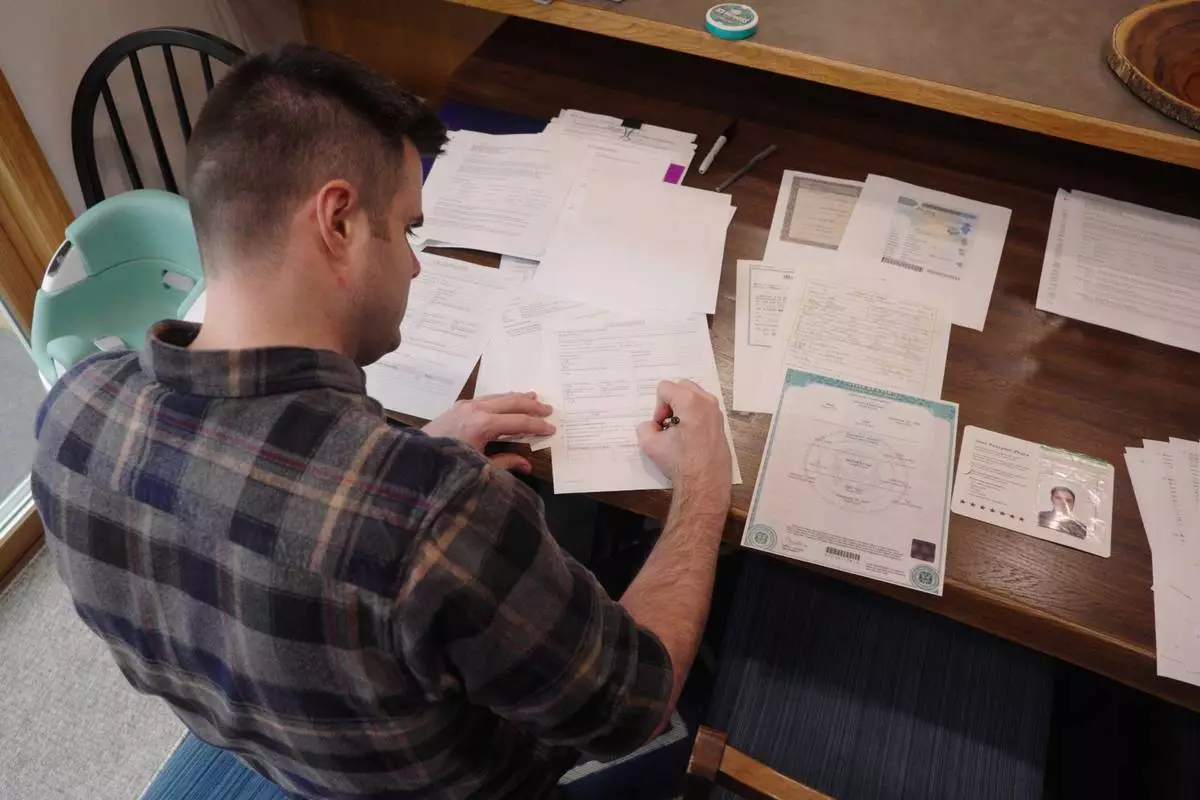
This image made from video shows Zach Loud completing his application for Canadian citizenship at his family's home in Farmington, Minn., April 17, 2026. (AP Photo/Mark Vancleave)