BANGKOK (AP) — U.S. officials have announced a sweeping crackdown on Southeast Asian cyberscam operations as part of what U.S. Attorney Jeanine Pirro characterized Friday as a “new theater of war” launched by the Trump administration against Chinese transnational organized crime.
The crackdown, led by a U.S. government Scam Center Strike Force, includes the Treasury Department's sanctioning of a prominent lawmaker and 28 other people and companies accused of operating from Cambodia. Criminal charges also were filed against two Chinese nationals involved in a similar operation in Myanmar.
The initiative includes a warrant to seize and shut down a major online recruitment channel on the Telegram messaging app and freezing hundreds of millions of dollars in illicit assets, Pirro said in a virtual press conference connecting her from Washington to journalists in Asia.
Cybercrime has flourished in Southeast Asia in recent years, particularly in Cambodia and Myanmar, with illegal operations making mammoth profits from victims around the world, according to United Nations experts and other analysts. Americans lost nearly $21 billion to cyber-enabled crimes and online scams in 2025 alone, according to the Federal Bureau of Investigation.
The illicit industry is closely involved in human trafficking, with foreign nationals employed to run romance and cryptocurrency scams, often after being recruited with false offers of legitimate jobs and then forced to work in conditions of near-slavery.
The Scam Center Strike Force comprises Pirro’s U.S. Attorney’s Office for the District of Columbia, the Department of Justice’s Criminal Division, the FBI and the U.S. Secret Service.
The most prominent target of the crackdown is Kok An, a Cambodian senator and prominent businessman described by the Treasury Department as a “scam center kingpin."
The department's Office of Foreign Assets Control announced sanctions against Kok An and associates for their roles in a network that has allegedly defrauded U.S. citizens of millions of dollars. They include blocking Kok An’s assets in the United States and prohibiting U.S. entities from doing business with him.
The Associated Press was unable to contact Kok An or any of his representatives for comment.
“His Excellency Kok An is a Cambodian Senator and he was elected by elections, and as a senator he has parliamentary immunity," said Chea Thyrith, a Cambodian Senate spokesperson, who added that only the U.S. side could speak clearly about the sanctions.
Kok An is at least the second Cambodian senator to be sanctioned by the U.S. In 2024, Washington acted against another top tycoon, Ly Yong Phat, who also was accused of being connected with forced labor, human trafficking and lucrative online scams.
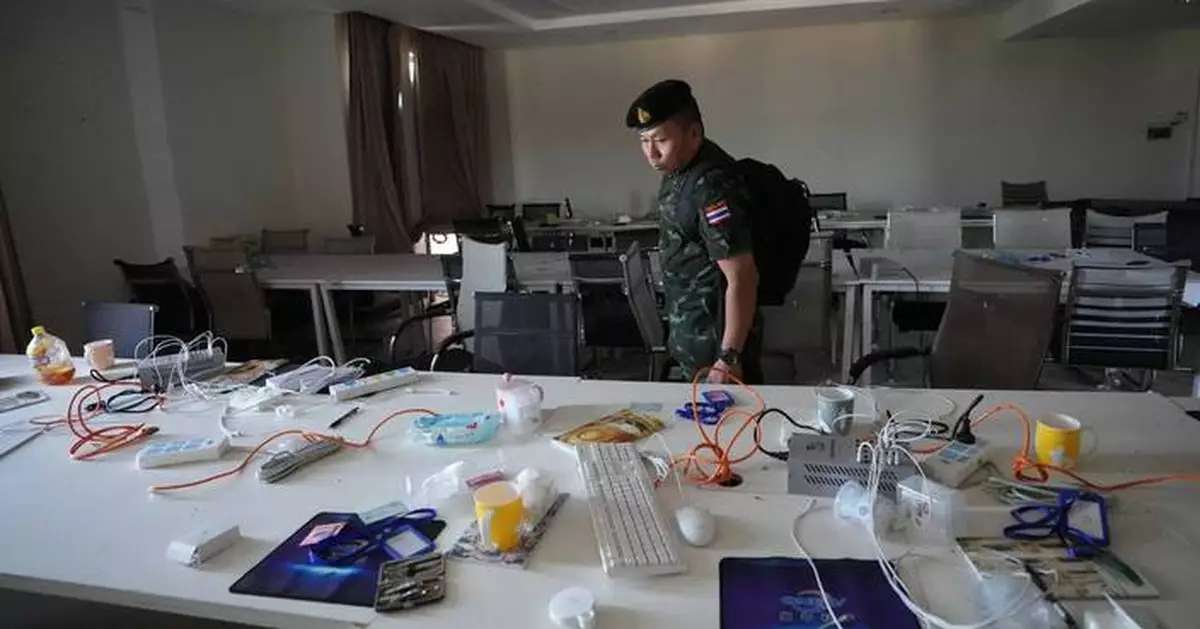
Pirro said the latest crackdown was set in motion in November when FBI agents sent to Thailand accessed copious evidence seized from an abandoned scam center in Myanmar, including more than 8,000 phones and 1,500 computers.
That led to charges of wire fraud conspiracy against two Chinese nationals, Huang Xing Shan and Jiang Wen Jie, who were managers of the compound before seeking to reestablish their operations in Cambodia. They are being held by Thai authorities for immigration violations and the U.S. is seeking their extradition, Pirro said.
Cambodian lawmakers unanimously adopted a new law in March targeting online scam operations with up to life in prison, following a government pledge to shut down the centers by the end of April.
In January, Cambodia extradited to China another alleged scam kingpin, Chen Zhi, the founder of business and banking conglomerate Prince Holding Group, even though U.S. authorities had sought custody after indicting him last year for allegedly running a huge scam operation.
Sopheng Cheang in Phnom Penh, Cambodia, and Michael Kunelman in Washington contributed to this report.

FILE -U.S. Attorney for the District of Columbia Jeanine Pirro arrives at The Mar-a-Lago Club, Feb. 1, 2026, in Palm Beach, Fla., to attend the wedding of White House deputy chief of staff Dan Scavino and Erin Elmore, the director of Art in Embassies at the U.S. Department of State. (AP Photo/Mark Schiefelbein), File)

FILE -Cambodian tycoons, Senator Kok An, right, Ly Yong Phat, second from right, Lao Meng Khin, center, sit as they attend a ceremony to mark International Anti-Drug Day in Phnom Penh Cambodia, T, June 26, 2012. (AP Photo/Heng Sinith, File)
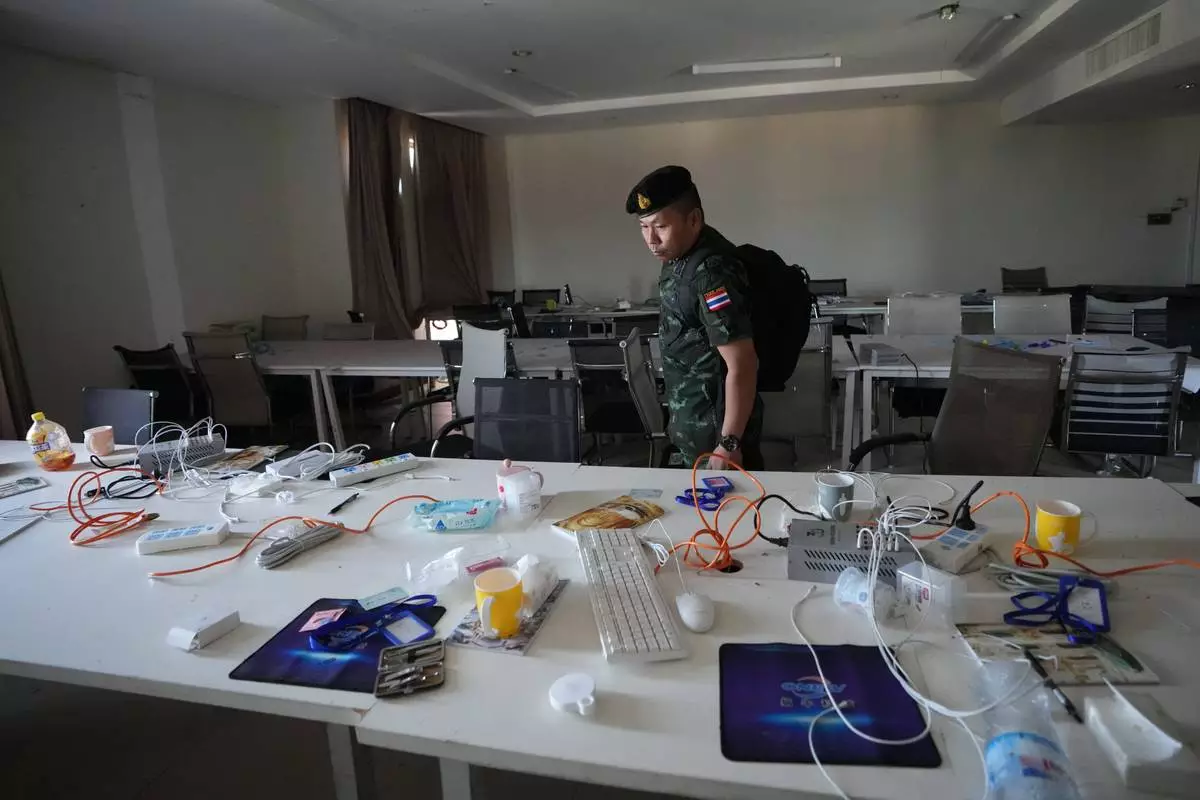
FILE -A Thai solider inspects a work station inside a scam center in O'Smach, Cambodia, Feb. 2, 2026, (AP Photo/Sakchai Lalit), File)
MALMÖ, Sweden (AP) — Long championed as a leader in adopting digital technology, Sweden is set to ban mobile phones in schools beginning in the fall for the next academic year as part of a broad, international reversal on the use of screens in classrooms.
Since 2023, the Scandinavian country’s center-right coalition government has pursued a policy prioritizing more reading time and less screen time, particularly among preschool students, by favoring books and other traditional learning tools.
Lawmaker Joar Forsell, chairperson of the Swedish parliament's education committee, said officials have seen a decline in the general ability to read and write in Sweden, especially among younger students.
“We’re rolling the screens back because we believe that books and more traditional ways of learning are better for kids,” Forsell said.
Sweden’s plans are part of a broader shift and a digital reckoning against smartphones in schools internationally after countries outfitted their campuses with laptops, tablets and learning apps for their students. Classrooms have become saturated with screens and a growing number of parents, teachers and school districts say it is time to scale back.
In the Nordics, Denmark looks set to implement a similar ban to Sweden, and a law restricting use of mobile devices in schools in Finland came into effect last August. Other countries from Spain to South Korea have taken a variety of steps that range from a ban of mobile phones in classrooms to limits on screen-based homework.
The Los Angeles Unified School District, the second-largest school district in the U.S., has said it will ban screens until second grade, require daily caps for screen time per grade, ban YouTube and require an audit of all education technology contracts.
Tech-savvy Sweden, which is home to music streamer Spotify and telecoms giant Ericsson, has one of the most digitally advanced education systems in the world. But the mobile ban aims to foster learning environments with fewer distractions by building on restrictions on phones already independently implemented by many schools in the nation of over 10 million.
Alongside the ban, the government this year set aside 555 million Swedish krona ($59 million) as part of a new grant for purchasing textbooks and teachers’ guides.
The back-to-books policy was triggered by falling reading levels. In the 2022 Program for International Student Assessment, the latest study by the Organization for Economic Cooperation and Development, 24.3% of Swedish ninth graders did not reach a basic level of reading comprehension. That figure is only slightly better than the European Union average of 26.2%.
Magnus Haake, an associate professor of cognitive science at Lund University in southern Sweden, said learning with physical materials engages the motor sensory part of kids’ brains and “boosts the whole system.”
Sweden also is taking steps outside of school: Its public health agency has provided advice to parents about being better role models on use of screens, like having the same “screen-free zones” at home as their kids do.
At the Malmö Borgarskola high school in southern Sweden, mobiles are already banned during classes. Students place their handsets in a box — nicknamed a “Mobile Hotel” — and pick them up at the end of class.
“When you have a phone, there’s always something to look at,” student Melina Sallahi, 17, said. “It’s less of a distraction.”
Classmate Vasilije Stjepanovic, also 17, said apps like games or social media are “more fun than learning,” adding that students can learn better by taking away the phones.
At the same time, every student is given a laptop computer. But Deputy Headmaster Patrik Sander said students are now discouraged from using them in class, unless teachers say so.
“Nowadays, we see the push going in the other direction,” Sander said. “We have pushed back, learning that writing with your hands and a pencil helps you remember.”
Starting last summer, Swedish children under 2 years old could use only nondigital materials such as books, and preschoolers in general face no requirement to use digital learning tools. A new curriculum to prioritize book-based learning is expected in 2028.
Not everyone in the Nordic nation supports the shift away from digital learning.
Trade association Swedish Edtech Industry said in a report that 90% of all future jobs are expected to require digital skills. A lack of this knowledge could cause a skills shortage among young Swedes, a lack of innovation in the public sector and even increased unemployment, the report warned.
Peter Carlsson, CEO of Malmö-based startup Imvi Labs, which uses virtual reality headsets to train brain-eye coordination in children and adults, said not all screens disrupt learning and some software is “critical” to help children with learning or reading difficulties.
“By having good tools, the teaching can become more efficient,” he said.
But at Malmö Borgarskola, there is little concern over learning digital skills. One morning in May, students clutched textbooks and discussed Russian history as they prepared for end-of-year exams.
“Everyone uses digital devices during their free time, so I don’t think that’s something that should be taught in school,” student Melina Sallahi said. “It’s nothing I’m worried about.”
Classmate Aslan Özhan Kilicasan added, “We learn much more easily when we use books.”

Patrik Sander, 64-year-old deputy headmaster at Malmo Borgarskola high school, looks on for a photograph at Malmo Borgarskola high school in Malmo, Sweden, May 21, 2026. (AP Photo/James Brooks)
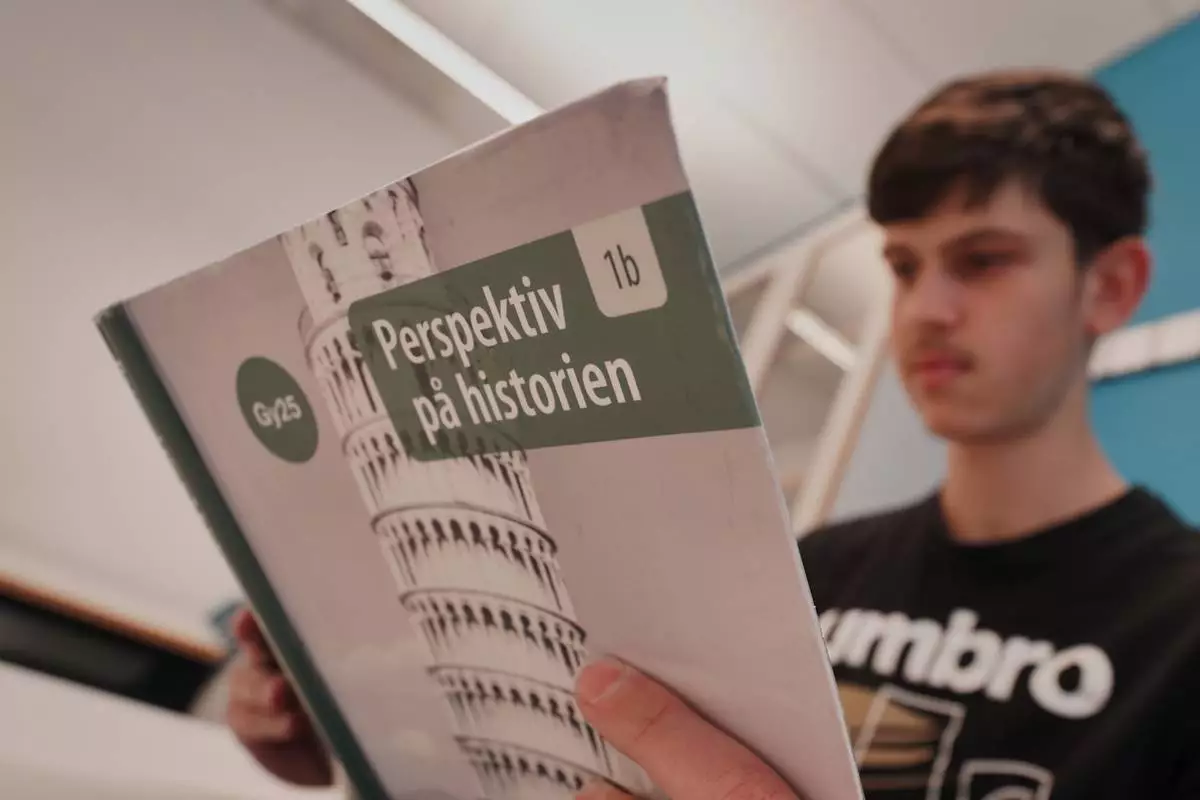
High school student Vasilije Stjepanovic reads a history text book at Malmo Borgarskola high school in Malmo, Sweden, May 21, 2026. (AP Photo/James Brooks)

High school students from left, Vasilije Stjepanovic, Aslan Ozhan Kilicasan and Melina Sallahi pose with a history text book at Malmo Borgarskola high school in Malmo, Sweden, May 21, 2026. (AP Photo/James Brooks)