Skip to Content Facebook Feature Image

Will Trump's reclassifying of medical marijuana have any impact on criminal justice reform?

News

Will Trump's reclassifying of medical marijuana have any impact on criminal justice reform?
News

News

Will Trump's reclassifying of medical marijuana have any impact on criminal justice reform?

2026-04-25 04:05 Last Updated At:04:20

The Trump administration's historic move to reclassify state-licensed medical marijuana as a less-dangerous drug was cheered by some advocates but for others, it fell far short for the thousands still incarcerated on federal cannabis-related convictions.

The executive order, which acting Attorney General Todd Blanche signed Thursday, does not address current penalties for possessing and selling marijuana or those jailed with yearslong sentences.

“While this is a victory, the fight is far from over," said Jason Ortiz, director of strategic initiatives for the Last Prisoner Project, a nonprofit focused on cannabis criminal justice reform.

Proponents of legalizing marijuana as well as overhauling prison sentencing say this order, which does not completely decriminalize the drug, benefits only cannabis researchers, growers and others in Big Weed. Meanwhile, thousands — many of whom are people of color — are stuck serving harsh sentences for marijuana-related offenses. Or they have served their time but having a conviction on their record has made life difficult.

Now, advocates are calling on Congress and state lawmakers to take concrete steps to ensure those with marijuana-related convictions receive fair treatment or be forgiven altogether.

Blanche's order reclassifies state-licensed medical marijuana as a less-dangerous drug. The major policy shift, which both Presidents Barack Obama and Joe Biden had considered, means cannabis won’t be grouped with drugs like heroin.

But it does not legalize marijuana for medical or recreational use. It shifts licensed medical marijuana from Schedule I — reserved for drugs without medical use and with high potential for abuse — to the less strictly regulated Schedule III. This will likely give licensed medical marijuana operators and cannabis researchers a major tax break and less stringent barriers to doing normal business.

Virtually no one imprisoned at the federal level is there solely for marijuana possession. But many are there for large-scale possession, trafficking offenses or both.

Hector Ruben McGurk, 66, has been serving life without the possibility of parole since 2007 for transporting thousands of pounds of marijuana and money laundering. He is currently imprisoned in Beaumont, Texas, over 800 miles (1,290 kilometers) from his son's El Paso home. His incarceration has been hard on his son, said McGurk's daughter-in-law, Ferna Anguiano. And the distance makes visits logistically difficult.

So it's tempting to see this order as a glimmer of hope, given that the family believes McGurk's punishment far outweighs his crimes. But Anguiano has no idea how to navigate lobbying for his release.

“His release date is death," Anguiano said. “I mean, we see all this stuff on the news — bigger cases, fatal cases — and people are going in and out of prison and coming out to their families.”

They try to keep in touch through phone calls and a prison texting service. They're concerned about McGurk's health and his diabetes management. It would be a dream come true for him to come home.

“He deserves a second chance,” Anguiano said. “Yes, it was a poor decision he did in his lifetime. He was younger. But he is not a bad person. I think it's fair to say he has served enough time for it.”

It's not clear whether punishments would be different had marijuana always been scheduled differently, drug policy experts say.

“In addition to schedule-specific penalties, there are marijuana-specific penalties that have nothing to do with the schedule,” said Cat Packer, director of drug markets and legal regulation at the nonprofit Drug Policy Alliance. “Even if marijuana were to be moved to Schedule V, those criminal penalties would still exist and there are mandatory minimums for simple possession.”

Destigmatizing marijuana has long been an issue for both political parties. Obama commuted the sentences of about 1,900 federal prisoners, almost all of whom were incarcerated for nonviolent drug crimes. Biden pardoned 6,500 people convicted of use and simple possession of marijuana on federal lands and in the District of Columbia. President Donald Trump's administration has taken far fewer drug clemency actions and does not have an overarching policy directing such actions.

“What many people on the right and the left would like is to move marijuana from this ‘just as bad as heroin’ category and to just sort of de-schedule it entirely,” said Marta Nelson, director of sentencing reform at the Vera Institute of Justice. “Regulate it like you do alcohol or tobacco.”

Studies show Black Americans are roughly 3.7 to 4 times more likely to be arrested for marijuana possession than white Americans, despite usage rates being roughly the same across racial groups. Federal-level marijuana cases are pretty small today, but those serving sentences for federal drug offenses are overwhelmingly Hispanic and Black, according to Justice Department and Bureau of Justice Statistics data.

The racial disparity with drug convictions is reminiscent of 2010 legislation Obama signed reducing the gap between mandatory sentences for crack cocaine versus powder cocaine. In 2018, Trump made it apply retroactively.

Because business owners with state medical marijuana licenses are predominantly white, the tax relief created by the rescheduling will also likely give a leg-up to mostly white businesses, Packer said. A lot of equity programs won't apply.

“This is going to, in my mind, widen the gap, the financial disparities, the business disparities that currently exist between Black and brown, Latino and white owners in the cannabis industry because licenses were not distributed equitably,” Packer said.

In theory, Trump could issue a blanket pardon like he did for Jan. 6 rioters. But Nelson thinks that is highly doubtful.

“Having marijuana convictions on the record for things like mass immigration enforcement is helpful to the administration,” Nelson said.

An impactful next step would be for Congress to outline very comprehensive legislation addressing existing marijuana-related convictions, expungements and industry regulations, she added.

The Last Prisoner Project and other organizations are planning to renew a dialogue with federal lawmakers, including the Congressional Cannabis Caucus, which includes Democratic Rep. Ilhan Omar and Republican Rep. David Joyce. They will also continue to lobby for Trump to conduct a large-scale act of commutation and clemency.

Advocates are also hoping Trump's order will prompt every state to rethink their marijuana classification and penalties.

“It is imperative that every state review their situation, as a lot of their controlled substances at the state level are tied to the federal government,” Ortiz said. “We’re gonna see other states that are going to need a little help from the public to remind them what the right thing to do is.”

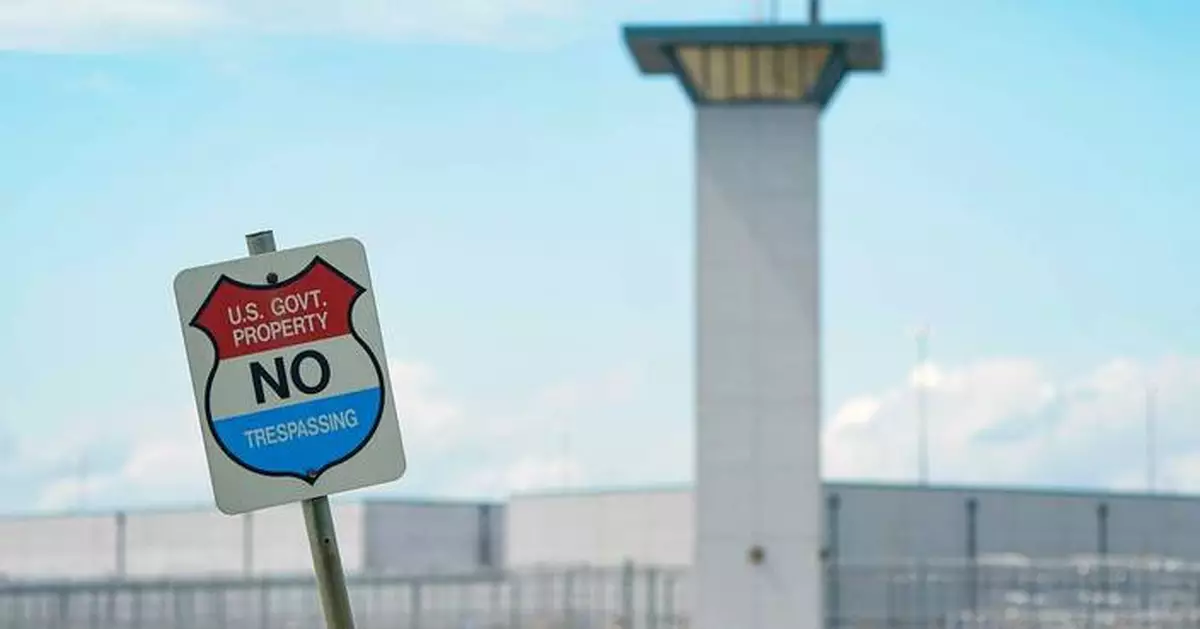
FILE - A no trespassing sign is displayed outside the federal prison complex in Terre Haute, Ind., Friday, Aug. 28, 2020. (AP Photo/Michael Conroy, File)

FILE - A no trespassing sign is displayed outside the federal prison complex in Terre Haute, Ind., Friday, Aug. 28, 2020. (AP Photo/Michael Conroy, File)
NEW YORK (AP) — A surge for Intel following a blowout profit report led the U.S. stock market to more records Friday, while oil prices kept yo-yoing in the wait for what’s next with the Iran war.

The S&P 500 climbed 0.8% and topped its prior all-time high, which was set on Wednesday. The Dow Jones Industrial Average dipped 79 points, or 0.2%, and the Nasdaq composite rallied 1.6% to its own record thanks to the jump for tech.

Intel led the way and roared past its 2000 peak during the dot-com boom to an all-time high. It soared 23.6% for its best day since 1987 after reporting much stronger results for the first three months of the year than analysts expected. CEO Lip-Bu Tan said the next wave of artificial-intelligence technology is increasing the need for Intel’s chips and products, and the company’s forecast for profit in the spring topped analysts’ estimates.

Such strong profit reports have helped Wall Street rally to records, and the S&P 500 has leaped nearly 13% in a little under a month. Hopes have also built in financial markets that the United States and Iran can find a way to avoid a worst-case scenario for the global economy because of their war.

A ceasefire is tenuously in place between the two, but tensions between them are still keeping oil tankers from passing through the Strait of Hormuz to deliver crude from the Persian Gulf to customers worldwide.

Oil prices climbed this week on worries about the strait, but an encouraging signal came Friday after Iran’s top diplomat said he was heading to Pakistan. That’s where officials have been trying to get the United States and Iran to convene for a second round of ceasefire negotiations.

White House press secretary Karoline Leavitt later said in an interview on Fox News Channel that President Donald Trump is sending his envoys Steve Witkoff and Jared Kushner to Pakistan to meet with Iran’s foreign minister.

The price for a barrel of Brent crude to be delivered in June yo-yoed for much of the day before settling at $105.33, up 0.2%. The price for a barrel of Brent oil delivered in July, which is where more of the trading is happening in the market, fell 0.2% to $99.13.

On Wall Street, Procter & Gamble rose 2.5% after reporting stronger profit for the latest quarter than analysts expected. CEO Shailesh Jejurikar said it saw broad-based growth across regions and products, which include Bounty paper towels and Tide detergent.

That helped offset a drop of 25.5% for Charter Communications, whose profit for the latest quarter came in weaker than analysts expected. It lost 120,000 internet customers during the three months, more than some analysts expected.

Hartford Insurance Group fell 3.7% after reporting profit growth for the latest quarter that fell short of analysts’ expectations.

All told, the S&P 500 rose 56.68 points to 7,165.08. The Dow Jones Industrial Average dipped 79.61 to 49,230.71, and the Nasdaq composite rallied 398.09 to 24,836.60.

In the bond market, Treasury yields eased as traders upped their bets on the possibility that the Federal Reserve could resume its cuts to interest rates later this year.

The path appeared to clear Friday for Trump’s nominee to chair the Fed, Kevin Warsh, after the U.S. Justice Department ended its probe into the Fed’s current chair, Jerome Powell.

Sen. Thom Tillis, a North Carolina Republican, has said he would oppose Warsh until the investigation was resolved, effectively blocking his confirmation. Warsh is the choice of Trump, who has been arguing loudly for lower interest rates, which could help mortgages and other kinds of loans become less expensive.

The yield on the 10-year Treasury dipped to 4.30% from 4.34% late Thursday.

A report in the morning also said sentiment among U.S. consumers remains sour. A survey by the University of Michigan found weaker sentiment in April across political party, income, age, and education, though it improved a bit after the ceasefire in the war with Iran was announced earlier in the month.

In stock markets abroad, indexes were mixed across Europe and Asia. Japan’s Nikkei 225 rose 1%, and France’s CAC 40 fell 0.8% for two of the world’s bigger moves.

AP Business Writers Chan Ho-him and Matt Ott contributed to this report.

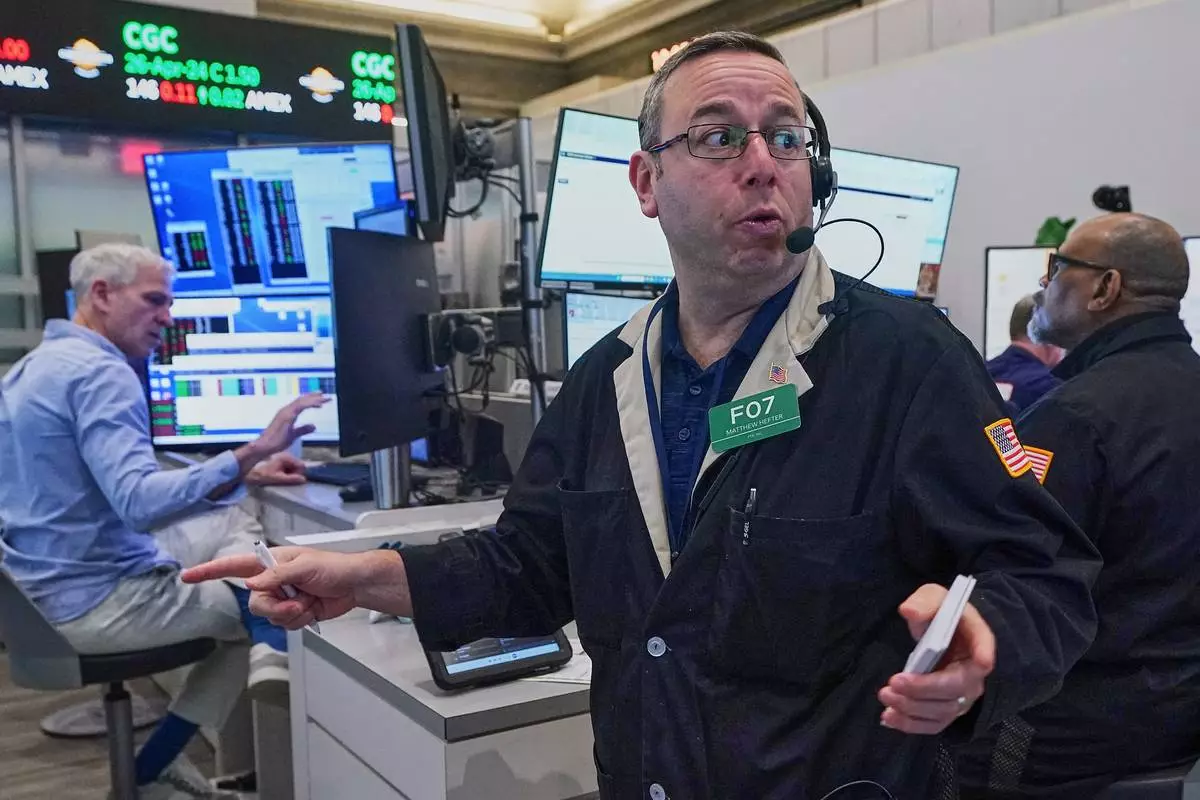
Options trader Matthew Hefter, center, works on the floor of the New York Stock Exchange, Thursday, April 23, 2026. (AP Photo/Richard Drew)

Options trader Matthew Hefter, center, works on the floor of the New York Stock Exchange, Thursday, April 23, 2026. (AP Photo/Richard Drew)

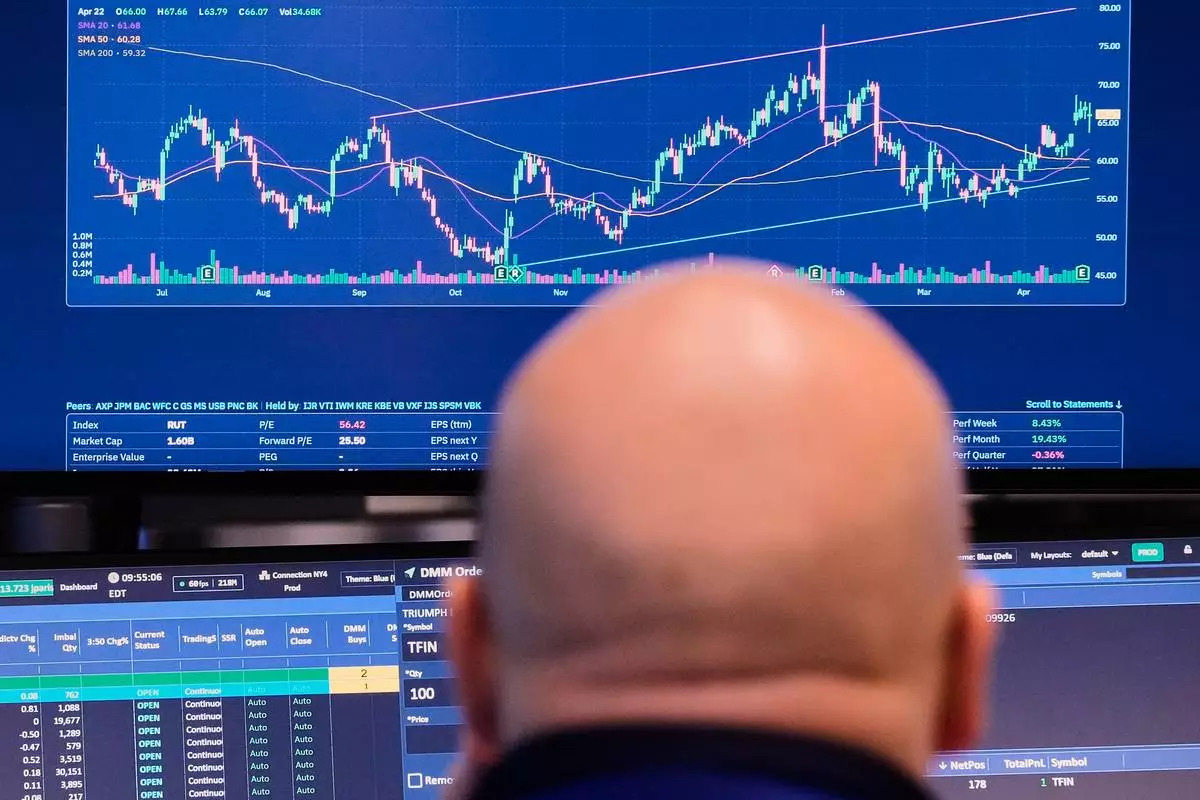
Specialist John Parisi works at his post on the floor of the New York Stock Exchange, Wednesday, April 22, 2026. (AP Photo/Richard Drew)

Specialist John Parisi works at his post on the floor of the New York Stock Exchange, Wednesday, April 22, 2026. (AP Photo/Richard Drew)

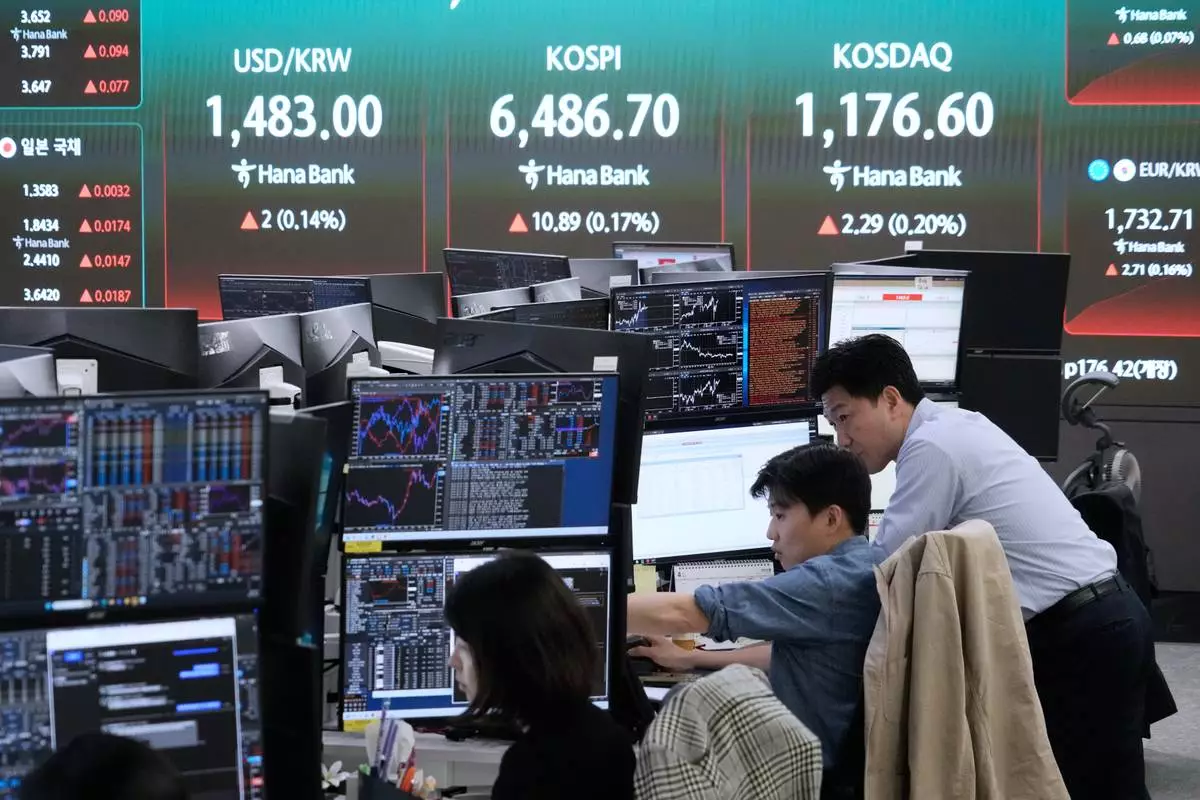
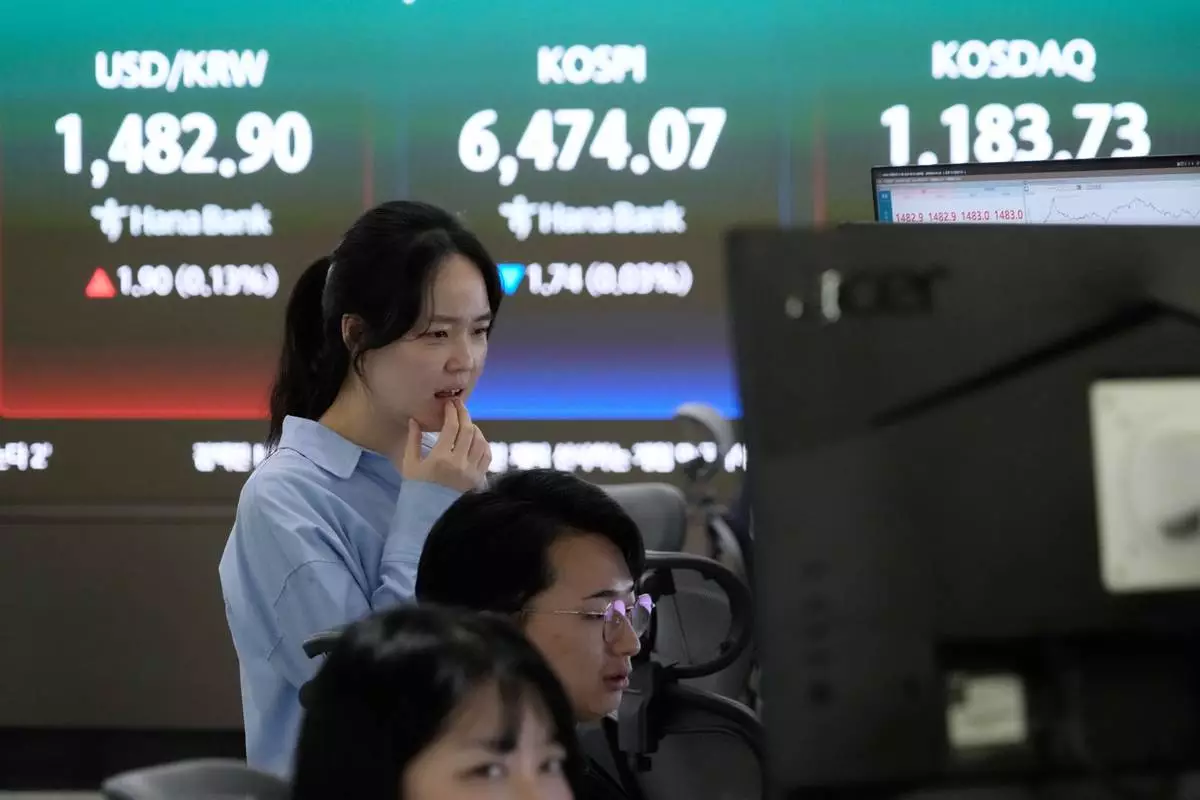
Currency traders watch monitors near a screen showing the Korea Composite Stock Price Index (KOSPI), top center, and the foreign exchange rate between U.S. dollar and South Korean won, top center left, at the foreign exchange dealing room of the Hana Bank headquarters in Seoul, South Korea, Friday, April 24, 2026. (AP Photo/Ahn Young-joon)

Currency traders watch monitors near a screen showing the Korea Composite Stock Price Index (KOSPI), top center, and the foreign exchange rate between U.S. dollar and South Korean won, top center left, at the foreign exchange dealing room of the Hana Bank headquarters in Seoul, South Korea, Friday, April 24, 2026. (AP Photo/Ahn Young-joon)

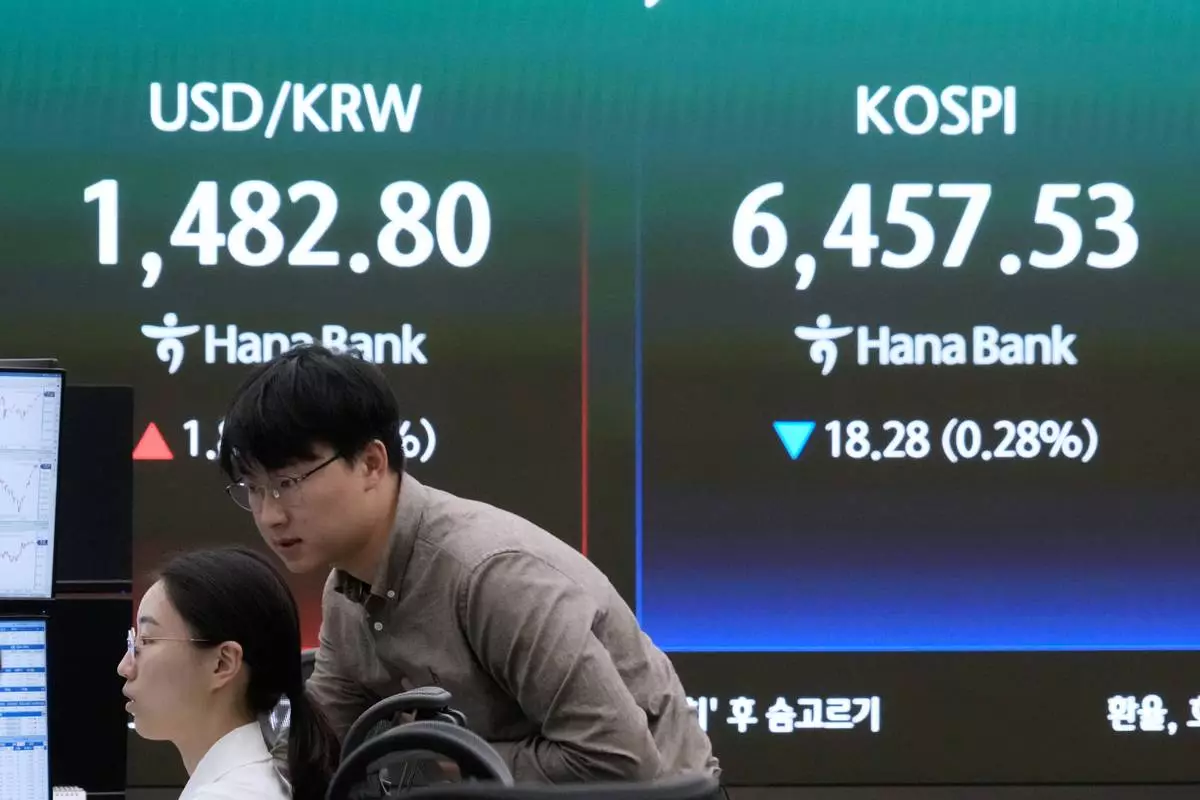
Currency traders work near a screen showing the Korea Composite Stock Price Index (KOSPI), right, and the foreign exchange rate between U.S. dollar and South Korean won at the foreign exchange dealing room of the Hana Bank headquarters in Seoul, South Korea, Friday, April 24, 2026. (AP Photo/Ahn Young-joon)

Currency traders work near a screen showing the Korea Composite Stock Price Index (KOSPI), right, and the foreign exchange rate between U.S. dollar and South Korean won at the foreign exchange dealing room of the Hana Bank headquarters in Seoul, South Korea, Friday, April 24, 2026. (AP Photo/Ahn Young-joon)

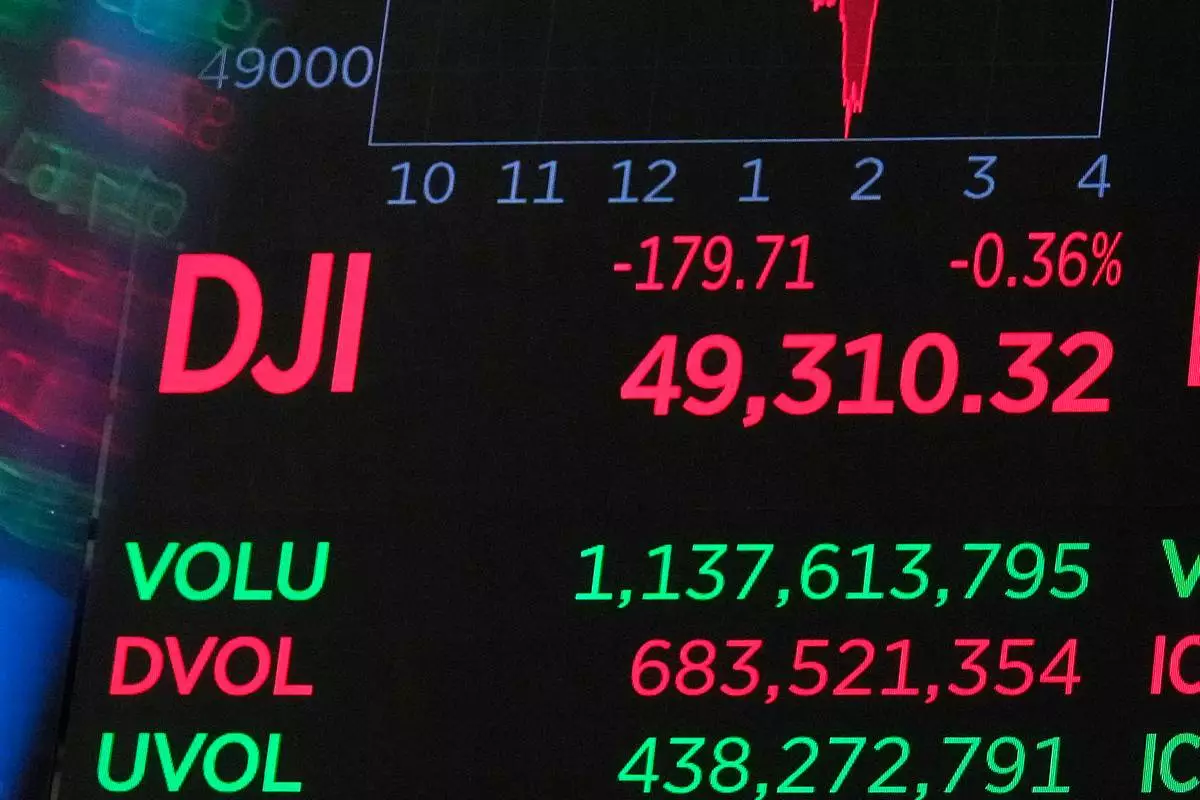
A board above the floor of the New York Stock Exchange displays the closing number for the Dow Jones industrial average, Thursday, April 23, 2026. (AP Photo/Richard Drew)

A board above the floor of the New York Stock Exchange displays the closing number for the Dow Jones industrial average, Thursday, April 23, 2026. (AP Photo/Richard Drew)

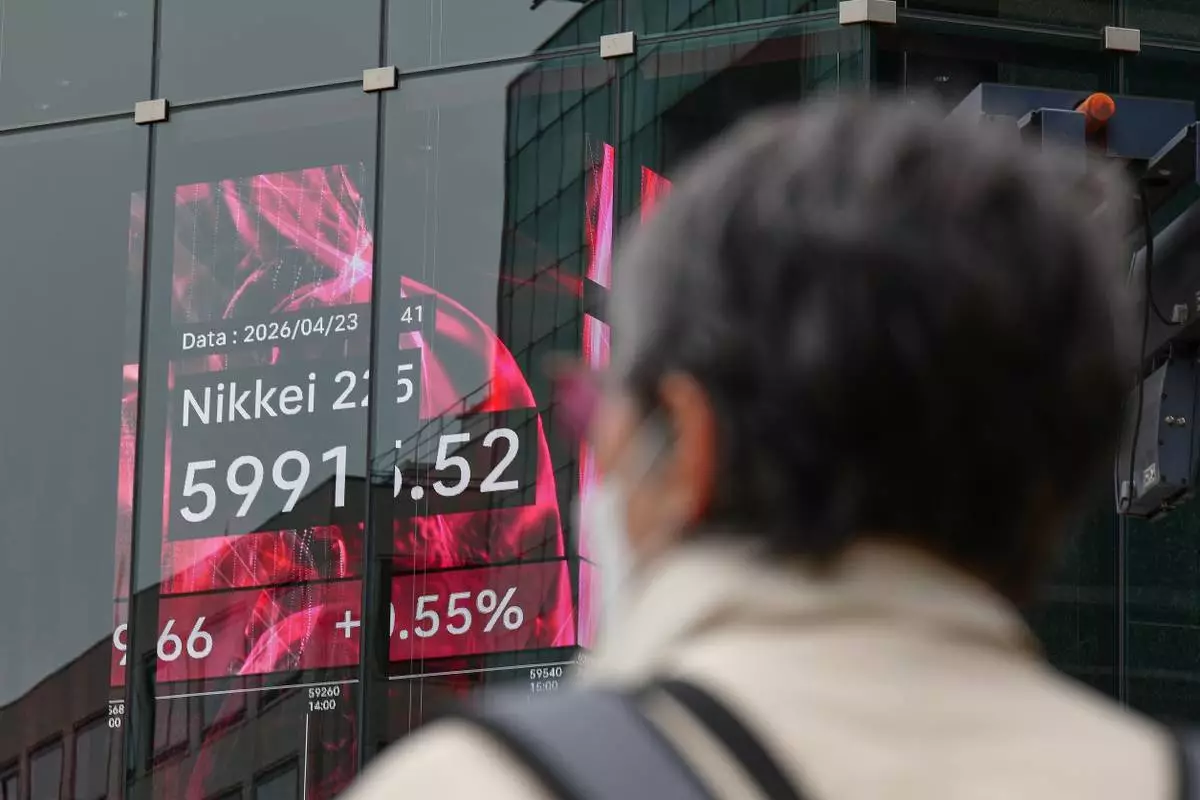
A person stands in front of an electronic stock board showing Japan's Nikkei index at a securities firm Thursday, April 23, 2026, in Tokyo. (AP Photo/Eugene Hoshiko)

A person stands in front of an electronic stock board showing Japan's Nikkei index at a securities firm Thursday, April 23, 2026, in Tokyo. (AP Photo/Eugene Hoshiko)

A currency trader watches monitors near a screen showing the Korea Composite Stock Price Index (KOSPI), top center, and the foreign exchange rate between U.S. dollar and South Korean won, top center left, at the foreign exchange dealing room of the Hana Bank headquarters in Seoul, South Korea, Friday, April 24, 2026. (AP Photo/Ahn Young-joon)

A currency trader watches monitors near a screen showing the Korea Composite Stock Price Index (KOSPI), top center, and the foreign exchange rate between U.S. dollar and South Korean won, top center left, at the foreign exchange dealing room of the Hana Bank headquarters in Seoul, South Korea, Friday, April 24, 2026. (AP Photo/Ahn Young-joon)

Recommended Articles