China's first space documentary, filmed with 8K ultra-high-definition cameras by its astronauts, premiered in St. Petersburg, Russia on Friday, the 11th Space Day of China.
The year 2026 also marks the 65th anniversary of the historic flight of Yuri Gagarin, the first human to travel into outer space.
The SHENZHOU 13, or Blue Planet Outside the Window, chronicles the Shenzhou-13 mission featuring China's first six-month manned space station stay and the first spacewalk by a Chinese female astronaut.
Largely told by Wang Yaping, the country's first female astronaut venturing on a mission to the space station, the documentary offers unprecedented, spectacular views of Earth from about 400 kilometers above and gives glimpses into life aboard the station.
"We were all watching. It was quite an original idea -- to show everything as it is, from beginning to end, how life unfolds aboard the space station. It's certainly very interesting. Young people can sense from the movie the very feeling of being so far away from home, from the homeland, from the relatives, and from people in general," said Mikhail Malenkov, vice president of the St. Petersburg branch of the Tsiolkovsky Russian Academy of Cosmonautics.
The 90-minute film employs a straightforward narrative style to tell the story of the astronaut trio -- Zhai Zhigang, Wang Yaping and Ye Guangfu. It depicts their experiences in space, including conducting experiments, going on spacewalks, exercising, getting haircuts, playing musical instruments, celebrating the New Year, giving lectures to students on Earth, and filming 8K footage.
"This film provides an opportunity for the viewers to see what experiments are being conducted, who are involved, and how long the experiments will last. It's extremely useful for students who attend this event, especially for those studying aerospace, and there are several of them here. The students can view these experiments from an instrumentation engineering perspective, understand what information technologies are being used, and think how they can apply their knowledge gained during studies," said Valentin Olenev, director of the Center for Aerospace Research and Development under the Saint-Petersburg State University of Aerospace Instrumentation.
"What a fantastic film! It has unique footage and was beautifully shot with deep love. And it was a joy to watch the film. There's a saying that one can't see borders from space. Cosmonautics is a field that unites humanity and unites different nations and countries," said Andrey Emelyanov, a renowned spacecraft test engineer.
"I really like the film. I even started crying at the beginning, because it was such a great film," said Nikita Sokolov, a Russian student.
The Shenzhou-13 mission sent three astronauts to China's space station core module on Oct. 16, 2021. They returned to Earth on April 16, 2022.
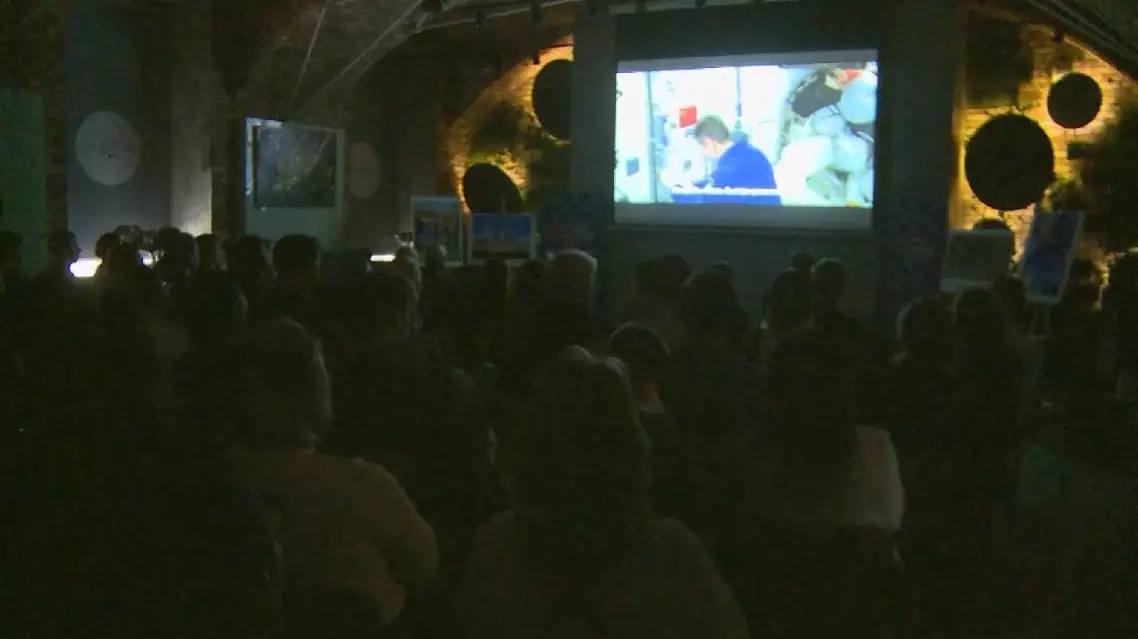
China's first 8K space-filmed movie premieres in St. Petersburg