HONG KONG SAR - Media OutReach Newswire - 27 April 2026 - Hong Kong is one of Asia's most active Copilot markets. At the same time, Hong Kong enterprises are entering a new phase of AI adoption—one that moves beyond pilots and proofs of concept, toward changing how work gets done at scale. At the Microsoft AI Tour in Hong Kong, Microsoft outlined how organizations can achieve Frontier Success: where AI agents become part of everyday operations, delivering real business impact with trust and governance built in. AIA and AS Watson Group are among the early pioneers locally that have already begun their Frontier journey.

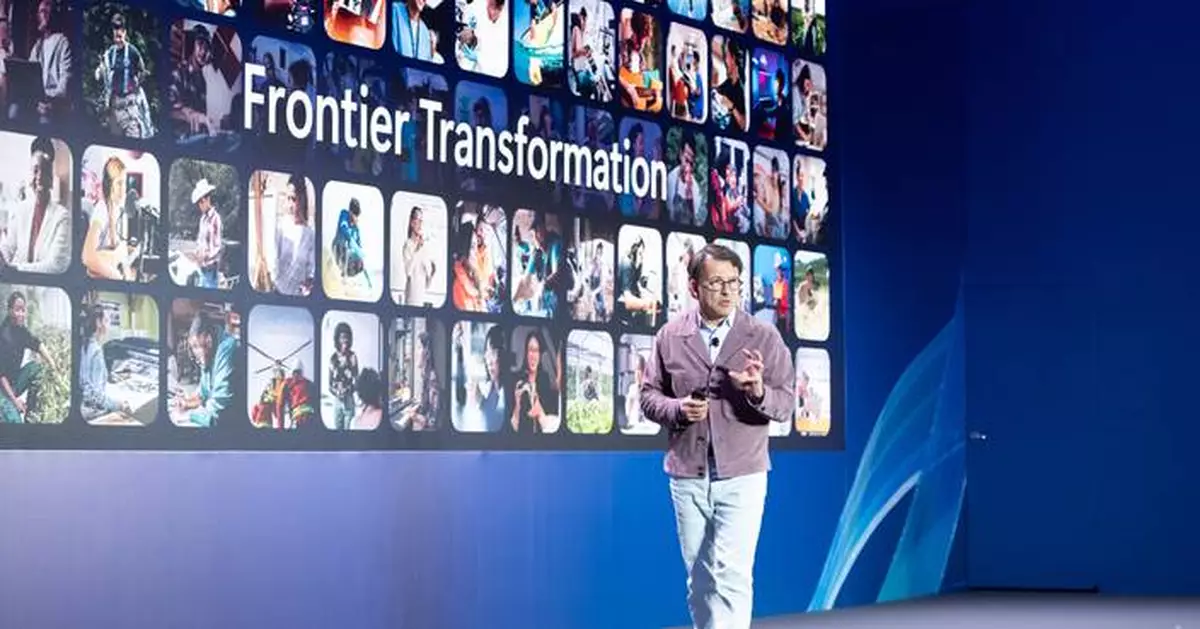
Photo: Judson Althoff, CEO of Microsoft’s Commercial Business, delivers a keynote at the Microsoft AI Tour in Hong Kong, outlining Microsoft’s Frontier Success Framework and how agentic AI is moving from experimentation to enterprise wide impact.
"Across Hong Kong, organizations are rethinking how work gets done with agentic AI—moving beyond experimentation to running operations at scale," said Judson Althoff, CEO of Microsoft's Commercial Business. "Frontier Transformation is helping them deliver business impact and measurable outcomes by embedding AI into real workflows, with trust, security, and governance fully integrated throughout."
Frontier Success Framework: How Microsoft Helps Organizations Scale Agentic AI with Confidence
As AI matures, success is no longer defined by deploying individual tools. At the AI Tour, Microsoft shared its Frontier Success Framework—a practical approach designed to help organizations turn agentic AI into business real, measurable business value. The framework centered on four outcomes: enrich employee experience, reinvest customer engagement, reshape business process, and bend the curve on innovation.
As part of this journey, Microsoft announced that Wave 3 of Microsoft Copilot, delivered through Microsoft 365 E7 (Frontier Suite) will reach general availability in Hong Kong on 1 May 2026. Built on the principles of Intelligence and Trust, Microsoft 365 E7 brings together Microsoft 365 Copilot, Work IQ and Agent 365, alongside enterprise security, identity, and agent governance. By grounding AI in deep work context—understanding how people collaborate, what they work on, and how decisions are made—Work IQ enables Copilot and AI agents to operate with relevance and accuracy. At the same time, Agent 365 provides a centralized control plane to govern agents, while integrated security and governance ensure AI can scale responsibly across the enterprise.
Frontier Success in Action across Hong Kong
Across industries, Hong Kong organizations are already demonstrating what Frontier Success looks like in practice.
AIA -AdvancingAgentic AI Across Its Enterprise: AIA is applying Microsoft's AI platform to deploy a holistic, agentic AI strategy across its operations. This includes agentic AI supporting product training, lead management and knowledge access, automated claims processing and customer self-service. In addition, a citizen developer program using Copilot Studio to increase productivity. Together, these capabilities enable AIA to reduce manual effort, improve accuracy, and scale operational efficiency while meeting the requirements of a highly regulated industry.
AS Watson Group - Driving Scaled AI‑Powered Personalization Across O+O Retail Channels: AS Watson Group has adopted a wide range of AI tools in its Retail HK businesses, including Microsoft Copilot and its AI capabilities across its O+O (Offline plus Online) platform to enhance productivity and decision‑making. Key use cases include AI‑driven product discovery, AI skin analysis, and in‑store personalization to enhance customer engagement, alongside employee‑focused applications such as AI‑enabled store support and AI‑generated marketing content. By scaling generative AI across operations and customer insight analysis, the Group achieves efficiency, effectiveness and cross-team collaboration in its unique O+O business model.
These examples reflect a broader shift across Hong Kong's business community: organizations are no longer asking whether AI works, but how it should sit inside the operating model to drive meaningful outcomes.
Looking Ahead: Sustaining Frontier Success Through Continuous, Enterprise‑Grade Trust
Microsoft has been part of Hong Kong's technology and business community for 35 years, supporting enterprises as the city evolves into a hub for innovation and global impact.
"Over the past 35 years, we have had the privilege of supporting Hong Kong through multiple waves of digital transformation. Today, as this momentum carries Hong Kong into the frontier era of AI, where organizations are not just adopting new technologies, but rethinking operating models across the enterprise," said Leo Liu, General Manager of Microsoft Hong Kong and Macau. "As this frontier journey accelerates, Microsoft is committed to empowering local customers and partners to get ahead in the age of AI while maintaining strong data governance and enterprise‑grade privacy—ensuring human judgment remains firmly in control and enabling Hong Kong to define what Frontier Success looks like on the global stage."
As AI adoption accelerates, Microsoft emphasized that Frontier Success is not a single milestone, but a continuous transformation—one that requires clarity of purpose, strong governance, and real-world execution. Through its platform, partners, and ecosystem, Microsoft aims to support Hong Kong organizations as they move from experimentation to sustained, responsible AI driven growth.
Hashtag: #Microsoft #AI #FrontierSuccess
The issuer is solely responsible for the content of this announcement.
About Microsoft
Microsoft (Nasdaq "MSFT" @microsoft) creates platforms and tools powered by AI to deliver innovative solutions that meet the evolving needs of our customers. The technology company is committed to making AI available broadly and doing so responsibly, with a mission to empower every person and every organization on the planet to achieve more.
** This press release is distributed by Media OutReach Newswire through automated distribution system, for which the client assumes full responsibility. **
NEW DELHI, INDIA - Media OutReach Newswire - 3 May 2026 - The Indo-Pacific region continues to be the focal point of global growth dynamics and strategic competition, and relations between Vietnam and India are facing new opportunities to develop in a deeper, more substantive, and more sustainable manner. Building on the Comprehensive Strategic Partnership established in 2016, cooperation in the fields of economy, science and technology, and environment has increasingly been identified by both sides as key pillars.
In 2024, the two sides adopted an Action Plan to implement the Comprehensive Strategic Partnership for the 2024-2028 period. This document not only consolidates traditional areas of cooperation but also expands into new domains such as science and technology, innovation, digital transformation, energy and sustainable development.
Economy continues to be a bright spot in bilateral cooperation
Over the past decade, Vietnam-India economic cooperation has recorded significant positive developments. Bilateral trade turnover has maintained steady growth, increasing from over USD 14 billion in 2023 to nearly USD 16.5 billion in 2025, reflecting the increasingly close integration between the two dynamic Asian economies.
The structure of two-way trade has increasingly demonstrated complementarity. Vietnam has strengthened its exports of electronics, machinery, processed agricultural products, wood, and seafood, while India serves as an important supplier of steel, pharmaceuticals, chemicals, and textiles to Vietnam.
Amid the ongoing restructuring of global supply chains, both Vietnam and India are intensifying efforts to diversify their partners and reduce dependency risks. This creates significant room for the two countries to promote supply chain linkages in areas such as processing and manufacturing industries, supporting industries, logistics, and high-tech agriculture. Vietnam, with its strategic location in Southeast Asia, can serve as a gateway for Indian enterprises to expand their presence deeper into ASEAN, while India represents a vast market with rapidly increasing consumer demand.
Science and technology: a new driver for deeper cooperation
Scientific and technological cooperation has seen remarkable development recently, gradually shifting from exchanges to more substantive collaboration, tied to specific products and developmental needs. Priority areas of cooperation include information technology, biotechnology, clean energy, and digital transformation.
Several representative projects, such as the Satellite Data Receiving Station and Satellite Image Processing Center, the Vietnam-India Nuclear Science Center (Da Lat), the Army Software Park (Nha Trang), and the Center of Excellence in Software Development and Training (CESDT), have been contributing to enhancing Vietnam's technological capacity. Notably, the Indian Technical and Economic Cooperation (ITEC) program continues to be an effective channel for human resource training, helping Vietnamese officials and experts access modern management knowledge and experience.
Against the backdrop of the vigorous Fourth Industrial Revolution, the potential for cooperation between the two countries remains vast. The two sides can expand their cooperation into emerging areas such as Artificial Intelligence, semiconductors, cybersecurity, fintech, and biotechnology, aiming for the goals of co-development and co-innovation.
Environmental cooperation and sustainable development are gradually expanding
In the context of increasingly complex climate change, environmental cooperation between Vietnam and India is becoming an important component of the bilateral agenda. Areas such as renewable energy, water resource management, circular economy, and disaster-resilient infrastructure are receiving growing attention and promotion from both sides.
Cooperation agreements in marine science, along with Quick Impact Projects (QIPs) supporting communities, such as clean water supply, drought mitigation, and saline intrusion prevention in the Mekong Delta, have delivered practical results. Vietnam's participation in the Coalition for Disaster Resilient Infrastructure (CDRI), initiated by India, also opens up opportunities to strengthen cooperation in sustainable infrastructure and climate change adaptation.
In the coming period, areas encompassing solar energy, energy storage, waste management, marine pollution monitoring, and early warning systems for natural disasters are considered promising directions for cooperation.
Prospects for cooperation
The prospects for cooperation in the coming period are assessed as positive. With the economic and scientific-technological complementarity, along with strong political will from both sides, Vietnam-India relations have many favorable conditions to grow more strongly, particularly in areas such as the digital economy, green economy, innovation.
Orientations for promoting cooperation in the coming period
With a foundation of excellent relations and significant room for cooperation, the two countries have the basis to elevate the Comprehensive Strategic Partnership to a new height, making it increasingly substantive and effective in the new phase, particularly in the context of the two countries heading towards new high-level engagements with the state visit of General Secretary and President To Lam to India in May 2026.
To effectively capitalize on opportunities, both sides need to continue maintaining high-level exchanges, intergovernmental mechanisms and specialized dialogues, and further translate strategic commitments into cooperation programs and projects with clear roadmaps and resources.
In the economic field, efforts should be intensified to remove trade barriers, improve logistics connectivity, and promote the review and upgrading of the ASEAN – India Trade in Goods Agreement (AITIGA); strengthen the development of large-scale investment projects in priority areas such as pharmaceuticals, the marine economy, renewable energy, and supporting industries.
In the field of science and technology, establishing joint research cooperation mechanisms, strengthening linkages between research institutes, universities, enterprises, as well as promoting expert exchanges, technology transfer, and human resource training will play an important role.
In the environmental field, efforts should be directed toward building a comprehensive green cooperation framework, focusing on water management, marine science, plastic pollution reduction, clean energy, and disaster-resilient infrastructure, while also effectively leveraging regional initiatives such as the CDRI.
Hashtag: #MAE
The issuer is solely responsible for the content of this announcement.
** This press release is distributed by Media OutReach Newswire through automated distribution system, for which the client assumes full responsibility. **