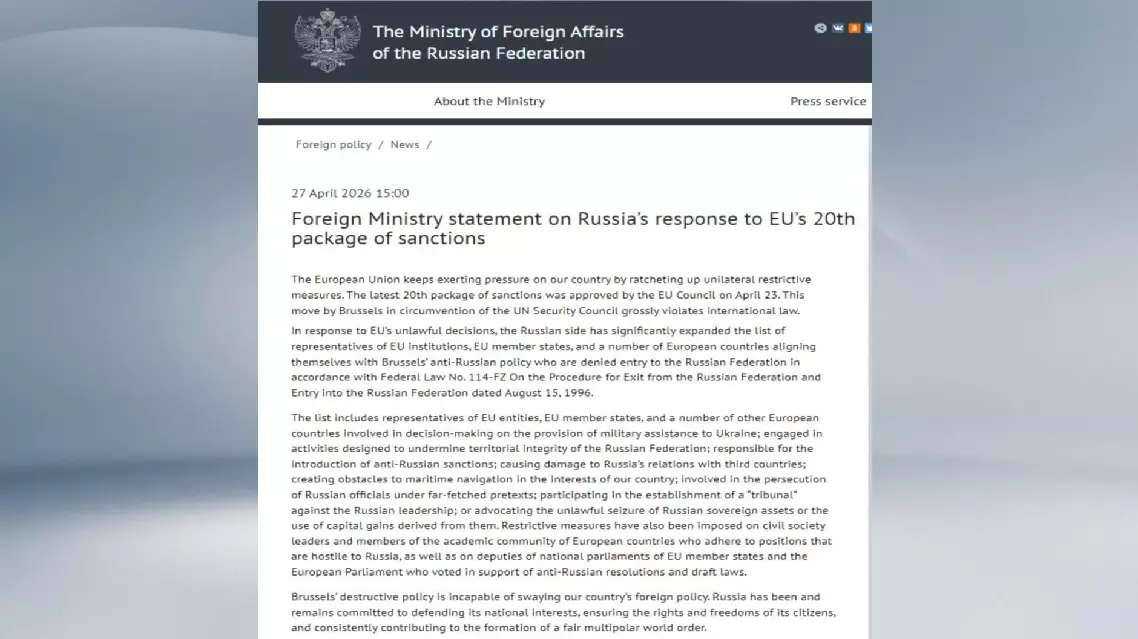
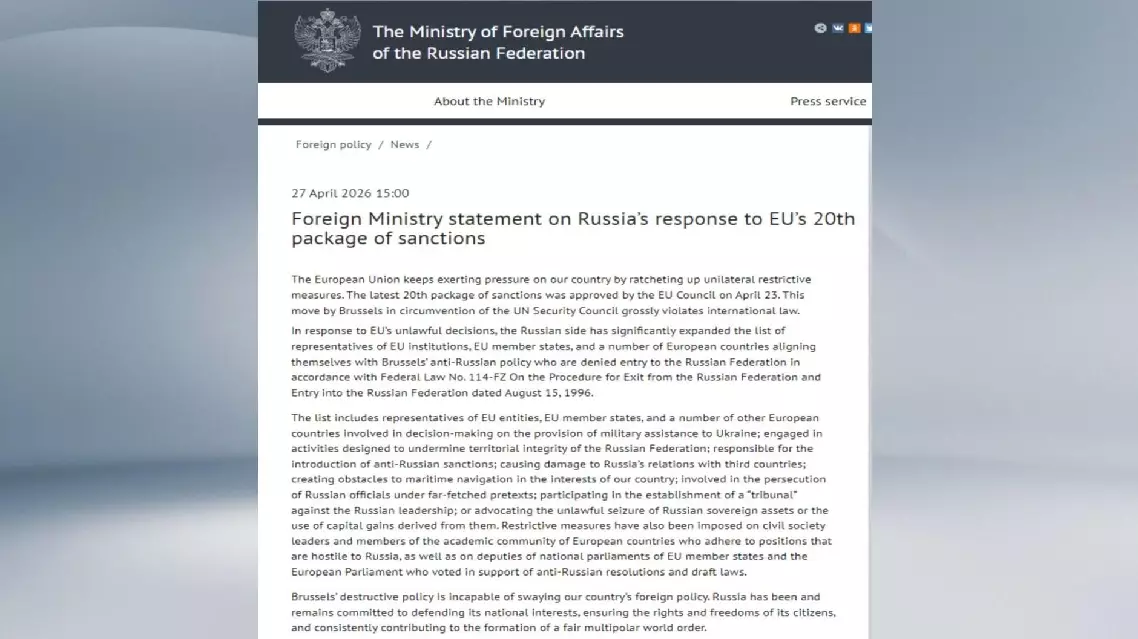
Russia has largely expanded the blacklist of European Union (EU) officials banned from entering the country in response to Brussels' 20th sanctions package against Moscow, the Russian Foreign Ministry said on Monday.
The EU continues its attempts to pressure Russia by scaling up unilateral restrictive measures, the ministry said in a statement, adding that Brussels' destructive actions grossly violate the norms of international law.
"We have also imposed restrictive measures against civil society activists and academics in European countries who hold hostile positions toward Russia, as well as members of national parliaments of EU member states and the European Parliament who voted in favor of anti-Russian resolutions and bills," said the statement.
Russia has also barred entry to representatives of European institutions and EU member states involved in decisions on providing military aid to Ukraine, it added.
European Council President Antonio Costa said on Thursday that the EU has approved a 90-billion-euro loan package for Ukraine, along with a 20th round of sanctions against Russia.
Russia expands blacklist of EU members in response to latest sanctions
Russia expands blacklist of EU members in response to latest sanctions
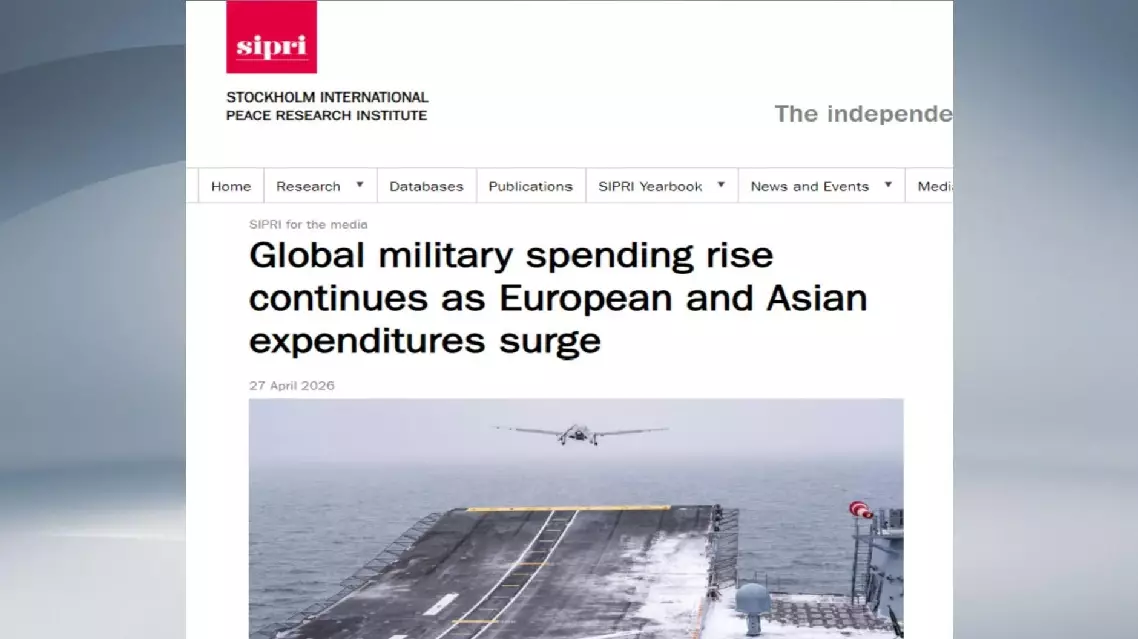
Global military expenditure rose to a record 2.89 trillion U.S. dollars in 2025, marking the 11th consecutive year of growth, according to a report released by the Stockholm International Peace Research Institute (SIPRI) on Monday.
The global military burden, or military expenditure as a share of gross domestic product (GDP), rose to 2.5 percent in 2025, the highest level since 2009, SIPRI said.
Military spending increased by 2.9 percent in real terms from 2024, a sharp slowdown, however, from the 9.7 percent rise recorded the previous year.
Global military spending rose again in 2025 as states responded to another year of wars, uncertainty and geopolitical upheaval with large-scale armament drives, said a researcher with SIPRI's Military Expenditure and Arms Production Programme.
The United States remained the world's largest military spender, though its expenditure fell by 7.5 percent to 954 billion dollars in 2025. SIPRI said the decline was mainly because no new financial military assistance for Ukraine was approved during the year, in contrast to the previous three years.
SIPRI said the decline in U.S. military spending was likely to be short-lived. The director of SIPRI's Military Expenditure and Arms Production Programme said spending approved by the U.S. Congress for 2026 had risen to more than one trillion dollars and could climb further to 1.5 trillion dollars in 2027 if U.S. President Donald Trump's latest budget proposal is accepted.
Europe was the main contributor to the global increase in 2025. Military spending in the region rose by 14 percent to 864 billion dollars.
The 29 European members of the North Atlantic Treaty Organization (NATO) spent a combined 559 billion dollars in 2025. Of them, 22 had military spending of at least two percent of GDP, according to SIPRI's methodology.
Military spending by European NATO members rose faster in 2025 than at any time since 1953, reflecting European efforts to strengthen self-reliance and growing U.S. pressure for greater burden-sharing within the alliance, SIPRI said.
In the Middle East, military expenditure reached an estimated 218 billion dollars in 2025, almost unchanged from 2024. SIPRI said regional spending remained stable despite ongoing conflicts and rivalries.
In Asia and Oceania, Japan's military expenditure rose by 9.7 percent to 62.2 billion dollars, equivalent to 1.4 percent of GDP, its highest share since 1958.
SIPRI said military expenditure covers government spending on current military forces and activities, including personnel, operations, arms and equipment purchases, military construction, research and development, and central administration.
Global military spending hits record high in 2025: report