China's Ministry of Education has introduced 38 new majors to advanced education institutions in response to the evolving needs of national strategies and the pursuit of high-quality development.
The ministry on Tuesday announced updates to the catalog of undergraduate majors in general colleges and universities, adding majors such as rare earth science and engineering, and deep earth science and engineering.
To support the optimization and upgrading of traditional industries, new majors such as traffic-energy integration engineering and agricultural robotics have been included. To promote the innovation and development of emerging industries and future industries, majors such as biomanufacturing, embodied intelligence, and brain-computer science and technology have been introduced. To focus on creating new forms of an intelligent economy, majors such as digital trade and digital finance have been added. To enhance the capacity and quality of the service sector, majors such as digital culture and tourism and business artificial intelligence have been launched.
"The new major is named 'Rare Earth Science and Engineering,' and it is also the first rare earth major based on the entire industrial chain in the world. Through systematic and professional undergraduate education, we hope to cultivate interdisciplinary and comprehensive outstanding technical talents," said Li Chaozhong, dean of the College of Rare Earths at Jiangxi University of Science and Technology.
Beijing International Studies University (BISU) has launched a new major that combines culture and tourism with digital intelligence.
"The digital culture and tourism responds to the trend of digital and intelligent transformation in the culture and tourism industry. It addresses the industry's demands in areas such as AI-driven transformation, cultural and tourism product design, and online platform operations. The program aims to cultivate versatile professionals equipped with the mindset of 'creativity plus scene' and 'AI plus culture and tourism,'" said Lyu Ning, dean of the School of Tourism Sciences of BISU.
To date, the catalog of undergraduate majors in general colleges and universities includes 883 majors in 13 fields of study.

China adds 38 new majors to higher education catalog

Anger and dismay is rising as a deadly spate of Israeli strikes in Lebanon have expanded beyond border villages and into areas that ordinary residents believed were outside the danger zone, while a ceasefire agreement appears not to be holding.
Despite the two sides agreeing on Thursday to a three-week extension of an original 10-day ceasefire deal which began in mid-April, Lebanon's health ministry reported that 14 people had been killed on Sunday by Israeli strikes on the south of the country.
Controversy has also risen over the Israeli military's efforts to extend the territories it occupies in southern Lebanon as part of what it terms as 'security buffer zone' along the border.
Lebanese residents have been warned against returning to their homes within this area, with Israel announcing that anyone who approaches this so-called "Yellow Line" will be considered a threat.
The buffer zone reaches north of key cities and towns including Bint Jbeil, Aita al-Shaab, and Khiam, and extends to the Litani River in some sectors, encompassing multiple villages and ridge lines.
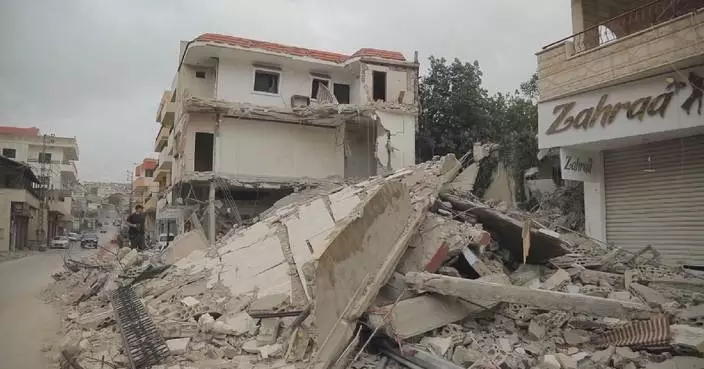
In Nabatieh, the road north of the Litani is lined with shattered concrete, burned out cars, and building facades which have left exposed after being blasted open. Residents say this was meant to be outside the danger zone -- beyond the so-called "Yellow Line" -- but the strikes have reached there too.
Mohammad Chbib, a local resident, walks through the ruins of what families once called home, a place he says was filled with apartments housing civilians, not Hezbollah fighters.
"Here, there was a building. A six-floor building with 12 apartments. They brought it down on the women, the children, and the people. It was supposed to be safe," he said as he showed the scale of the damage.
Israel has issued warnings and carried out strikes in towns north of the Litani, while also expanding its campaign eastward into the Bekaa Valley and areas close to Lebanon's border with Syria.
Though Israel says it is targeting Hezbollah infrastructure, local officials say civilian areas are being continually hit as the ceasefire has failed to stop the violence.
"The commercial center in the city of Nabatieh is not a center affiliated with the resistance. The municipality of Nabatieh is a municipality affiliated with the Lebanese state," said Abbas Fakher Eldeen, mayor of the city of Nabatieh.
The mayor said the cost can be measured not only in destroyed markets and municipal buildings, but in the lives lost on the streets.
"Inside the city of Nabatieh, three citizens from this area were martyred -- three civilians -- in a drone strike on their car inside Nabatieh," the mayor said.
On Monday, Israel's military said it had begun striking Hezbollah infrastructure in the eastern Bekaa Valley, while security sources reported strikes near Nabi Chit, close to the Syrian border.
Anger grows after Lebanese civilians killed as Israeli attacks go beyond "Yellow Line"