SINGAPORE--(BUSINESS WIRE)--Apr 28, 2026--
KAYTUS, a leading provider in AI infrastructure and liquid-cooling solutions, announced that its AI Compute Pod has received both the 2026 iF Design Award and Red Dot Award. This dual recognition not only stems from its outstanding performance in green, low-energy operation—achieving up to 130 kW cooling capacity per rack and a PUE as low as 1.1 through optimized thermal and power design—but also from its innovative approach to intelligent control and efficient O&M. The solution enables second-level synchronization between cooling and IT workloads, and leverages a dual-group control strategy to improve cooling energy efficiency by over 10%.
This press release features multimedia. View the full release here: https://www.businesswire.com/news/home/20260428825343/en/
Jury panels from both awards highlighted the AI Compute Pod's excellence in miniaturization, modularity, and intelligence, recognizing its ability to deliver superior computing density and energy efficiency. Its innovations spanning enclosed airflow management, AI-driven thermal control, and modular scalability earned consistent acclaim across two of the world's most competitive design stages.
Both the iF Design Award and red dot award are widely recognized as the “Oscars of Design” and are two of the world’s most prestigious and enduring design competitions that have long served as global benchmarks for design excellence. This year’s iF Award alone drew 10,003 submissions from 68 countries were reviewed by a panel of 129 international design experts, with an acceptance rate of only 0.75%. Earning both accolades simultaneously, the KAYTUS AI Compute Pod emerged as a standout among leading global entries.
With demand for high-density computing accelerating across AI training, large-scale computing, high-performance computing, and scientific research, traditional data centers are under growing pressure from lengthy deployment timelines, limited space efficiency, and rising energy consumption.
Purpose-built for high-density computing applications, the KAYTUS AI Compute Pod seamlessly integrates design excellence, operational efficiency, and sustainability, establishing a new benchmark for next-generation AI datacenters.
Design Aesthetics Meet Modular Flexibility and Efficiency
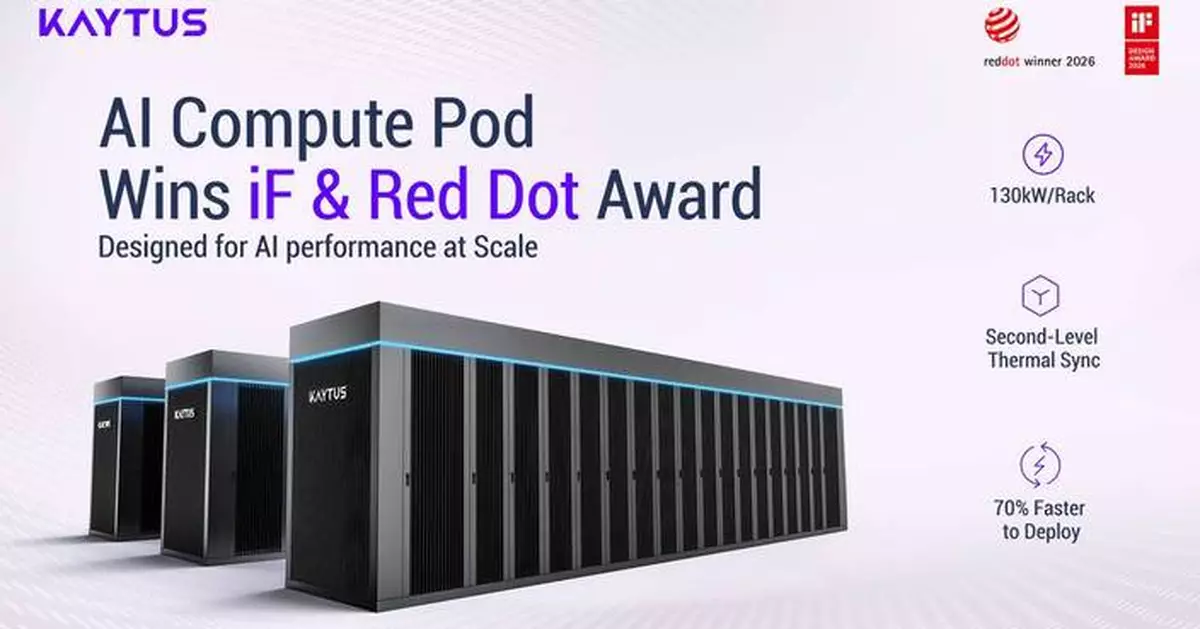
Guided by modern industrial design principles, the AI Compute Pod features a linear modular rack architecture that combines visual elegance with deployment flexibility. Standardized cabinet dimensions and end panels create a clean, cohesive appearance, while the design’s simple yet robust structure enables seamless stacking and scalable expansion. By concealing high-density computing hardware behind refined lines, it projects a calm, efficient, and distinctly technology-forward visual appeal.
Modular Delivery: 70% Faster Deployment, Faster Time-to-Value
While its visual design reflects a strong emphasis on aesthetics, the true foundation of the AI Compute Pod lies in its modular architecture. Its highly integrated design supports on-demand horizontal scaling of compute, storage, and networking resources, delivering both flexibility and efficiency for evolving workload requirements.
Featuring factory-integrated hot- and cold-aisle containment and an engineering-free installation approach, the AI Compute Pod helps users avoid the complex on-site construction requirements common to traditional air-cooled data centers. By unifying AI servers and data center infrastructure into a single turnkey solution, it shortens deployment time by 70%, allowing AI datacenters to become operational within one month and substantially accelerating time-to-value for AI model training and real-world applications.
Green Design: 30% Lower Power Loss and PUE as Low as 1.1
Sustainability is integral to every aspect of the AI Compute Pod’s design. Engineered with an optimized thermal architecture for high-density workloads, the solution delivers:
The solution further features an optimized power architecture designed to support megawatt-level power delivery. By streamlining traditional power distribution through a simplified full-power short-path design and an integrated high-efficiency UPS, it ensures that power reaches load through the most direct path, reducing data center footprint by as much as 60%.
The deep integration of UPS and power distribution components further streamlines internal electrical connections, reducing power loss by more than 30% and enhancing overall energy efficiency.
Intelligent Management: Precision Control for Every Watt
KAYTUS AI Compute Pod embeds advanced intelligence at the core of its design. Its dual-group air-conditioning control strategy, enabled by nested algorithms, helps prevent localized hotspots while improving cooling system efficiency by more than 10%. A unified DCIM platform delivers centralized management through a single interface, offering both 2D and 3D visualization of high-density micro-modules as well as remote control of key cooling components. The intelligent cooling system further synchronizes cooling the output with IT load in real time within seconds, eliminating the 5–10 minute response lag typical of conventional systems. Leveraging AI-based modeling, the platform can forecast thermal load trends up to one minute in advance and adjust cooling output 12–48 seconds ahead of demand. After 1–2 weeks of continuous data optimization, PUE can be reduced from 1.5 to 1.3.
Beyond industry recognition, the AI Compute Pod has achieved large-scale deployment across diverse sectors worldwide. In the financial and energy industries, 12 systems across 108 racks were installed within just 860 m²—delivering 9–10 times higher computing density than traditional data centers, a PUE consistently below 1.2, and annual electricity savings of approximately 4.5 GWh. In scientific research and advanced manufacturing, the solution powered a high-end equipment manufacturing laboratory from planning to commissioning in just four months, supporting compute-intensive workloads such as structural simulation and fluid dynamics analysis, with resource utilization consistently above 90%. These real-world results demonstrate the AI Compute Pod's maturity, rapid deployability, and proven reliability at global scale.
About KAYTUS
KAYTUS is a leading provider in AI infrastructure and liquid cooling solutions, delivering a diverse range of innovative, open, and eco-friendly products for cloud, AI, edge computing, and other emerging applications. With a customer-centric approach, KAYTUS is agile and responsive to user needs through its adaptable business model. Discover more at KAYTUS.com and follow us on LinkedIn and X
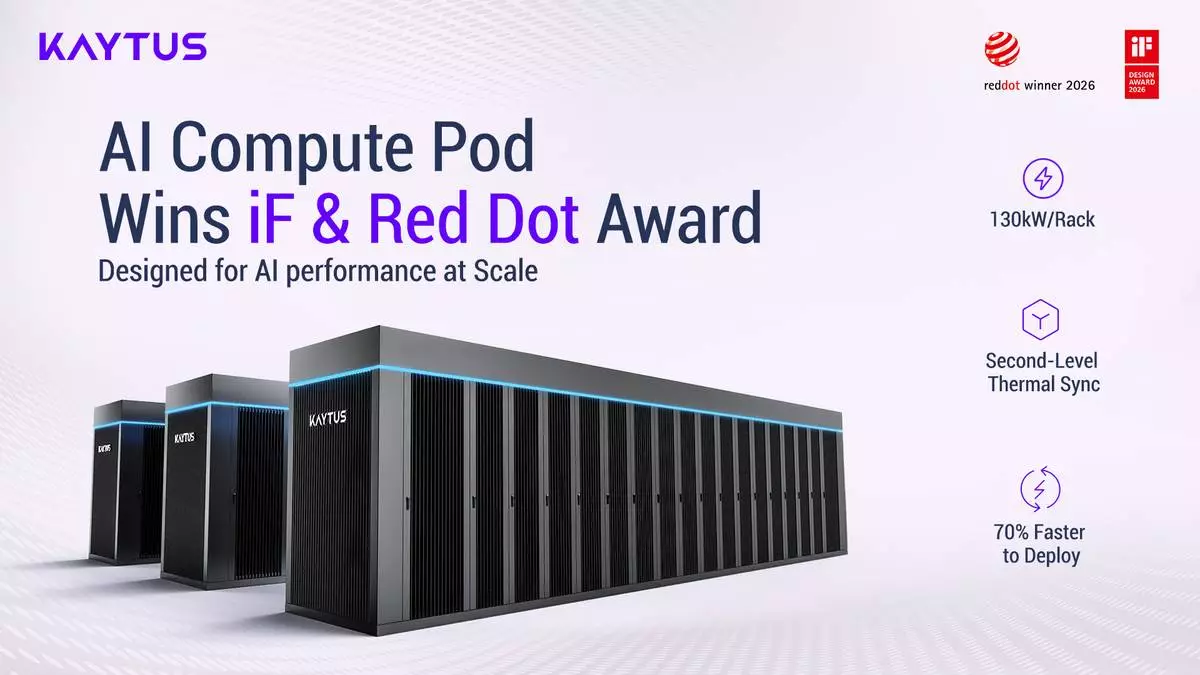
KAYTUS AI Compute Pod Wins 2026 iF Design Award and Red Dot Award, Setting a New Standard for AI Data Center