Skip to Content Facebook Feature Image

China labels accusations of "Chinese nuclear threat" as groundless, ill-intentioned at UN conference

China

China

China

China labels accusations of "Chinese nuclear threat" as groundless, ill-intentioned at UN conference

2026-04-28 16:41 Last Updated At:19:37

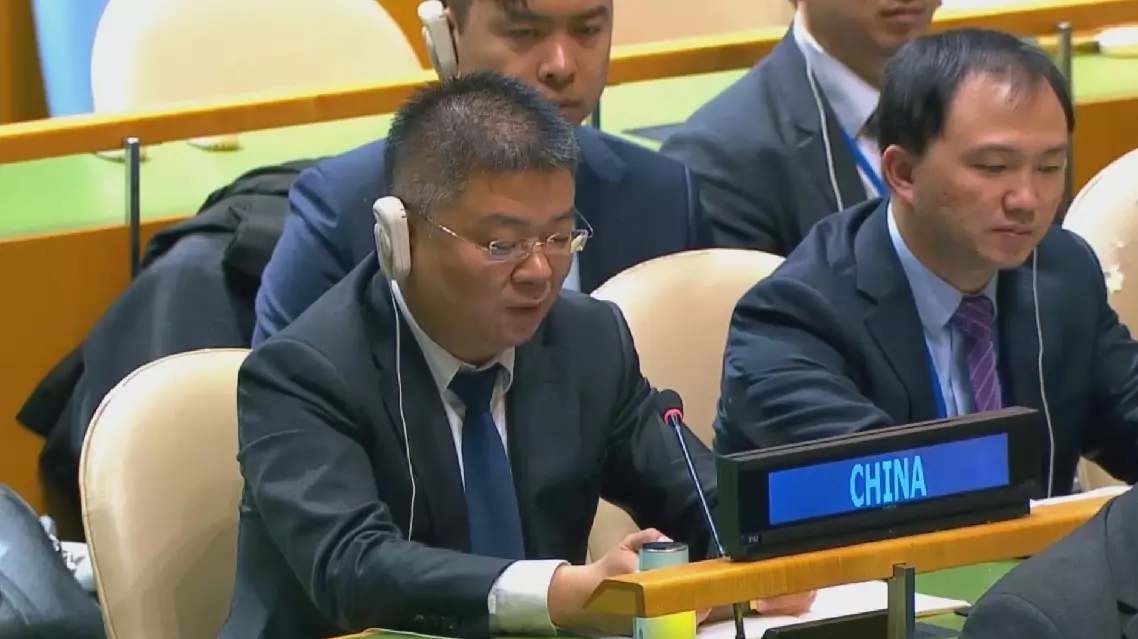
Labeling the accusations of a "Chinese nuclear threat" as groundless and ill-intentioned, a Chinese representative said on Monday at a UN conference that China has always followed a defensive nuclear strategy and exercised utmost restraint over nuclear buildup.

Xu Feng, counselor for the Disarmament Division at China's Permanent Mission to the United Nations, made the remarks at the 11th Review Conference of the Parties to the Non-Proliferation of Nuclear Weapons (NPT) which opened Monday at the United Nations Headquarters in New York and will run until May 22.

"China has always kept its nuclear forces at the minimum level required for national security, and has always shown extreme restraint in the size and development of its arsenal. It has never competed with other nuclear-armed states in investment, quantity, or scale. China has not done so in the past, nor will it ever engage in a nuclear arms race with any country in the future," Xu said.

"Some countries choose to turn a blind eye. They have deliberately hyped up the claim that China is pursuing a nuclear arms race and rapidly building up its arsenal, stoking fears of a so-called 'Chinese nuclear threat.' These accusations are completely unfounded and ill-intentioned," Xu said.

He also slammed certain countries for applying double standards on issues such as nuclear sharing, nuclear umbrellas, and extended deterrence, noting that such practices undermine the international nuclear disarmament process and the non-proliferation system.

The Treaty on the Non-Proliferation of Nuclear Weapons, commonly known as the Non-Proliferation Treaty or NPT, is a landmark international treaty whose objective is to prevent the spread of nuclear weapons and weapons technology, promote cooperation in the peaceful uses of nuclear energy and further the goal of achieving nuclear disarmament.

The treaty represents the only binding commitment in a multilateral treaty to the goal of disarmament by the nuclear-weapon states. Opened for signature in 1968, the treaty entered into force in 1970. On May 11, 1995, the treaty was extended indefinitely. A total of 191 states have joined the treaty, including the five nuclear-weapon states.
China labels accusations of "Chinese nuclear threat" as groundless, ill-intentioned at UN conference

China labels accusations of "Chinese nuclear threat" as groundless, ill-intentioned at UN conference
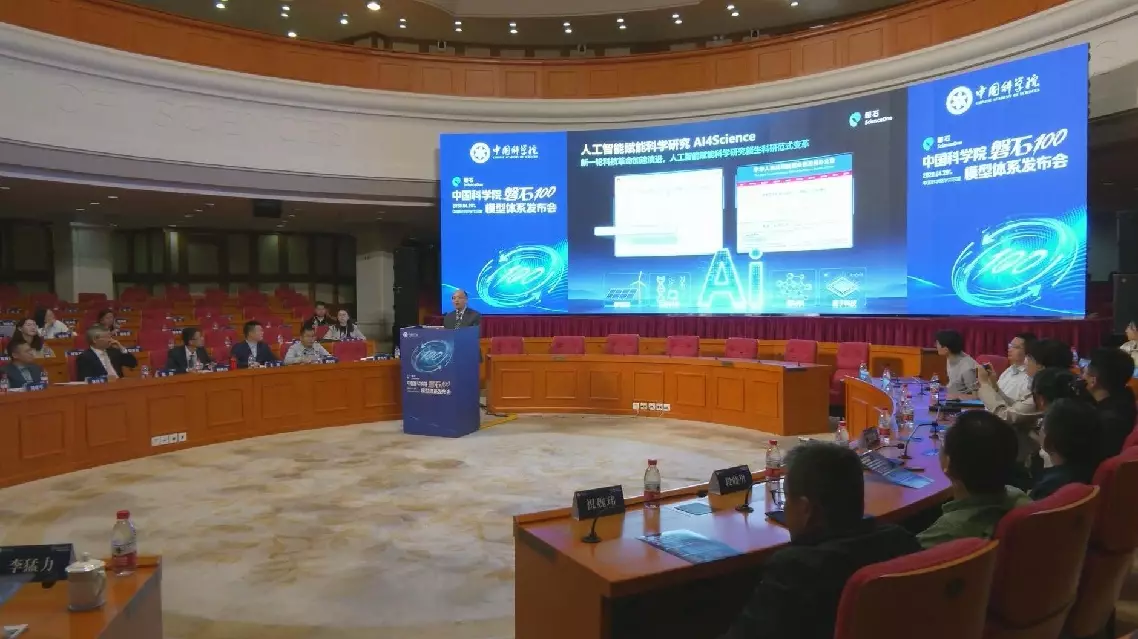
The Chinese Academy of Sciences (CAS) on Tuesday revealed an artificial intelligence (AI) model system supporting scientific research, empowering multiple scientific domains including mathematics, physics and biology.

This marks a transition in AI-driven scientific research from fragmented and isolated exploration toward collaborative, efficient and platform-based innovation.

Named ScienceOne 100, the model system has been built on the basis of the scientific foundation model ScienceOne, with a cluster of multidisciplinary domain-specific large models.

ScienceOne provides three core functions: literature compass, innovation evaluation and agent factory, empowering the entire research and innovation workflow.

ScienceOne was released in 2025 and trained on professional scientific corpus and data. Its latest version has achieved flagship-level performance for scientific knowledge and agentic long-horizon reasoning, and has attained state-of-the-art results in terms of multiple benchmarks related to scientific image understanding and manipulation.

The model system currently comprises eight domain-specific large models, covering mathematics, physics, materials science, astronomy, environmental science, aerospace, geosciences and biology.

Zeng Dajun, deputy director of the Institute of Automation at CAS, cited the system's application in materials design as an example.

"In the design of various materials, catalyst design is a critical step. In the past, developing a new catalyst was highly time-consuming, requiring extensive literature review and numerous experiments. Now, with the ScienceOne 100 model system, research efficiency can be boosted by dozens of times," said Zeng.

The system has already been deployed and applied across over 50 CAS institutes, covering more than 100 research scenarios.

It has demonstrated tremendous potential in typical applications such as high-speed rail flow field reconstruction, spectral identification, materials discovery, adjuvant design, astronomical observation, Qinghai-Tibet Plateau scientific expedition, marine forecasting and ecological research.

Chinese Academy of Sciences unveils AI model system for scientific research

Chinese Academy of Sciences unveils AI model system for scientific research

Recommended Articles