The 9th Digital China Summit opened on Wednesday in Fuzhou City, east China's Fujian Province, with more than 120 outcomes in building a "Digital China" expected to be released during the event.
The summit, themed on accelerating innovation in digital technologies and deepening the building of Digital China, is jointly hosted by the National Development and Reform Commission (NRDC), the National Data Administration (NDA), the Cyberspace Administration of China (CAC), the Ministry of Industry and Information Technology (MIIT) and the Fujian provincial government.
It runs from April 29 to 30, with an extended exhibition period from April 28 to May 4.
The opening ceremony and main forum were held Wednesday, with landmark reports and phased updates on advancing the Digital China Initiative set to be released during the event, including the Digital China Development Report (2025), the Digital China development index and the National Data Resources Survey Report (2025).
"As for this year's summit, we put greater emphasis on the concept of serving enterprises and promoting development as the organizing principle. Among the 24,000 registered guests so far, 75 percent are from enterprises. Of the over 50 sub-forums and dialogue events, 28 are hosted by enterprises. There are over 400 exhibitors in the on-site experience area, of which more than 320 are enterprises, accounting for more than 80 percent. More than 120 achievements are expected to be released during the summit. We will strive to present a wonderful digital event," said Gao Bo, a spokesman for the NDA.
The on-site experience area features five core sections including an AI-driven innovation zone. With over 100 immersive interactive projects, the exhibition showcases the latest application scenarios of data elements across sectors such as industry and people’s wellbeing.
China's 15th Five-Year Plan (2026-2030) highlights the construction of Digital China as a key priority and places greater emphasis on the integration of digital technologies with AI than the 14th Five-Year Plan.
In the coming five years, efforts will be made to harness data and digital-intelligent technologies to propel the transformation and upgrading of traditional industries and cultivate emerging and future industries.

Digital China Summit opens in Fuzhou with over 120 outcomes expected

Digital China Summit opens in Fuzhou with over 120 outcomes expected
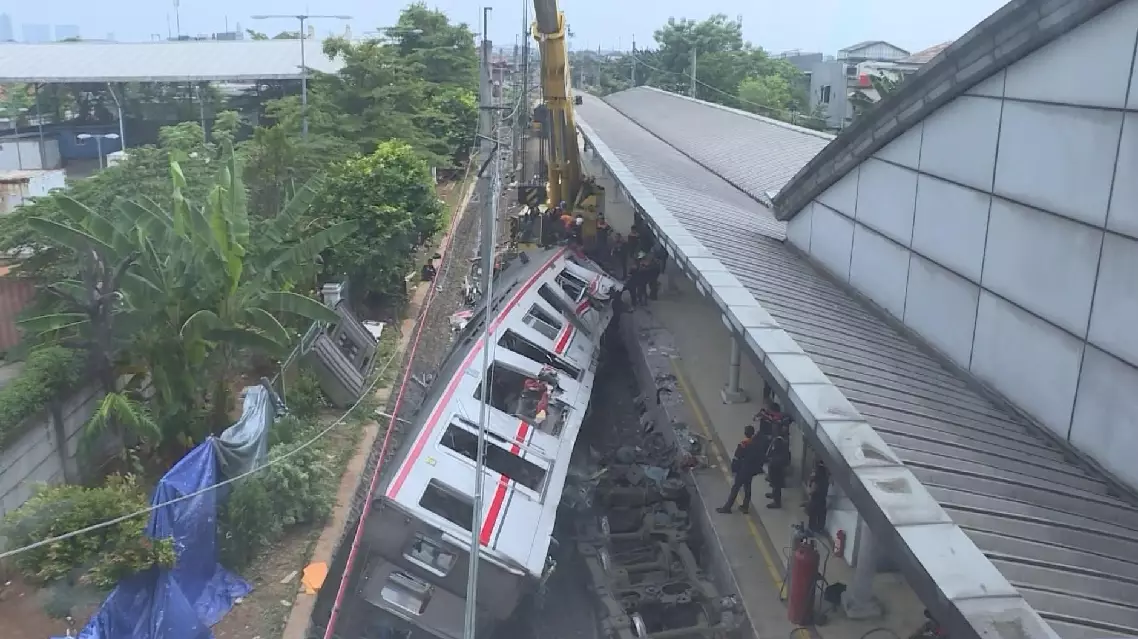
Rescue and recovery work is ongoing at the site of a deadly train collision at a station on the outskirts of the Indonesian capital Jakarta which has killed at least 15 people and left dozens injured, while the search for potential survivors trapped in the wreckage continues.
The incident unfolded at around 20:50 local time on Monday when a commuter train on the Jakarta-Bekasi route hit an electric taxi and came to a halt. Minutes later, a long-distance express train traveling from Jakarta to Surabaya crashed into the stationary commuter train from behind. The rear carriage, designated for women only, bore the full force of the impact.
One anxious mother, Fitria Yunis, said she had been waiting at a hospital overnight following the crash. Her daughter, who was on board the commuter train, suffered serious injuries and is receiving treatment in the ICU.
"My daughter didn't realize at first that a train had hit a taxi. She was on her phone. When the second crash happened and the train collided, she was immediately thrown across the carriage. Her legs flew up in the air, and she became trapped between two metal poles. She screamed for help, and after several hours, they were able to evacuate her through a nearby window," she said.
Rescue teams have remained on-site since the collision and have been using heavy-duty equipment to reach victims who who are trapped inside the damaged carriages. Officials say the scale of destruction has made the operation slow and highly challenging.
Indonesian President Prabowo Subianto visited survivors at a hospital in Bekasi on Tuesday morning, extending condolences on behalf of the government and promising a swift investigation.
Agus Yudhoyono, Coordinating Minister for Infrastructure and Regional Development of Indonesia, gave an update from the site of the tragic incident.
"Right now we are in the second stage: the recovery process. We aim to have the damaged carriages lifted from the tracks. We will continue to evaluate the technical and operational side of this accident. We are aware that having a rail network that overlaps with our road and land transport is challenging, but we will investigate this further to find out what steps are needed to prevent a similar incident from happening," he said.
The accident has disrupted services across Jakarta's commuter rail network, which carries nearly one million passengers daily, affecting hundreds of thousands of commuters who rely on the trains for their daily journeys.
An investigation into the cause of the incident is being conducted by the rail operator and the National Transportation Safety Committee.
Death toll rises in Indonesian train collision as rescue, recovery work continues