LOUISVILLE, Ky. (AP) — Silent Tactic is out of the Kentucky Derby because of a foot injury, trainer Mark Casse said Wednesday, the first change to the field of 20 horses for the first leg of the Triple Crown.
Silent Tactic opened at odds of 13-1 on the morning line. His exit means Great White is in.
Click to Gallery
Kentucky Derby alternate Great White works out at Churchill Downs Monday, April 27, 2026, in Louisville, Ky. (AP Photo/Charlie Riedel)
Kentucky Derby entrant Silent Tactic works out at Churchill Downs Tuesday, April 28, 2026, in Louisville, Ky. (AP Photo/Charlie Riedel)
Kentucky Derby alternate Great White gets a bath after a workout at Churchill Downs Tuesday, April 28, 2026, in Louisville, Ky. (AP Photo/Charlie Riedel)
Kentucky Derby entrant Silent Tactic works out at Churchill Downs Tuesday, April 28, 2026, in Louisville, Ky. (AP Photo/Charlie Riedel)
“You can’t run in the Kentucky Derby and not be 100%,” Casse said at his barn at Churchill Downs. “It’s very, very slight. It’s very slight, so that’s the good news. The timing’s poor, but it’s not a big deal and that’s the most important thing.”
Casse compared the horse’s ailment to a fingernail separation, which is painful and enough to lead to him and owner John Oxley to make the decision to scratch Silent Tactic more than 72 hours before the race.
"It wasn’t a tough decision," Casse said. “It’s not tough because we’re always going to try to do what we feel is best for the horse, Mr. Oxley and our entire group.”
The most difficult part for Casse is this means jockey Cristian Torres will have to wait to ride in the Kentucky Derby for the first time. Casse said the call to skip the Derby was made early to allow preparations to begin to run Silent Tactic in the Preakness Stakes at Laurel Park on May 16.
“Today we start preparing for the Preakness,” Casse said. “And the quicker we made the decision — we could’ve held on for another day or two — but then it would slow down our chances of getting to the Preakness.”
The timing is beneficial for those around Great White, who was first on the also-entered list and was initially set as a 50-1 long shot.
"We’re just delighted to have confirmation that we did get in and we draw in so early," trainer John Ennis told The Associated Press. “It’s only Wednesday, so everybody’s thrilled and over the moon.”
The big, and still growing, gray colt is coming off a fifth-place finish in the Blue Grass Stakes on April 4.
“He didn’t need to be on the lead,” Ennis said. “We kind of thought he’d run big in the Blue Grass, and he kind of disappointed. He was flat the week prior, of the Blue Grass. He was kind of quiet himself and lacking in energy.”
It has been an uncertain week for Ennis and his stable, not knowing if Great White would get to the starting gate on Saturday.
“It can be tough mentally in your mind to straighten things out and get things squared away,” Ennis said. “It's not easy when you’re kind of sitting on the fence like that.”
Jockey Alex Achard will make his Kentucky Derby debut aboard Great White, who by all accounts is doing well.
“The horse is fit and healthy and strong,” Ennis said. “Yes, he has to improve, but it’s the Kentucky Derby and if you’re not in, you can’t win.”
AP horse racing: https://apnews.com/hub/horse-racing

Kentucky Derby alternate Great White works out at Churchill Downs Monday, April 27, 2026, in Louisville, Ky. (AP Photo/Charlie Riedel)

Kentucky Derby entrant Silent Tactic works out at Churchill Downs Tuesday, April 28, 2026, in Louisville, Ky. (AP Photo/Charlie Riedel)

Kentucky Derby alternate Great White gets a bath after a workout at Churchill Downs Tuesday, April 28, 2026, in Louisville, Ky. (AP Photo/Charlie Riedel)

Kentucky Derby entrant Silent Tactic works out at Churchill Downs Tuesday, April 28, 2026, in Louisville, Ky. (AP Photo/Charlie Riedel)
WASHINGTON (AP) — The Supreme Court will weigh arguments Wednesday over the Trump administration’s push to end legal protections for Haitians and Syrians as migrants fleeing war and natural disaster.
Haitians and Syrians were among those from 17 countries with Temporary Protected Status, which allows migrants already in the U.S. to stay with work permits in 18-month increments, so long as the Secretary of the Department of Homeland Security deems their country of origin unsafe for return.
Since President Donald Trump ’s second term began, Homeland Security has ended the protections for 13 countries, exposing their migrants to potential deportation.
The case focuses on whether the administration properly weighed conditions in Haiti and Syria when it ended TPS and if it prejudiced non-white immigrants.
Here's the latest:
Justice Amy Coney Barrett jumps in with a question about constitutional claims the migrants have made, which include the argument that race played a role in the decision to end the protections.
She’s another key member of the conservative majority, and one with a personal connection to Haiti. Two of her seven children were adopted from the country.
The Trump administration has denied racial animus played a role in the decision, and Sauer argued the plaintiffs’ constitutional claims are “not a close call.”
The three liberal-leaning justices, Sonia Sotomayor, Elena Kagan and Ketanji Brown Jackson, are grilling Sauer on his main argument.
Their focus: Even if judges can’t question the decision to terminate legal protections, why can’t they weigh arguments about whether Homeland Security followed the steps Congress laid out in the law?
Justice Elena Kagan is struggling with some voice issues.
She was questioning Sauer, stopped to cough, and then apologized.
Still struggling as she questioned Sauer further, she then joked that “the likelihood of me asking a follow-up is very diminished.”
That sparked some laughter in the court.
Sauer mentioned in his opening statement that when the secretary issued her TPS decisions the fact that her decisions were consistent was a “virtue and not a vice.”
That seemed to be in reference to criticism by immigration advocates that former DHS Secretary Kristi Noem wasn’t doing a substantive consultation with the State Department when it comes to assessing country conditions and deciding whether it was safe enough for them to return home.
Chief Justice John Roberts questions whether Sauer is seeking a “significant expansion” of the court’s ruling in Trump v. Hawaii, the case where the court upheld Trump’s travel ban for Muslim-majority countries during his first term.
Roberts holds a key vote on the court as both the chief and a member of the conservative majority who has voted against the administration in some cases, like the ruling that stuck down Trump’s tariffs.
Arguments have started in the TPS case.
The justices first released a number of opinions before launching into oral arguments in this key case.
First up is the federal government. Solicitor General D. John Sauer argues that the law doesn’t allow courts to block or delay Homeland Security decisions, or question any of the steps along the way.
The Supreme Court struck down Louisiana’s second majority Black congressional district in a decision that could open the door for Republican-led states to eliminate Black and Latino electoral districts that tend to favor Democrats and affect the balance of power in Congress.
The court’s conservative majority found that the district, represented by Democrat Cleo Fields, relied too heavily on race. Chief Justice John Roberts had described the district as a “snake” that stretches more than 200 miles (320 kilometers) to link parts of the Shreveport, Alexandria, Lafayette and Baton Rouge areas.
The decision weakens a landmark voting rights law’s protections against discrimination in redistricting. It’s unclear how much is left of the provision, known as Section 2, the main way to challenge racially discriminatory election practices.
The court is releasing several opinions on previous cases before getting into the TPS-related arguments.
In the first opinion, The court sided with a faith-based pregnancy center that raised First Amendment concerns about an investigation into whether it misled people to discourage abortions.
The high court’s unanimous ruling is a procedural victory for First Choice Women’s Resource Centers, which is challenging a New Jersey probe of its practices.
The conservative-majority court has given abortion opponents high-profile wins in recent years, most notably the watershed case that overturned the nationwide right to abortion in 2022. First Choice, though, had also drawn support from the American Civil Liberties Union, which supports abortion rights but backed the group’s First Amendment concerns.
The Supreme Court’s decision lets First Choice sue over the subpoena in federal court.
Dozens of immigrants who have been protected from deportation under a temporary status are beginning to gather in front of the Supreme Court to follow the arguments on the Trump administration’s attempt to end these protections for Haitians and Syrians.
The Supreme Court will weigh arguments at 10 a.m. The case has wider implications for more than 1.3 million people from 17 countries who have been living and working in the U.S., protected under TPS.
Immigrants and advocates outside the Supreme Court are demanding “equal justice under the law.”
TPS holders plan to offer their testimony. There are performances by musicians from TPS countries and by Los Jornaleros del Norte, a band from Los Angeles made up of current and former day laborers.
Solicitor General D. John Sauer, the government’s top Supreme Court attorney, will argue the case for the Trump administration.
Two lawyers will argue on the other side, since the court is considering the future of legal protections for people from two countries. Ahilan Arulanantham, a professor at the UCLA School of Law, will argue the Syrian case and attorney Geoffrey Pipoly will represent people from Haiti.
This lawsuit originally was directed at Kristi Noem, who was Trump’s first Homeland Security secretary.
But when she was fired, and Markwayne Mullin was sworn in as the new DHS secretary, he also got the honor of being the person named in all the lawsuits.
Lawsuits tend to follow the head of the agency or department so when those people change, the new secretary or agency head takes over the role of being named in all the lawsuits, even if they happened before he or she took office.
This even happens when administrations change. For example, advocates sued the first Trump administration over its efforts to terminate TPS, specifically naming his DHS Secretary Kirstjen Nielsen.
But by the time the case concluded six years later, it was Biden’s DHS Secretary Alejandro Mayorkas who was named in the suit.
One of the key complaints by conservatives about TPS is that something that is supposed to be temporary essentially becomes permanent.
Republicans often point to TPS designations that are extended repeatedly, even after the reason for the original designation has long passed.
The TPS designation for El Salvador, for example, was first designated in 2001 following devastating earthquakes in the country.
But immigration advocates say there’s no time limit on TPS use, and the administration is trying to send people back to countries still in turmoil.
The United Nations High Commissioner for Refugees, also known as the UN Refugee Agency, says that Syria’s operational contexts reflect a dual dynamic of large-scale returns and persistent humanitarian needs.
As of March 2026, 15.6 million Syrians required assistance, while over 1.5 million refugees and 1.8 million internally displaced persons (IDPs) have returned since December 2024, according to the agency.
“Internal displacement remains high (5.5 million), underscoring that returns are occurring within a still-fragile system with strained absorption capacity,” said the UN agency in a report.
Haiti has not had a president since Jovenel Moïse was killed in July 2021 at his private residence.
The government hopes to hold the first round of elections by year’s end, but experts say that’s unlikely given the surge in gang violence.
A recent assessment from the International Rescue Committee (IRC) assessment reveals “grave protection risks and rapidly shrinking access to public services” for civilians in Haiti, as the country faces one of the worst humanitarian crises in the world.
The report notes that conditions could deteriorate further as political instability and violence and clashes between gangs and security forces continue.
“Millions of people in Haiti continue to face a compounding crisis of food insecurity, forced displacement, deadly disease outbreaks, and surging violence,” said Alice Ribes, emergency country director for the IRC in Haiti. “Public services in many areas have collapsed under gang rule, leaving people with limited or no access to clean drinking water, food, medical care, and education.”
On April 16, in a rare bipartisan moment, the House passed legislation that would extend TPS for Haitians.
The bill, pushed forward by House Democrats with a group of Republicans over the objections of the GOP leadership, would require a three-year extension of temporary protected status for Haitians by the Trump administration. That would allow hundreds of thousands of qualifying immigrants to remain in the United States without fear of deportation.
But it faces uncertainty in the Senate, and President Trump would almost certainly seek to veto it.
Democratic Senator Edward J. Markey and Congresswoman Ayanna Pressley, both of Massachusetts, Senator Lisa Blunt Rochester, of Delaware, and Congresswoman Debbie Wasserman Schultz, of Florida, asked the Supreme Court on Tuesday to reject the administrations attempts to terminate TPS.
They were joined by a coalition of senior, workers and advocates from the American Business Immigration Coalition, and the National Domestic Workers Alliance, among other organizations.
“TPS holders serve as a backbone for families and our economy—caring for our elders and loved ones through illness, strengthening our communities, and making innumerable contributions daily,” Pressley. “Our message to the Supreme Court today is simple: do your job, uphold the law, save lives, and protect our communities.”
The administration’s claims that TPS holders can safely return to their home countries, where conditions have changed since the protection was originally granted.
Advocates argue that safe conditions do not exist for people to return to their countries of origin. They point out that the government is engaging in a contradiction, given that the State Department warns U.S. citizens not to travel to Haiti or Syria due to violence, instability, and limited access to basic services.
“These terminations have come without credible evidence that conditions have improved,” said Krish O’Mara Vignarajah, president and Chief Executive Officer of Global Refuge, one of the largest faith-based nonprofit organizations serving refugees.
“The administration is essentially arguing two things at once: that these countries are too dangerous for American tourists, but safe enough to deport families to. Policy makers cannot credibly hold both positions at the same time,” Vignarajah said.
Immigrant advocates argue that the administration’s decision to end TPS is not based on conditions in the countries of origin. They contend that, on the contrary, it is part of a broader policy aimed at deporting not only those who entered the country illegally, but also hundreds of thousands of people who have been residing in the country legally.
“By trying to kill TPS, they are attacking people who are living and working here legally, paying fees and taxes, following all the rules,” said José Palma, coordinator at the National TPS Alliance. “They are de-documenting people… it’s cruel, arbitrary, pointless, needless, and wrong.”
Viles Dorsainvil, Co-Founder and Executive Director, Haitian Support Center, and a Haitian TPS holder, said “TPS provides dignity, stability, and hope... TPS represents more than protection. It represents the ability of families to stay together.”
Public Rights Project, a non-governmental that helps local governments with litigation, filed an amicus brief outlining the economic, workforce and public service impacts cities would face if TPS is revoked.
The brief was filed on April 13 on behalf of a coalition of 47 local governments, mayors and local leaders across the country urging the Court to preserve TPS.
The court has set aside 80 minutes for arguments, but it would be unsurprising if they last two hours or longer.
In the post-pandemic era, the other justices allow the 77-year-old Thomas, the longest-serving member of the court, to pose a question or two before the free-for-all begins. In a second round of questioning, the justices ask questions in order of seniority. Chief Justice John Roberts, whose center chair makes him the most senior, gets the first crack.
The justices have some business to take care of before arguments get going. They’ll issue a decision in at least one case that was argued during the fall or winter, and the justice who wrote the majority opinion in each case will read a summary from the bench. Then, the court will ceremonially swear in lawyers to the Supreme Court bar. Once that’s done, the livestream should begin.
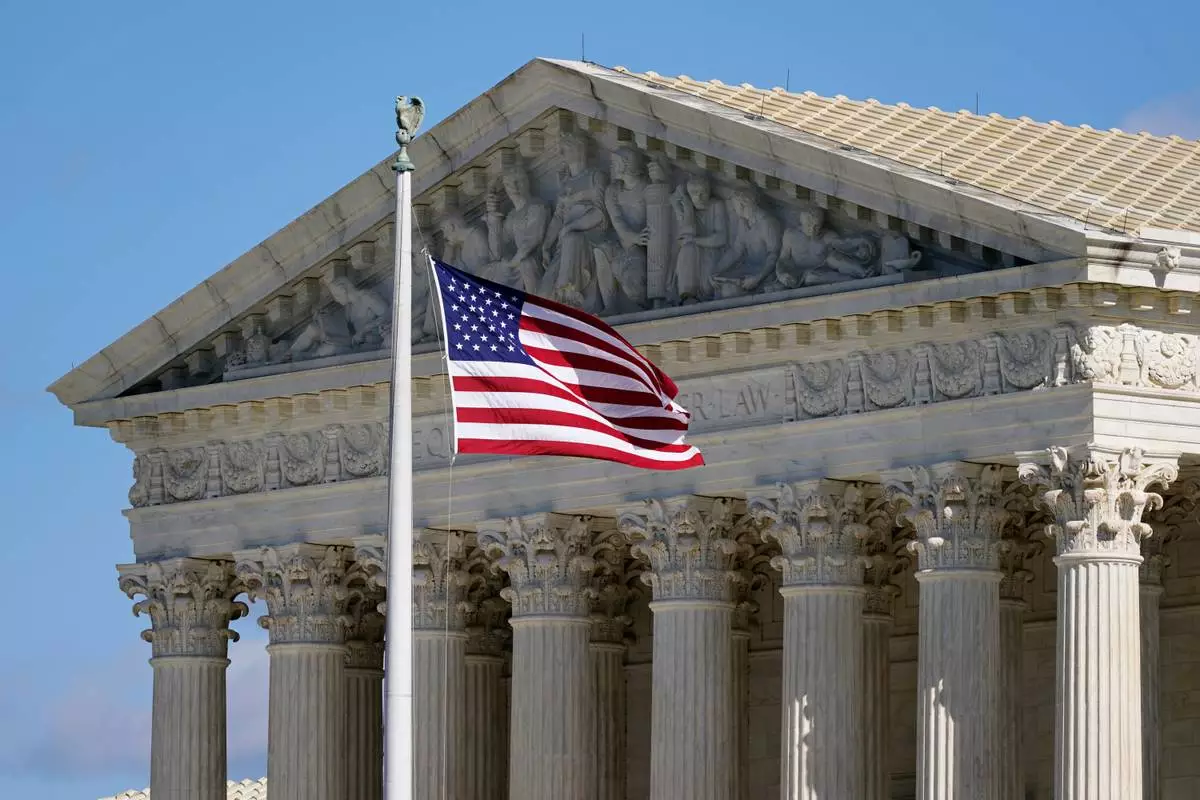
FILE - An American flag waves in front of the Supreme Court building on Capitol Hill in Washington, on Nov. 2, 2020. (AP Photo/Patrick Semansky, File)
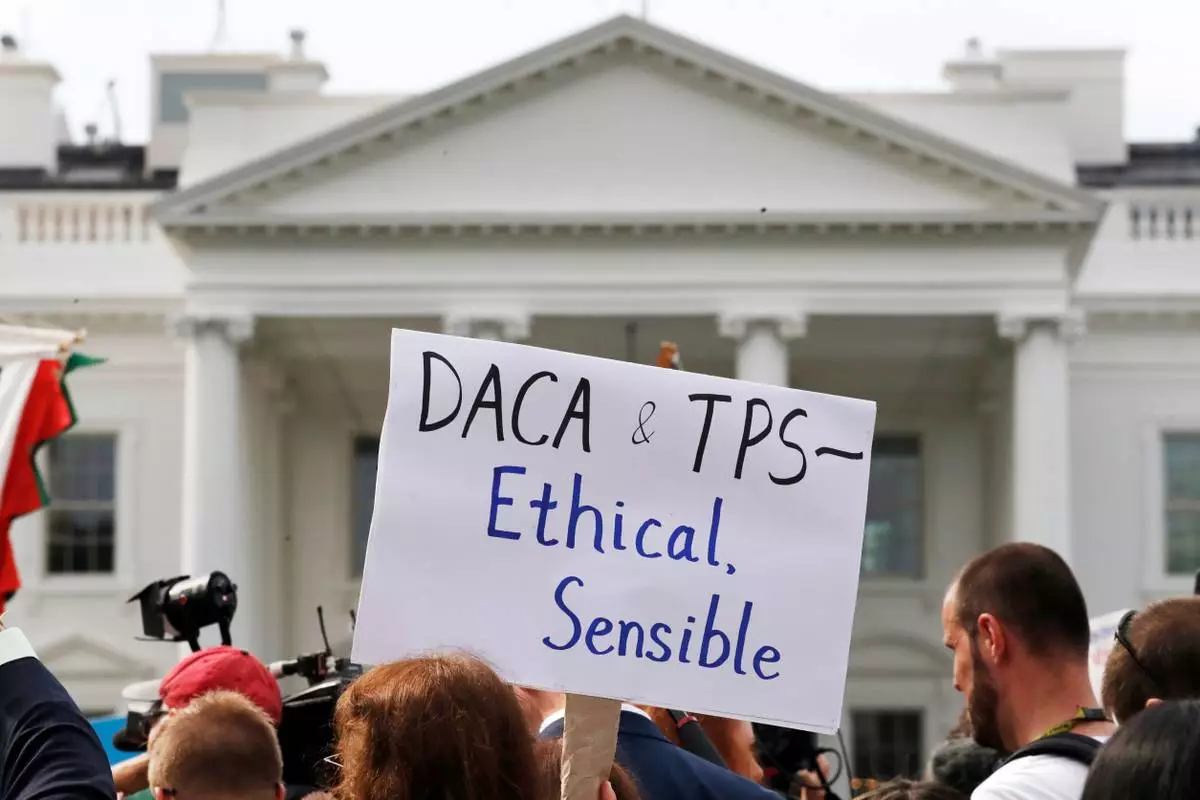
A person holds up a sign in support of the Deferred Action for Childhood Arrivals, known as DACA, and Temporary Protected Status programs during a rally in support of DACA and TPS outside of the White House, in Washington, Sept. 5, 2017. (AP Photo/Jacquelyn Martin, file)