SAN FRANCISCO--(BUSINESS WIRE)--May 1, 2026--
SoftBank Robotics Corp. today announced the U.S. debut of its autonomous cooking robots, “STEAMA” and “FLAMA,” developed based on its FOOD DX expertise cultivated in Japan. The robots will be showcased at the National Restaurant Association Show 2026, one of the largest foodservice industry trade shows, taking place in Chicago from May 16 to 19, 2026.
This press release features multimedia. View the full release here: https://www.businesswire.com/news/home/20260501411759/en/
This exhibition is part of SoftBank Robotics’ global expansion strategy in the FOOD DX domain and represents an initiative aimed at advancing next-generation foodservice operations in the U.S. market.
STEAMA is a steam-based cooking robot that uses high-pressure, high-temperature steam to prepare frozen noodle dishes in about 90 seconds. Designed for simple, one-touch operation, it recreates the smooth, springy texture of freshly boiled noodles, along with the rich aroma of soup and ingredients. By heating noodles and ingredients evenly with steam, STEAMA helps operators serve hot, freshly prepared, high-quality noodle dishes with consistency and ease.
FLAMA is a food-service cooking robot that automates the entire process—from adding ingredients and seasonings to stir-frying, mixing, thickening, plating, and post-cooking cleaning. By integrating with the recipe management software “SyncKitchen,” it enables synchronization of recipes from renowned chefs and popular restaurants, making it possible to consistently reproduce and serve them anywhere.
The foodservice, ready-meal, and retail industries in the U.S. —much like in Japan—are at an inflection point, facing mounting structural challenges including chronic labor shortages, rising labor costs, workforce instability driven by low retention, and inconsistent quality across multi-location operations. At the same time, rapidly evolving consumer expectations for convenience and speed are raising the bar for operators, demanding faster, more efficient, and highly consistent food service delivery.
These pressures are not confined to restaurants and cafeterias. They are increasingly impacting a broad range of sectors where food service plays a critical role—including corporate dining as part of employee experience, food programs within technology companies, and food court operations in large-scale retail—highlighting a shared need for more scalable and resilient food service models.
SoftBank Robotics Corp. goes beyond product delivery to redesign foodservice operations by integrating technology, workflows, and human expertise. Through solutions centered on automated cooking robots, the company is enabling operators to reduce labor dependency, standardize quality, optimize service speed, and build more scalable and sustainable foodservice models.
“We’re excited to bring STEAMA and FLAMA the U.S. market and showcase our vision for the future of foodservice. These solutions are designed to enable operators to improve consistency, reduce operational complexity, and unlock greater value for both staff and customers,” said Tatsuhiko Hata, Executive Vice President, RX&Food Business, SoftBank Robotics Corp.
️Exhibit Information: National Restaurant Association Show 2026
For more information about STEAMA and FLAMA implementation, please contact : GX-FLAMA@softbankrobotics.com , GX-STEAMA@softbankrobotics.com
About SoftBank Robotics Corp.
SoftBank Robotics Corp. has been at the forefront of robotics technology development since the launch of its humanoid robot “Pepper” in 2014. The group has consistently introduced innovation, including autonomous cleaning robots in 2018, multi-tray delivery robots in 2021, and automated logistics solutions consulting in 2022. Leveraging extensive knowledge and operational data, SoftBank Robotics is playing a pioneering role as a Robot Integrator (RI) by providing effective robotic implementation solutions. With a global presence in 21 locations across 9 countries, SoftBank Robotics' robots are deployed worldwide. The group is committed to advancing towards a society where people and robots coexist through robots' transformation (RX). For more information on SoftBank Robotics, please visit https://www.softbankrobotics.com/

SoftBank Robotics: Autonomous Cooking Robots “STEAMA” and “FLAMA” to Debut in the U.S.
WASHINGTON (AP) — When Homeland Security Secretary Markwayne Mullin was questioned by senators during his confirmation hearing about his vision for implementing President Donald Trump's mass deportation agenda, he said his goal was to keep his department off the front pages of the news.
To some degree, he has. Gone are the social media video clips of now-retired Border Patrol commander Greg Bovino clashing with protesters. Mullin's predecessor, Kristi Noem, made her first trip as secretary to New York City to make arrests with Immigration and Customs Enforcement. In contrast, Mullin went to North Carolina to review hurricane recovery efforts.
The Republican administration appears to be recalibrating its approach to a centerpiece policy that helped bring Trump back to the White House, moving in many ways away from aggressive, public-facing tactics toward a quieter approach to enforcement. Despite that shift, the administration insists it is not backing down from its lofty deportation goals.
“Clearly they’ve stepped back from the, for want of a better word, the Bovinoist tactics of before," said Mark Krikorian, the president of the Center for Immigration Studies, which advocates for immigration restrictions. "But it’s not clear this means they’re actually stepping back from immigration.”
The Trump administration launched a series of immigration enforcement operations last year in mostly Democratic-led cities, which drove up arrests in large-scale sweeps. The crackdown sparked clashes between protesters and enforcement officers and led to the shooting deaths in Minneapolis of two U.S. citizens.
Since then, the president’s hard-line anti-immigration agenda has lost popularity with voters and there have been no new high-profile city-based operations launched, raising questions about the administration's strategy.
“We’re still enforcing immigration laws. We’re still deporting illegals that shouldn’t be here. We’re still going after the worst of the worst — but we’re doing it in a more quiet way,” Mullin said in an interview April 16 with CNBC.
ICE arrests have fallen in recent months, and the number of people in immigration detention has dropped from a high of roughly 72,000 in January to 58,000 this week, according to data obtained by The Associated Press.
But in a sign of its continued determination, ICE in budget documents says it plans to remove 1 million people this fiscal year and the next compared with roughly 442,000 people last year. The agency also has plenty of money to carry out its mission, with Congress granting the Department of Homeland Security more than $170 billion for Trump's immigration agenda last year.
The administration aims to have enough space to detain roughly 100,000 people this fiscal year, which would more than double the average daily number held in ICE detention last year. The administration has already expanded its detention capacity with the purchase of 11 warehouses across the country.
“They are working on really building a juggernaut of a system,” said Doris Meissner, who headed the U.S. Immigration and Naturalization Service, a predecessor to ICE, during President Bill Clinton's Democratic administration and is now a senior fellow at the Migration Policy Institute.
White House spokesperson Abigail Jackson said there had been no change to Trump's strategy.
"President Trump’s highest priority has always been the deportation of illegal alien criminals who endanger American communities,” Jackson said.
ICE did not respond to repeated requests for comment.
Advocates for immigrants are bracing for the Trump administration to turn its attention more intently to stripping away protections for migrants with temporary legal status to remain in the U.S. while their cases are being adjudicated.
In one example of this, the number of green cards approved by U.S. Citizenship and Immigration Services dropped by half over the course of a year under the Trump administration, according to an analysis by the Cato Institute, which supports immigration into the U.S. Humanitarian visas for refugees or people who qualified for asylum saw the biggest declines.
USCIS spokesman Zach Kahler said the drop was due to increased vetting of applicants by the administration.
The Trump administration has also pushed to strip Temporary Protected Status from hundreds of thousands of people, with a key case weighing whether it's overstepped its power to do so being heard at the Supreme Court this week.
Advocates see it as a way to send a chilling message to immigrant communities and make more people vulnerable to deportation. It also enables the department to operate without the public spectacle of workplace raids or home arrests.
ICE has also focused over the past year on creating agreements with jurisdictions around the country that allow local and state law enforcement to carry out an expanding array of immigration enforcement tasks, ranging from checking the immigration status of people in their jails to incorporating immigration checks during routine traffic stops.
These agreements, known as 287g, have grown from 135 in 20 states before Trump took office to more than 1,400 in 41 states and territories now.
Some states, most noticeably Florida and Texas, have mandated various forms of cooperation between local law enforcement and ICE.
Meissner, from MPI, said Trump’s border czar, Tom Homan, is likely to prioritize further discussions about how cities and states can cooperate with ICE.
“At the end of the day, some of this may very well succeed in increasing the numbers,” Meissner said.
Conservatives who want more deportations say the only way to truly crack down on illegal immigration is to make it so difficult for the migrants to work that they’ll leave on their own.
The Trump administration has already taken steps to make life harder for people in the country illegally including limiting who can live in public housing by immigration status, sharing Medicaid information with ICE and requiring people in the country illegally to register with the federal government.
Krikorian, of the Center for Immigration Studies, said the Social Security Administration could send out letters alerting employers when an employee's name doesn't match their Social Security number. Authorities could repeatedly and consistently carry out audits of I-9 forms, which companies are supposed to fill out and submit to the federal government showing that new hires are legally able to work. And they could require banks to collect citizenship information on customers.
Whatever the strategy going forward, the administration is facing heavy pressure not to back away from its goals.
“The numbers are too low," said Mike Howell, part of the Mass Deportation Coalition, which launched a playbook for how the administration can actually get to a million deportations a year by using tactics such as worksite enforcement.
“The deportation numbers are just too low," Howell said, "and they need to be much higher, and they can be much higher.”
This story has been corrected to show Meissner’s quote was “working on really building a juggernaut,” not “working really on building a juggernaut.”
Associated Press writers Lisa Mascaro and Will Weissert contributed to this report.

FILE - A federal agent approaches a vehicle on Jan. 29, 2026, in Minneapolis. (AP Photo/Adam Gray, File)

Federal agents from U.S. Immigration and Customs Enforcement and U.S. Customs and Border Protection walk along West Wacker Drive in the Loop, Sunday, Sept. 28, 2025, in Chicago. (Ashlee Rezin/Chicago Sun-Times via AP)
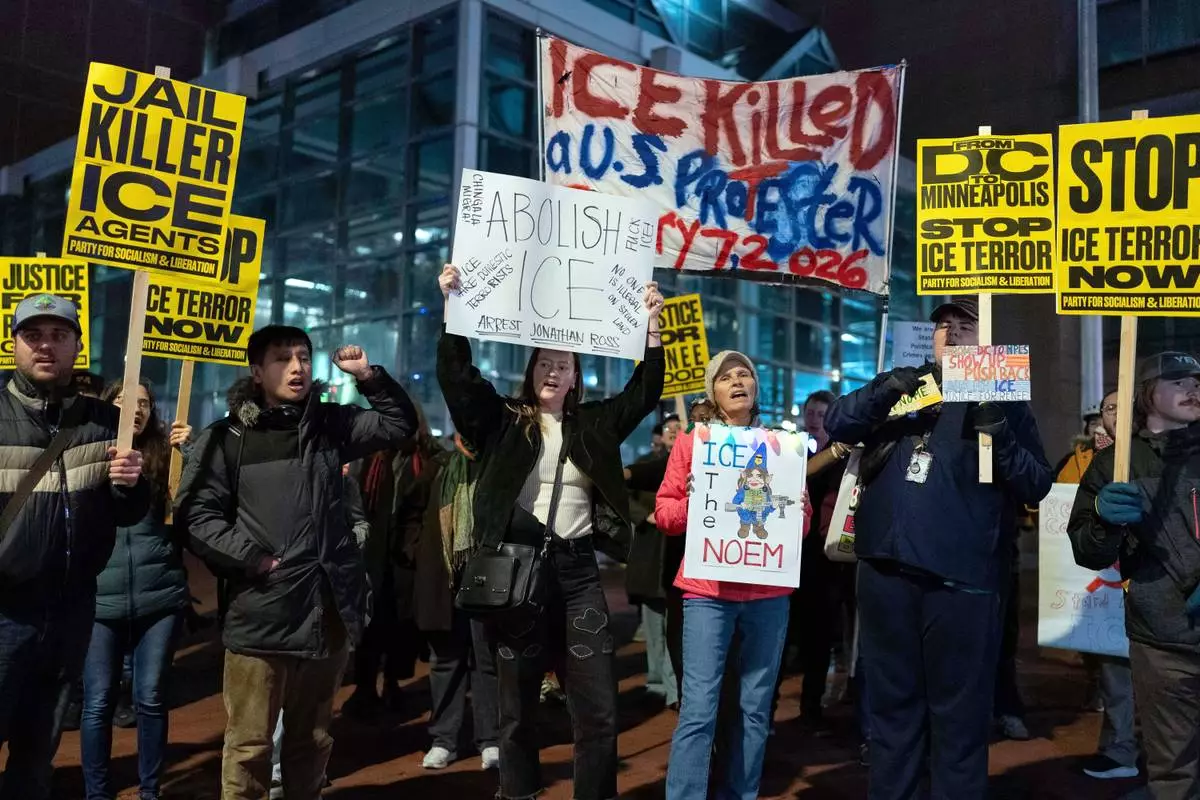
FILE - Demonstrators rally before marching to the White House in Washington, Jan. 8, 2026, as they protest against the Immigration and Customs Enforcement (ICE) agent who fatally shot Renee Nicole Good in Minneapolis. (AP Photo/Jose Luis Magana, File)
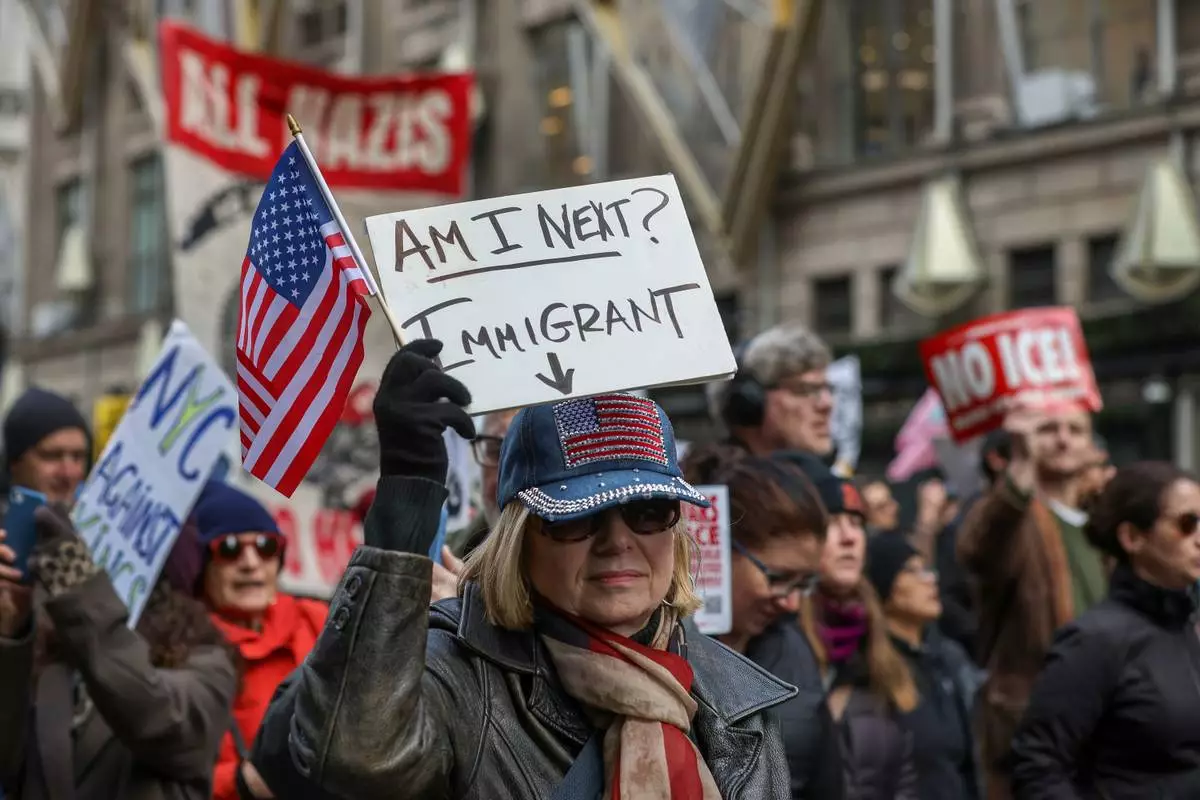
FILE - Demonstrators march down Fifth Avenue during a protest against war in Venezuela and Immigration and Customs Enforcement, Jan. 11, 2026, in New York. (AP Photo/Heather Khalifa, File)

FILE - Federal officers stand guard after detaining people outside of Bishop Henry Whipple Federal Building, Jan. 13, 2026, in Minneapolis. (AP Photo/Adam Gray, File)