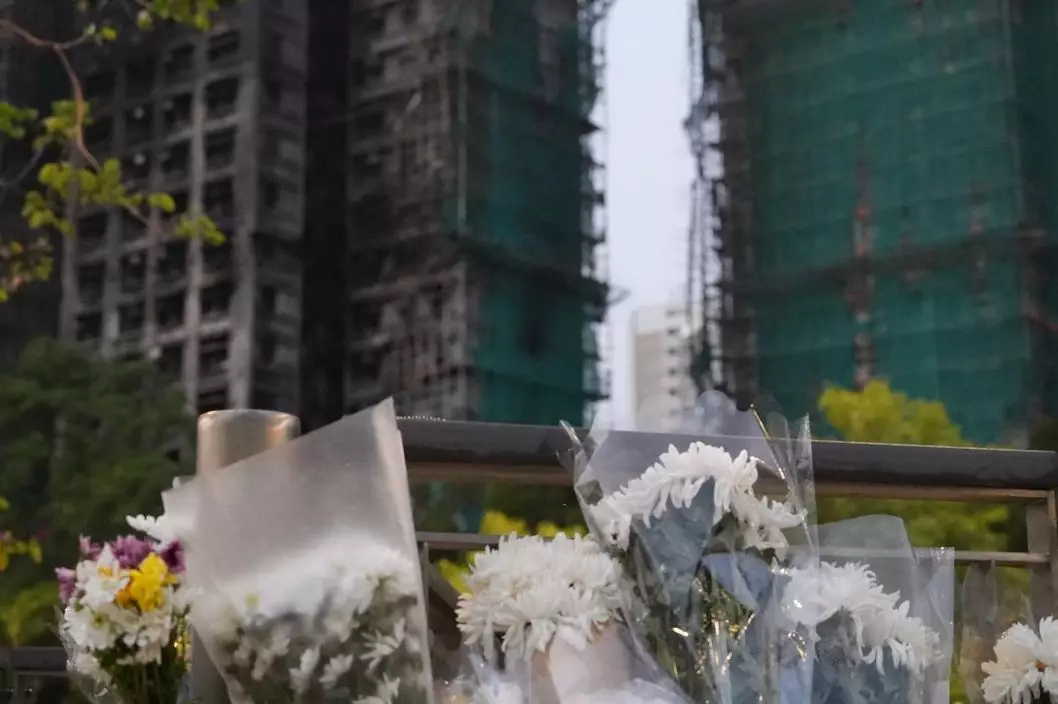
Today (May 3rd) marks the 14th day for Wang Fuk residents to return in batches to retrieve their belongings. Residents of Wang Shing House and Wang Tai House continued their turns to go upstairs to collect possessions.

Photo by Bastille Post

Photo by Bastille Post
Mr. Wong, who lives on the 25th floor of Wong Tai House, went upstairs with his 70-year-old mother. He said they had been climbing stairs over the past few days to build up their stamina, hoping to make it slowly to the floor they live. He described his mother as having a deep attachment to the unit, having lived there for more than 40 years, and insisted on making the climb herself despite her age.
Click to Gallery
Photo by Bastille Post
Photo by Bastille Post

Mr. Wong, Photo by Bastille Post

Mr. Wong, Photo by Bastille Post

Ms. Kwong, Photo by Bastille Post

Ms. Kwong, Photo by Bastille Post

Ms Tam, Photo by Bastille Post

Ms. Tam's sister (left) and Ms. Tam (right), Photo by Bastille Post
Mr. Wong, Photo by Bastille Post
Mr. Wong said his main goal was to retrieve family photos, items his father had left behind, and watches, though he worried they might already have been taken. "I was a bit nervous and didn't sleep too well in the past days," he admitted.
After finishing the retrieval, Mr. Wong said he had managed to collect most of the things that mattered to him, including photo albums, sentimental family keepsakes, and some cash. Having lived in Wang Fuk Court for over 40 years, he admitted to feeling reluctant when leaving his unit. "But everyone is safe after the fire; that alone is a blessing," he said.
Mr. Wong, Photo by Bastille Post
He noted that the climb with his mother took about 10 to 20 minutes, and the whole process went smoothly. He added that he had largely completed his retrieval and was still deciding whether to return. "We've taken most of the things. We'll see when the time comes."
Ms. Kwong, Photo by Bastille Post
Ms. Kwong, who lives on the 18th floor of Wang Shing House, bought her unit with her boyfriend a few years ago. Though they had already renovated the unit and gotten ready to get married, the fire forced them to postpone the wedding. She said her greatest hope was to find her diamond engagement ring, which she had left on a table and now feared might have been stolen. Ms. Kwong said the floor she lived on was less severely affected, and that her belongings might still be intact. She came prepared with large bags, backpacks, tape, pens, and newspapers, hoping to take away her most treasured possessions.
Ms. Kwong, Photo by Bastille Post
She admitted that she had already expected to feel emotional upon returning to her unit. "Previously, when you came home from work, the surroundings were all green, and there were plenty of parks. Now, when you walk in, it just turns into a ruin," she said. However, she also said that after such a long time, she had mentally prepared herself and felt calmer than in the early days. As for her wedding, there is still no decision on when it might take place. "Right now we have to deal with what's in front of us first," she said, adding that she would make plans once everything has settled down.
Ms Tam, Photo by Bastille Post
Ms. Tam, a resident of Wang Shing House, went upstairs with her three siblings to collect their belongings. She said conditions inside the unit were better than expected. "It wasn't as badly burned as we thought. We were lucky," she said. Given three hours to retrieve the items, she and her family completed in about an hour, successfully retrieving her rings, bracelets, family photos, and other keepsakes.
Ms. Tam's sister (left) and Ms. Tam (right), Photo by Bastille Post
Her younger sister, who accompanied her, explained that since the unit had already been scheduled for a major renovation, there were not many possessions inside. Consequently, they were unfazed by the damage. "We think only taking back what has sentimental value is enough." She added that the greatest value of returning was seeing the inner condition of the unit with her own eyes. When asked whether the family might one day return to live here, she admitted it was unlikely. Even if the site were rebuilt, she said, it would possibly take more than a decade. Her hope, instead, is to move into a new home as soon as possible. She called on the government to offer residents more choices in resettlement arrangements and expressed deep sympathy for those who lost family members in the fire. In her view, the loss for them is simply beyond repair.