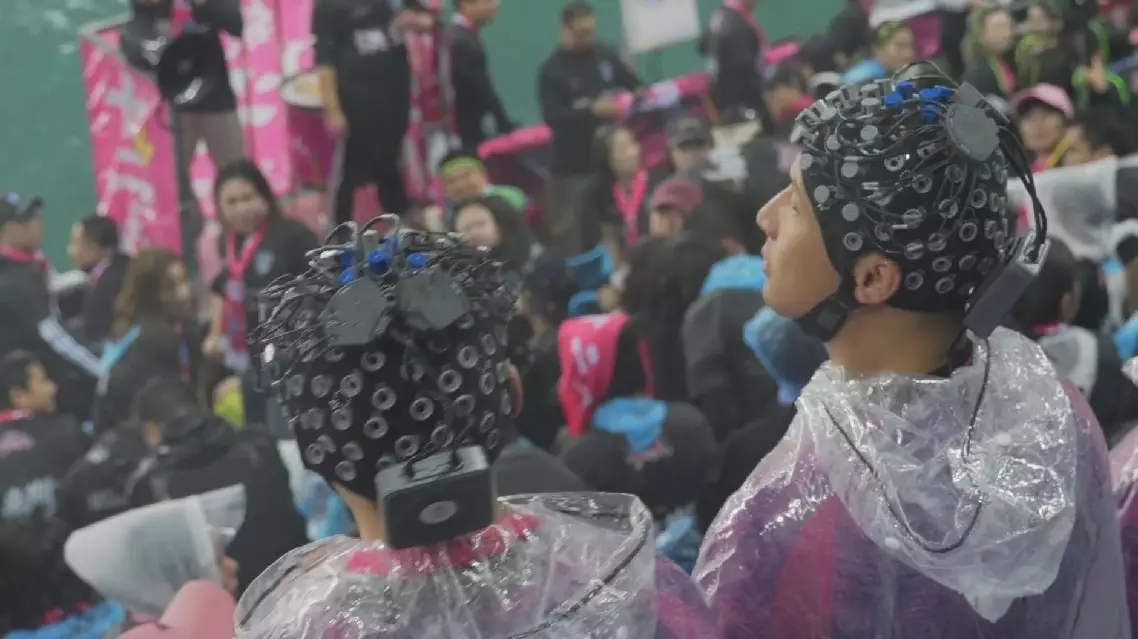
A grassroots football match held on Saturday in east China's Zhenjiang City, Jiangsu Province, became a testbed for brain-computer-interface (BCI) tech, with data to be collected for improving intelligent management of events.
The experiment involved 15 participants whose footage and emotion data were captured real time and were displayed on the on-site large screen.
The collected data will be sent to relevant research teams to further explore the correlations between fans’ emotions, progression of match, and on-site atmosphere.
"I was initially curious whether wearing the device would distract me from watching the game. But it's surprisingly lightweight. It doesn't restrict me at all when I was cheering or waving my scarf. It is really meaningful to take part in an experiment like this," said a participant.
The BCI device tested at the football match adopts near-infrared technology, which detects emotions by measuring changes in cerebral hemoglobin levels.
The technology is expected to be applied to large-scale sports, cultural and tourism events, helping optimize on-site atmosphere, perceive emotional fluctuations and quantify the experience of spectators and tourists.
China's grassroots football match becomes testbed for BCI tech
Global media and research institutions are reflecting on the legacy of the Tokyo Trials, which convicted 25 Japanese Class-A war criminals, and warning against the resurgence of Japanese militarism, as Sunday marked the 80th anniversary of the trials' opening.
Russia's TASS news agency highlighted the Tokyo Trials' landmark significance, saying Japan's ongoing military expansion proves a persistent trend of militarism.
Russia's Rossiyaskaya Gazeta spotlighted Japan's biological warfare in northeast China's Harbin and the Nanjing Massacre.
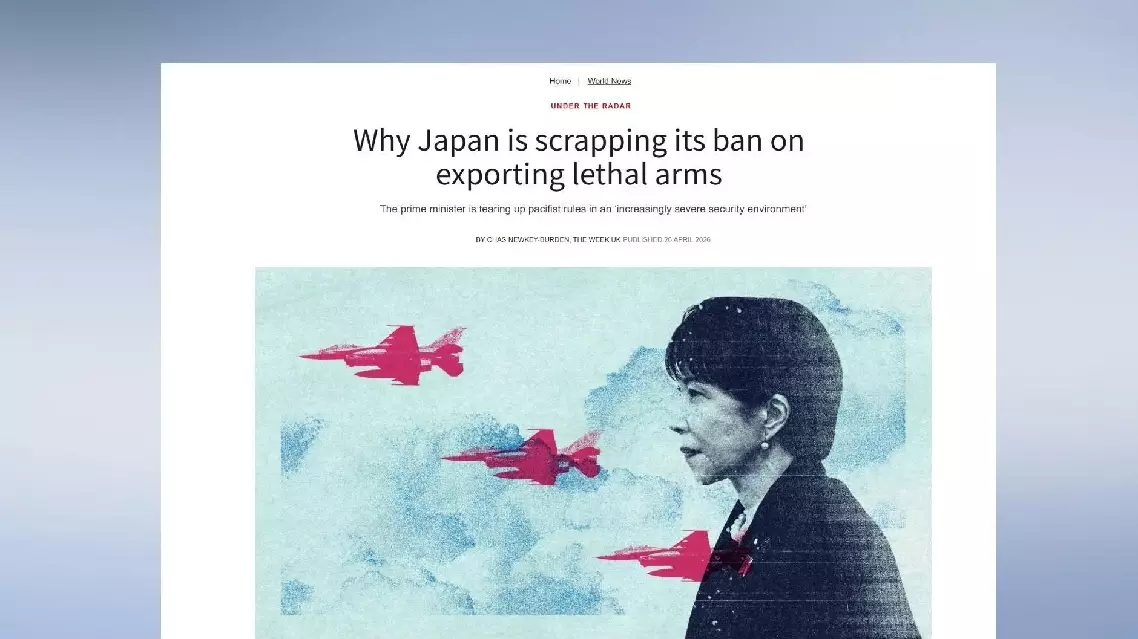
Britain's The Week reported that Japanese Prime Minister Sanae Takaichi is ending Japan's pacifist constitution by lifting lethal weapons exports bans.
The Philippines' Asian Century Journal cited global concerns over Japan's WWII atrocities and resurgent militarism.
The Republic of Korea (ROK) scholar Oh Seung-Hee has called for communication between the ROK, China, and Japan to ensure regional stability and peace.
Sunday marks the 80th anniversary of the opening of the International Military Tribunal for the Far East, or the Tokyo Trials.
From May 3, 1946, to Nov 12, 1948, the International Military Tribunal for the Far East was held in Tokyo by 11 countries, including the United States, China, the UK and the Soviet Union, to try Japan's Class-A war criminals after World War II.
Global media, research institutions reflect on Tokyo Trials' legacy, warn of Japan's rising militarism