Creative small commodities are drawing strong demand at the 139th China Import and Export Fair, or Canton Fair, in south China's Guangzhou, where innovative accessories have become standout attractions for overseas buyers. At a booth featuring bags, those with creative anti-theft designs have become one of the bestselling products favored by foreign buyers.
"Compared with similar products without this design, orders for the new product have increased by 30 to 40 percent," said Huang Yu, an exhibitor.
Shifting from price competition to innovation, and from volume-driven growth to quality improvement, a growing number of China's small-commodity enterprises are unlocking new growth opportunities through refined design.
"Chinese products are very good and very interesting. Its new products have so many innovations, and it's very interesting for us to come here in China to looking at new products and to get the new products in our country," said an Argentine purchaser.
In the exhibition area for sports, tourism and leisure products, outdoor goods covering various specialized segments offer more professional options for buyers from different regions.
"You just get an opportunity to get so much better value than visiting each factory obviously. When we see a product that's very, very special or very specialized, that's why we're more interested," said Trend Goulding, an Australian purchaser.
The Canton Fair runs from April 15 till May 5 in three phases, each highlighting categories from advanced manufacturing to home living and lifestyle products. Covering 1.55 million square meters, the fair features 75,700 booths and more than 32,000 enterprises, including about 3,900 first time exhibitors.
Established in 1957, the Canton Fair takes place twice a year in Guangzhou. It is the longest-running of several comprehensive international trade events in China, and has been hailed as the barometer of China's foreign trade.

Creative small commodities draw strong demand at 139th Canton Fair
China's steel industry has achieved intensive breakthroughs in high-end precision materials since the beginning of this year, with a batch of advanced specialty steels empowering frontier industries including electronics, new energy and high-end equipment.
In the mobile communication era of 4G, the thickness required for an ultra-thin low-carbon steel foil is 0.12 mm to enable convenient and speedy signal transmission.
Such a demanding requirement is tightened to a mere 0.10 mm in today's 5G new era, which means more complicated techniques for its manufacturers.
For a long time, the rolling methods relied heavily on foreign enterprises. However, Shougang Group teamed up with the University of Science and Technology Beijing (USTB) in 2013 to conduct scientific research and development on the continuous rolling process of "5G steel," a nickname of the ultra-thin low-carbon steel foil.
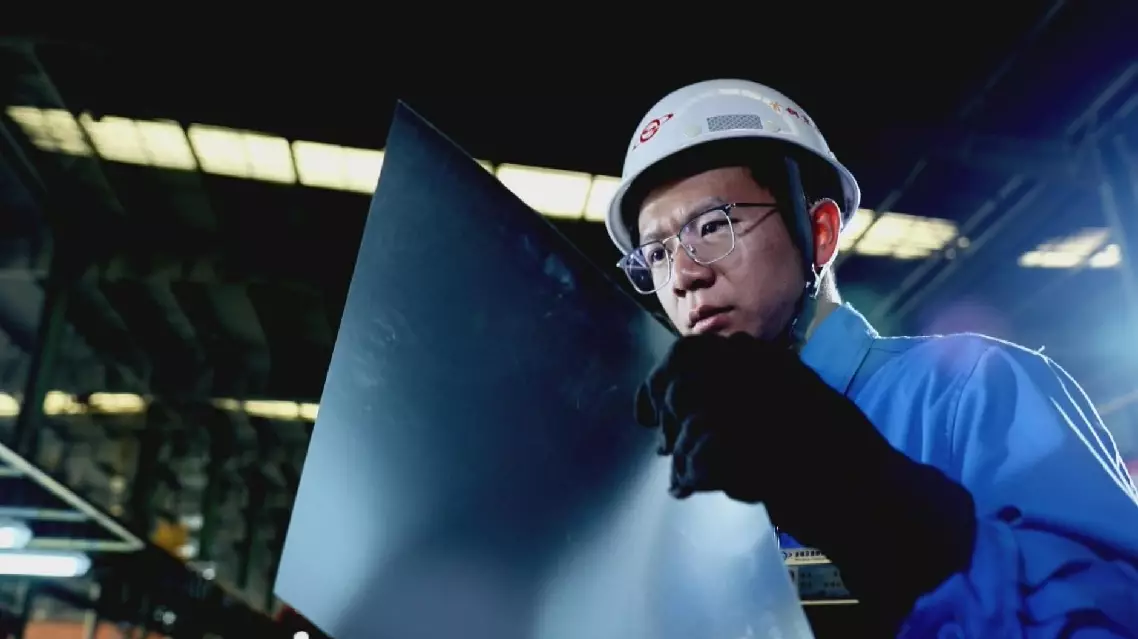
The "5G steel" that independently developed by China - as thin as 0.07 mm - has entered mass production and been widely used for 5G base station signal receivers, signal transmission filters, and integrated circuit boards, and new energy battery connection pieces.
"Although it's thin, it has excellent toughness and feels like paper, and we can easily bend it and repeatedly fold it," said Hu Na, an engineer at Shougang Jingtang Steel United Iron and Steel Co., Ltd. She folded the steel into a classic "paper plane" to show its flexibility.
This year, China has been using specialty steels to empower the development of new quality productive forces.
For instance, in industrial sector, China has continued to push performance limits of silicon steel -- an iron-silicon alloy used primarily in electrical applications due to its good magnetic properties, with 0.1-millimeter-grade non-oriented electrical steel achieving global top-tier status in electrical steel iron loss indicators.
The material now is widely used in drive motors for new energy vehicles and joint motors for humanoid robots.
The breakthroughs came as China's steel industry continues to shift toward higher value-added products, with the manufacturing sector's share of steel consumption surpassing that of the construction sector for the first time in 2025.
China makes intensive breakthroughs in high-end steel products in 2026