The University of Michigan has issued a formal apology after a history professor lauded pro-Palestinian student protesters in a commencement speech over the weekend.
The remarks — and the ensuing apology — have set off cascading recriminations, with pro-Israel advocates calling to slash the school's funding as others accuse university officials of bowing to political and donor pressure.
In a speech on Saturday at the universitywide commencement ceremony, Derek R. Peterson, a professor of East African history and outgoing chair of the faculty senate, credited "pro-Palestinian student activists who have over these past two years opened our hearts to the injustice and inhumanity of Israel’s war in Gaza.”
The comments followed Peterson’s praise for Moritz Levi, the first Jewish professor at the University of Michigan, among others who he said had advanced causes of justice through the school’s history.
Within hours, video of the pro-Palestinian portion of Peterson’s speech had widely circulated online, drawing condemnations from Jewish groups, who allege that campus protests against Israel created a hostile environment for some students.
The same day, the university’s president, Domenico Grasso, issued a public apology, saying the comments were “inappropriate and do not represent our institutional position.”
“We regret the pain this has caused on a day devoted to celebration and accomplishment,” Grasso said, adding that Peterson's speech “deviated from the remarks he had shared before the ceremony.”
The swift apology did not stop some Republican officials, including Florida Sen. Rick Scott, from calling for the school to be stripped of federal funding. A Republican member of the Board of Regents, which governs the public university, also hinted at possible discipline for the professor. The prominent Israeli-American investor Adam Milstein urged Jewish people to halt any donations to the school.
Peterson said he stood by the comments, calling it “ridiculous” to expect that graduations be apolitical.
“Michigan is not a finishing school for polite young men and women,” he said in a statement. “They do not need sentimental, cloying nostalgia. They need encouragement to face a flawed and unjust world head on, using the tools we’ve given them: critical reasoning, careful research, sympathy for the oppressed.”
Peterson also accused the administration of scrubbing the speech from the internet. A university spokesperson said it had been temporarily removed by YouTube over a music copyright issue and was back online.
In a joint letter published Tuesday, a coalition of academic labor groups — including the American Association of University Professors and the American Federation of Teachers — condemned the university’s statement.
“Institutional leaders have an obligation not only to tolerate faculty speech, but to defend it — especially in the face of external political pressure,” the letter read.
The speech came two years after protests against the war in Gaza erupted across college campuses, leading to canceled speeches and other disruptions to the springtime commencement ritual. Michigan's campus saw students form a campground and walk out from classes in protest of the war.
A handful of students at U.S. universities also faced discipline in 2025 for seeking to highlight pro-Palestinian issues at graduation ceremonies, including a graduate of New York University whose diploma was withheld for criticizing Israel in a speech.
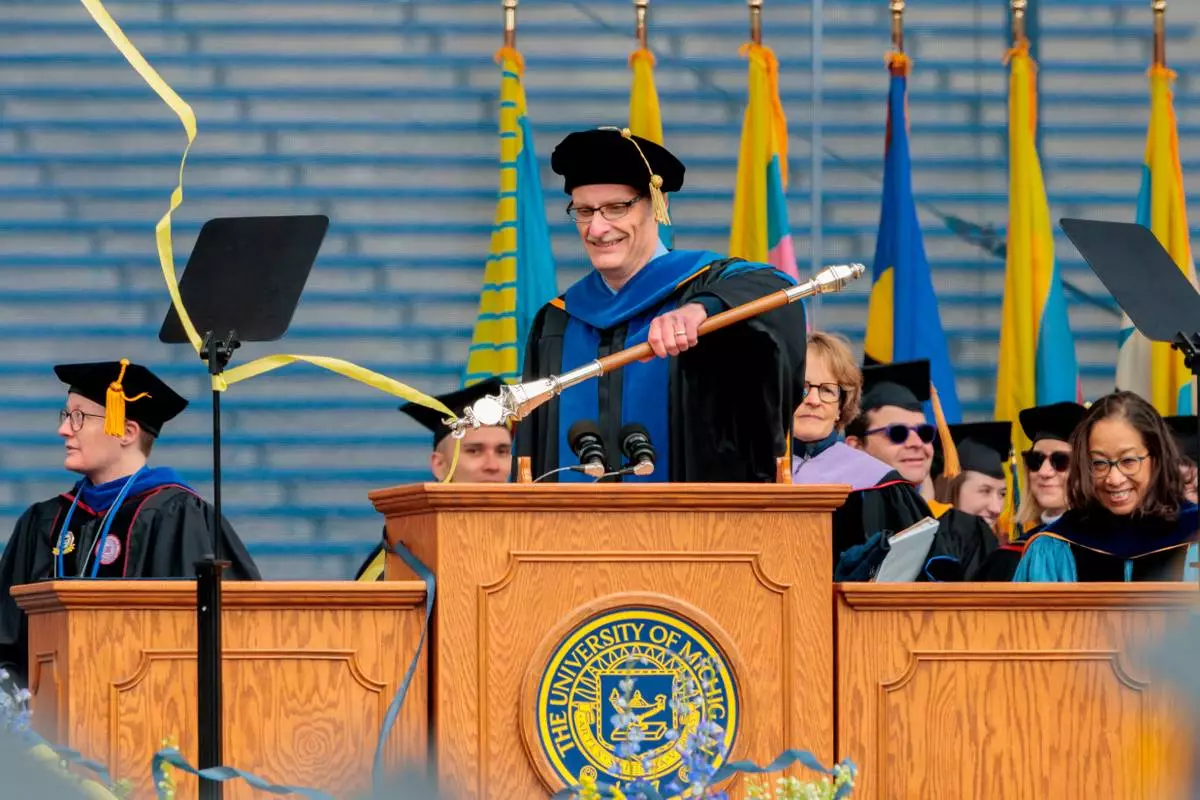
Derek Peterson, chair of the University of Michigan Faculty Senate, frees the ceremonial mace from falling ribbons during the University of Michigan's spring commencement ceremony at Michigan Stadium in Ann Arbor, Mich., Saturday, May 2, 2026. (Jacob Hamilton/Ann Arbor News via AP)
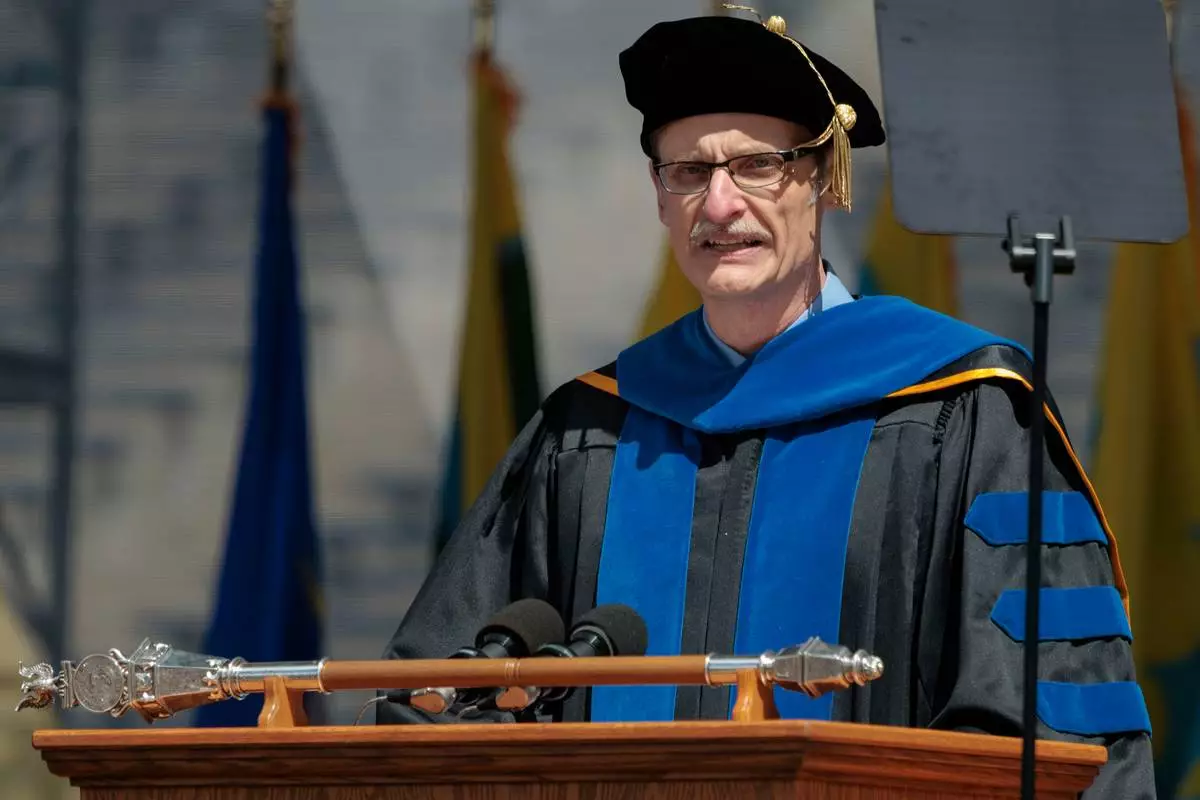
Derek Peterson, chair of the University of Michigan Faculty Senate, speaks during the University of Michigan's spring commencement ceremony at Michigan Stadium in Ann Arbor, Mich., Saturday, May 2, 2026. (Jacob Hamilton/Ann Arbor News via AP)
FORT COLLINS, Colo. (AP) — While some Americans were gazing at tulips and mowing lawns, people in Colorado and Wyoming were getting out their snow shovels.
A late snowstorm swept over the Rocky Mountains and into the High Plains on Tuesday, bringing heavy, wet accumulation north of Denver into southeastern Wyoming.
In Fort Collins, Colorado, heavy snow fell throughout the day on ground that was still too warm for significant accumulation. Slushy snow clung to leaves, grass and flowers, and homeowners shut off yard sprinklers lest sub-freezing temperatures damage their plumbing.
More accumulation was on the way with temperatures expected to keep dropping overnight.
Boulder, nestled against the mountains, could get upward of a foot (30 centimeters) of snow. Up to 8 inches (20 centimeters) was possible in the Denver area into Wednesday.
Even as Denver imposed lawn-watering restrictions to address what have been low mountain snows, the city was facing what may be its biggest snowfall of the season.
“We just had our driest winter on record,” Kenley Bonner, a meteorologist in the weather service’s Denver office, said. “We were kind of joking earlier in the season that winter’s not going to come until spring, and it did exactly that.”
The snow was expected to continue into Wednesday, followed by more plunging temperatures before warmer temperatures return Thursday, the National Weather Service said.
Accumulated snow could snap tree branches and knock out power, Bonner said. Utilities were preparing, with Xcel Energy putting 165 employees on standby across the state.
Highways remained open Tuesday for the time being. Interstate 80 across southern Wyoming, including a high-elevation stretch between Cheyenne and Laramie that closes often, was open but webcams showed heavy snowfall.
Others along northern Colorado mountain highways also showed deteriorating conditions.
The forecast is somewhat unusual but not unheard of.
Denver typically sees its last snowfall around April 28, although May storms do happen. The “Mile High City” recorded half an inch of snow (1.2 centimeters) on May 21, 2022, while nearby Boulder got 4.5 inches (11.4 centimeters).
Historically, Denver has seen at least five May storms with snowfall over 10 inches (25 centimeters). The biggest, in 1893, dropped 15.5 inches (39.3 centimeters). The city's most recent double-digit snow was May 25-26, 1950, with 10.7 inches (27 centimeters).
A light dusting on June 2, 1951, was the latest time in the year it snowed.
The worsening storm caused the Colorado Rockies to reschedule two games against the New York Mets. But that happens more often than not during Denver's spring baseball season, including four times in 2015, according to MLB.
May snows are even more common in the Wyoming capital of Cheyenne, which is almost 1,000 feet (300 meters) higher than Denver and cooler year-round. Wyoming is also windier than Colorado, pushing snow into drifts that must be re-plowed if gusts persist.
April was warmer than usual and short on precipitation, with Denver missing an inch of rain (2.5 centimeters) and 2.8 inches of snow (7 centimeters) last month compared to normal.
But one storm won't solve the West's water problems.
A report from the National Drought Mitigation Center said recent precipitation helped boost topsoil moisture and reduced irrigation demands, but hasn't changed a “mostly bleak” water outlook heading into the summer.
Wildfires also thrive in the dry conditions. Firefighters across the West have been turning to artificial intelligence and other technology to catch small fires before they expand.
The unsettled weather isn’t limited to the Rockies.
Thunderstorms are expected from northeast Texas into western Tennessee, with Arkansas facing the greatest risk of large hail, damaging winds and possible tornadoes, according to the Storm Prediction Center. Isolated strong storms could also reach parts of the Northeast.
McCormack reported from Concord, New Hampshire.
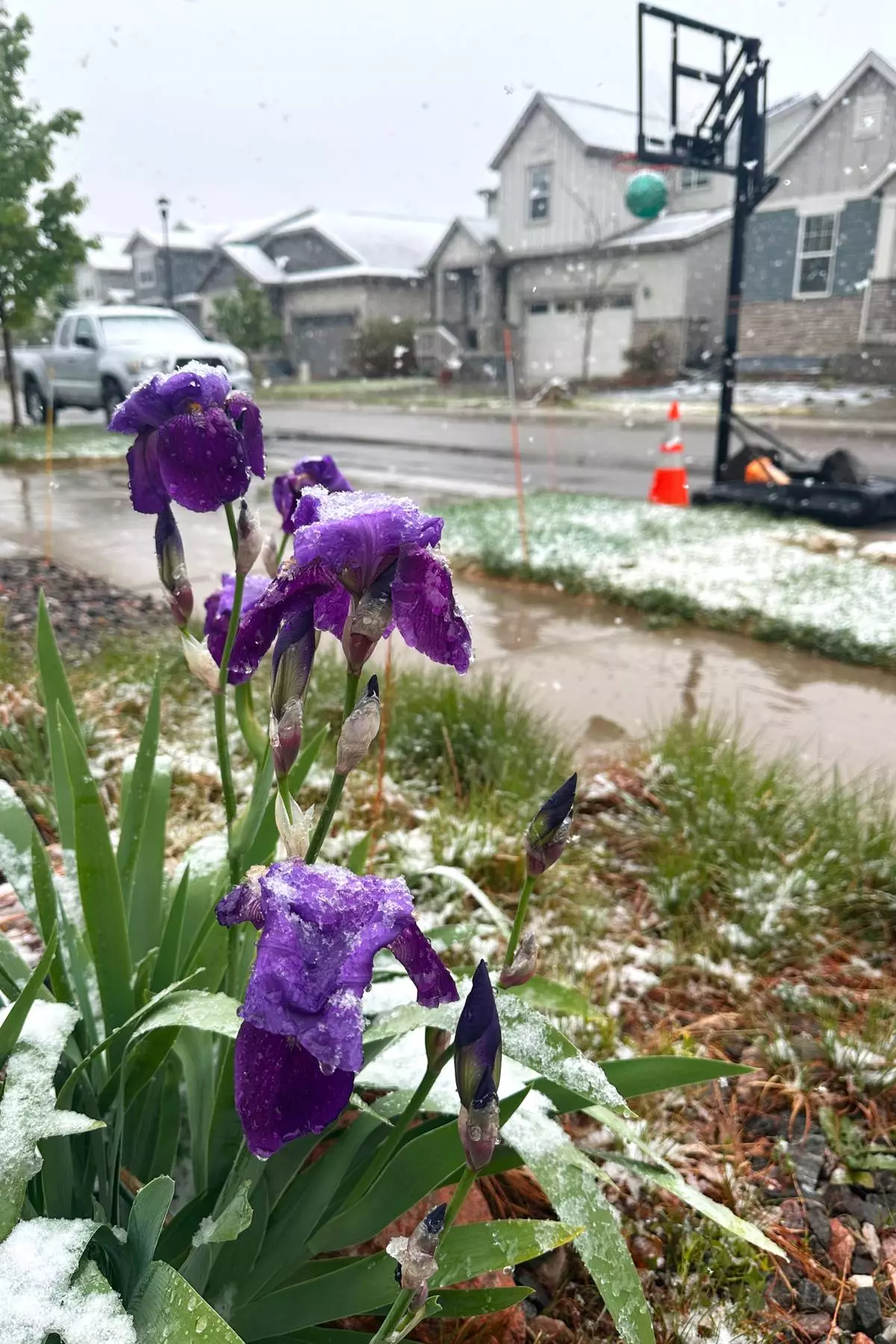
Wet snow falls on flowers Tuesday, May 5, 2026, in Fort Collins, Colo. (AP Photo/Mead Gruver)
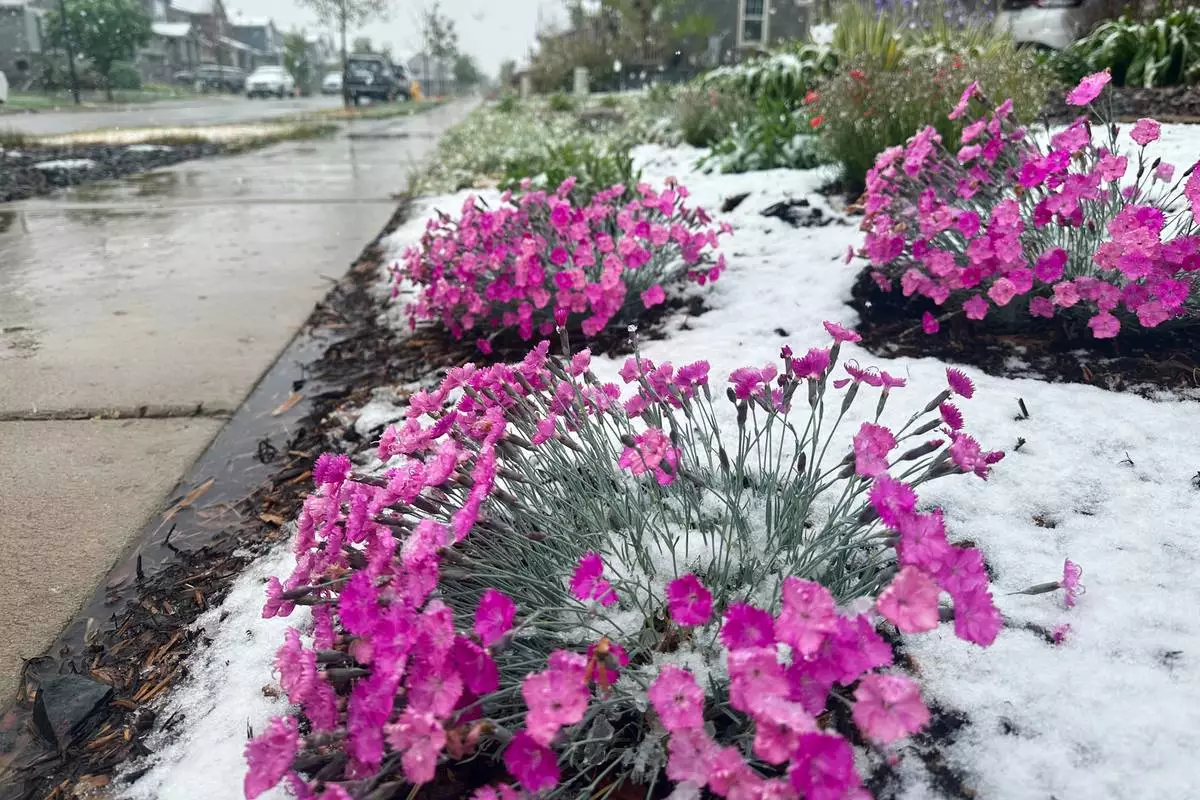
Wet snow falls on flowers Tuesday, May 5, 2026, in Fort Collins, Colo. (AP Photo/Mead Gruver)
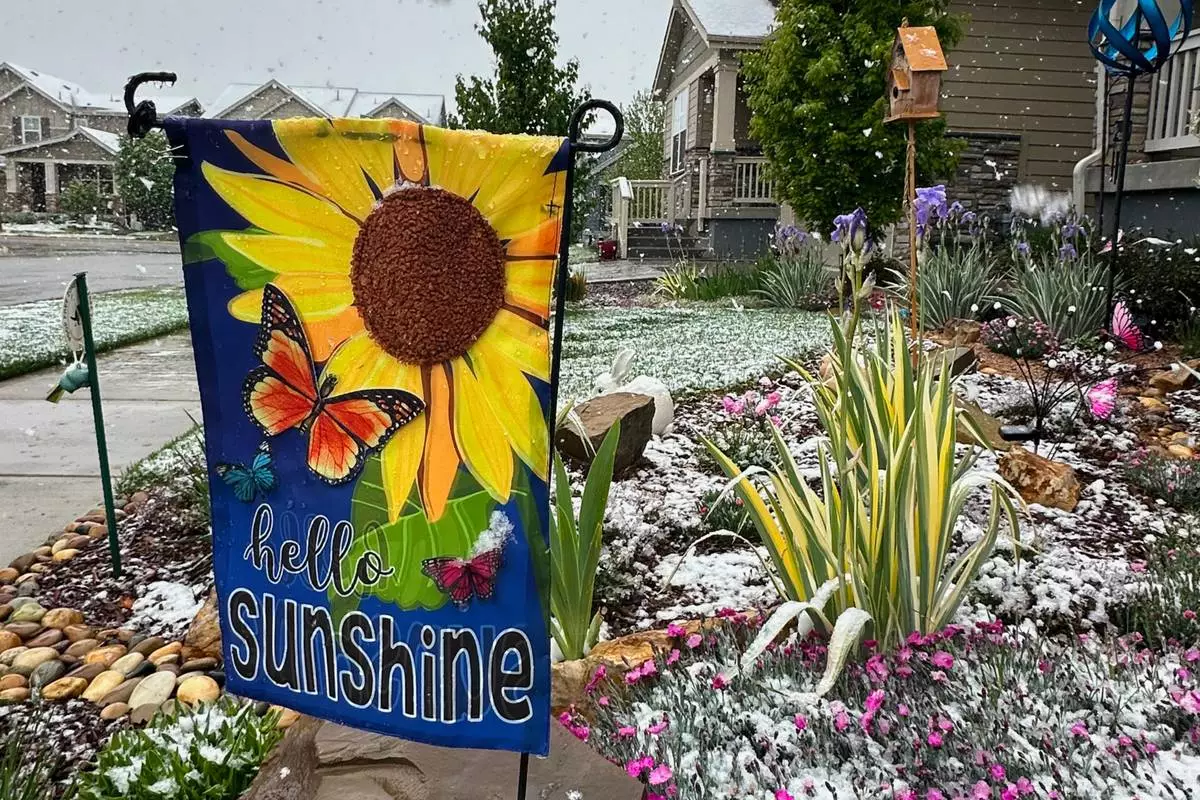
Wet snow falls on flowers Tuesday, May 5, 2026, in Fort Collins, Colo. (AP Photo/Mead Gruver)