LONDON (AP) — British voters will cast ballots Thursday in elections that could hasten the end of Prime Minister Keir Starmer’s troubled term and confirm that an increasingly fractured United Kingdom has entered an era of messy multiparty politics.
Starmer’s center-left Labour Party is expected to take a battering in elections for local authorities across England and for semiautonomous legislatures in Scotland and Wales.
Click to Gallery
Britain's Conservative Party leader Kemi Badenoch during a rally at the National Motorcycle Museum in Solihull, England, Tuesday May 5, 2026, whilst on the campaign trail for the upcoming local elections. (Jacob King/PA via AP)
Britain's Prime Minister Keir Starmer gestures to supporters during a visit to All Saints Hall in south London, Tuesday May 5, 2026, whilst campaigning for the upcoming local elections. (Ben Whitley/PA via AP)
FILE - Nigel Farage, the leader of Reform UK, drinks a cup of tea as he meets supporters after a news conference in London on April 2, 2026. (AP Photo/Kirsty Wigglesworth, File)
FILE - Britain's Prime Minister Keir Starmer leaves 10 Downing Street in London on April 29, 2026. (AP Photo/Kirsty Wigglesworth, File)
With the prime minister’s popularity in the doldrums from a weak economy and repeated questions about his judgment, rival parties are framing Thursday’s votes as a referendum on Starmer and his 2-year-old government. “Vote Reform, Get Starmer Out” is the campaign slogan of the hard-right party Reform UK.
The next national election does not have to be held until 2029, but a wipeout on Thursday could tip a restive Labour Party into revolt against its unpopular leader.
Less than two years after winning a landslide election victory, “Keir Starmer has become a vessel for people’s disappointment (and) disillusionment,” said Luke Tryl of pollster More in Common.
Starmer's popularity has plunged after repeated missteps since he became prime minister in July 2024. His government has struggled to deliver promised economic growth, repair tattered public services and ease the cost of living — tasks made harder by the U.S.-Israeli war with Iran, which has choked off oil shipments through the Strait of Hormuz.
The prime minister has been further hurt by his disastrous decision to appoint Peter Mandelson, a scandal-tarnished friend of Jeffrey Epstein, as Britain’s ambassador to Washington.
Forecasters suggest Labour will lose well over half of the 2,500 seats it is defending on English local councils. It is expected to lose votes to parties on both left and right — especially to the Green Party in London and Reform UK in working-class, former Labour strongholds in England’s north.
“These elections are a perilous, perilous moment for Keir Starmer,” said Tony Travers, professor in the Department of Government at the London School of Economics. He said that after a series of policy U-turns and in an economy where “there isn’t much money to spend on anything … his opponents are lining up.”
Starmer has already survived one crisis in February, when some Labour lawmakers, including the party’s leader in Scotland, urged him to quit over the Mandelson appointment.
An election rout could trigger a snap leadership challenge from a high-profile rival such as Health Secretary Wes Streeting, former Deputy Prime Minister Angela Rayner or Greater Manchester Mayor Andy Burnham. Any challenger would need the support of 80 lawmakers, one-fifth of the party in the House of Commons, to trigger a contest. In Burnham’s case he would have to win election to Parliament before he could take over.
Alternately, Starmer could face pressure from the party to set a timetable for his departure after an orderly leadership contest.
“His parliamentary party are unsure as to whether now is the right time to unseat him,” said Tim Bale, professor of politics at Queen Mary University of London. “So there might be a stay of execution.”
But, Bale added, “it’s a case of when rather than if he goes.”
For decades, Labour losses would have been good news for its main rival, the right-of-center Conservative Party. But the Conservatives are tarnished by 14 tumultuous years in power that ended in 2024. In these elections, it’s Nigel Farage-led Reform UK, the left-leaning Greens and nationalist Welsh and Scottish parties that will likely be the main beneficiaries.
Opponents have heightened their scrutiny of Reform and the Greens in an effort to stop their rise. Farage is facing questions over a 5 million pound ($6.8 million) donation from a cryptocurrency billionaire that he accepted in 2024 but did not declare. He says it was a personal gift.
The environmentalist Greens, who have stressed their pro-Palestinian credentials under self-described “eco-populist” leader Zack Polanski, have fired several candidates for antisemitic social media posts.
Travers said Britain is moving from being a “two-and-a-half party system” — with the Liberal Democrats as the usual third party — “to something more like a five-party one.”
That is excellent news for Rhun ap Iorwerth, who leads Plaid Cymru (the Party of Wales) and stands a strong chance of leading that country’s semiautonomous government.
“The old politics is gone,” he said. “Labour is not going to win this election.”
Labour has dominated Welsh politics for a century and has held power in Cardiff since the Welsh government was established in 1999. Polls suggest Labour will be pushed into third place behind Plaid Cymru and Reform UK, who are running neck-and-neck.
A Plaid victory would give three of the four parts of the U.K. pro-independence leaders. Northern Ireland is governed by Irish nationalist party Sinn Fein in a power-sharing arrangement with the pro-British Democratic Unionist Party.
The Scottish National Party, which has governed in Edinburgh since 2007, says it will push for a new referendum on independence if it wins a majority on Thursday. Scottish voters rejected leaving the U.K. in a 2014 vote.
Plaid Cymru says a secession vote isn’t on the agenda in the next few years, though independence remains the party’s ultimate goal. In the short term, it wants more power to raise taxes and more control over how money is spent.
“We need a fundamental redesign of Britain,” ap Iowerth said. “This is an unequal union.”

Britain's Conservative Party leader Kemi Badenoch during a rally at the National Motorcycle Museum in Solihull, England, Tuesday May 5, 2026, whilst on the campaign trail for the upcoming local elections. (Jacob King/PA via AP)

Britain's Prime Minister Keir Starmer gestures to supporters during a visit to All Saints Hall in south London, Tuesday May 5, 2026, whilst campaigning for the upcoming local elections. (Ben Whitley/PA via AP)

FILE - Nigel Farage, the leader of Reform UK, drinks a cup of tea as he meets supporters after a news conference in London on April 2, 2026. (AP Photo/Kirsty Wigglesworth, File)

FILE - Britain's Prime Minister Keir Starmer leaves 10 Downing Street in London on April 29, 2026. (AP Photo/Kirsty Wigglesworth, File)
LONDON--(BUSINESS WIRE)--May 6, 2026--
Type One Energy, Tokamak Energy, and AECOM today announced the UK Infinity Fusion Consortium to pursue development of the first private-sector-led fusion power plant project in the United Kingdom. Together, the companies intend to develop a fusion project that is commercially credible, deployable using existing enabling technologies, and capable of attracting private capital — consistent with the long-term goals of the government’s recently announced UK Fusion Strategy.
This press release features multimedia. View the full release here: https://www.businesswire.com/news/home/20260506129586/en/
This announcement comes at a time of increasing U.S.-U.K. bilateral cooperation on fusion. His Majesty King Charles III said during his address to the United States Congress last week that, “Our nations are combining talent and resources in the technologies of tomorrow — our new partnerships in nuclear fusion and quantum computing, and in AI and drug discovery, holding the promise of saving countless lives.”
The Consortium partners are all members of the Sustainable Markets Initiative (SMI), a global CEO-led network founded by His Majesty King Charles III with the mandate to lead the private sector in accelerating the transition to a sustainable economy.
At its core, the UK Infinity Fusion Consortium combines Type One Energy’s 400 MWe Infinity Two stellarator fusion power plant design, AECOM’s leading engineering capabilities, and Tokamak Energy’s HTS magnet technology and manufacturing expertise in the UK. The Consortium will use these capabilities to develop a UK Infinity Two fusion power plant project that will include participation by the broader UK fusion value chain spanning construction, finance, offtake and other supply chain partners.
The Consortium will build on the UK’s significant investment in magnetic confinement fusion technology, supply chain capabilities, regulation, and power plant siting for the government’s STEP Fusion programme. It will also capitalize on the synergy and experience gained from the first-of-a-kind (FOAK) Infinity Two fusion power plant project at the Tennessee Valley Authority’s (TVA’s) Bull Run site in the United States, which is targeted for commercial operation in 2034. The TVA Infinity Two project is being supported by the U.S. government’s own fusion programmes and provides a strong technical and programmatic foundation for the UK Infinity Two deployment project.
The development of a UK Infinity Two fusion power plant project by the Consortium is aligned with the UK Government’s strategy to move from world-leading fusion science to commercial deployment — a strategy guiding the STEP Fusion programme. The Consortium will create a private-sector-led fusion commercialization pathway complementing the STEP Fusion programme. The UK Infinity Two project further scales growth of the UK fusion supply chain and accelerates time-to-market for this critical new energy source, while strengthening the country’s industrial base.
Chris Mowry, Chief Executive Officer, Type One Energy, said: “Fusion needs to be delivered, not just developed. This Consortium brings together the core industrial capabilities in the UK and US required to deploy real-world fusion power plant projects that are commercially viable. By aligning fusion technology, advanced manufacturing, and power plant engineering, we are closing the gap between today’s energy innovation and tomorrow’s energy infrastructure. Our initiative is fully aligned with UK and US ambitions to be leaders in commercial fusion deployment.”
Warrick Matthews, Chief Executive Officer, Tokamak Energy, said: “This Consortium puts Tokamak Energy’s transformative magnet technology and manufacturing expertise in the centre of another world-class fusion programme. Together, we can accelerate towards commercialising a new form of limitless, clean energy and, in combination with our role as STEP magnet systems partner, strengthen the UK supply chain’s leadership in global fusion.”
Troy Rudd, Chairman and Chief Executive Officer, AECOM, said: “Fusion represents one of the most important long-term energy solutions, offering a clean, safe and reliable source of power for future generations. Delivering on fusion’s potential requires disciplined engineering, well-established infrastructure delivery models and collaboration across the entire energy ecosystem. Through this Consortium, AECOM is bringing its global experience in complex energy infrastructure to help lay the groundwork for commercial fusion projects that can scale with confidence, supporting the UK’s energy system while strengthening its industrial and infrastructure base.”
Lord Vallance, UK Minister for Science, Innovation, Research and Nuclear, said: "This government is backing fusion with over £2.5 billion and recently announced a deal with the United States, which includes closer working on fusion research and development, taking us closer to a future powered by limitless clean energy. Our long-term vision and investment in the sector is now helping turn that ambition into reality.”
Lord Stockwood, UK Minister for Investment, said: "The UK is a world leader in renewables, and this consortium will play a key role in new fusion projects, creating exciting opportunities for people in local communities. We’re serious about the benefits of clean energy technologies, which is why our modern Industrial Strategy is attracting investment into the sector to boost economic growth as the UK powers towards net zero."
Jennifer Jordan-Saifi, CEO of the Sustainable Markets Initiative (SMI) said: “Type One Energy, Tokamak Energy and AECOM have come together as members of the SMI, demonstrating the SMI’s Terra Carta and Astra Carta mandates in action — business and finance working together to turn breakthrough innovation into measurable progress in building a more sustainable future.”
About Type One Energy
Type One Energy Group is mission-driven to provide sustainable, affordable fusion power to the world. Established in 2019 and venture-backed in 2023, the company is led by a team of globally recognized fusion scientists with a strong track record of building state-of-the-art stellarator fusion machines, together with veteran business leaders experienced in scaling companies and commercializing energy technologies. Type One Energy applies proven advanced manufacturing methods, modern computational physics and high-field superconducting magnets to develop its optimized stellarator fusion energy system. Its FusionDirect™ development program pursues the lowest-risk, shortest-schedule path to a fusion power plant over the coming decade, using a partner-intensive and capital-efficient strategy. Type One Energy is committed to community engagement in the development and deployment of its clean energy technology.
About Tokamak Energy
Tokamak Energy is a global leader in high temperature superconducting (HTS) and fusion technologies founded in 2009 as a spin out from UK Atomic Energy Authority. The company works with governments and industry to develop and bring HTS and fusion solutions to market through innovation and strategic partnerships. A major part of this is its end‑to‑end capability in HTS systems, from design to manufacturing, delivered through its subsidiary Ridgway Machines.
About AECOM
AECOM is the global infrastructure leader, committed to delivering a better world. As a trusted professional services firm powered by deep technical abilities, AECOM solves its clients’ complex challenges in water, environment, energy, transportation and buildings. The company partners with public- and private-sector clients to create innovative, sustainable and resilient solutions throughout the project lifecycle — from advisory, planning, design and engineering to program and construction management. AECOM is a Fortune 500 firm that had revenue of $16.1 billion in fiscal year 2025.
About Sustainable Markets Initiative
The Sustainable Markets Initiative (SMI) is the go-to private sector organization for sustainable transition characterized by its unique brand of “private sector diplomacy.” Founded by His Majesty King Charles III, SMI facilitates action between world leaders and CEOs to embed sustainability at the heart of value creation and mobilize the trillions needed for a sustainable future, guided by its Terra Carta and Astra Carta mandates. SMI believes that with bold ambition and courageous leadership a new era of global prosperity that will last for generations is possible — “The Growth Story of Our Time.”
About Stellarator Technology
The stellarator is the only fusion technology demonstrated to operate in a stable, continuous manner appropriate for commercial baseload power generation. Through use of powerful superconducting magnets and shaped using the world’s fastest supercomputers, the stellarator can efficiently confine a hydrogen plasma at temperatures higher than those at the center of the sun. Under these conditions, hydrogen fuses into helium, producing vast amounts of energy cleanly and safely. The fundamental science underpinning the stellarator has been demonstrated through the performance of large-scale experimental machines, including Wendelstein 7-X in Germany. Modern stellarator technology, using today’s most durable materials and advanced manufacturing techniques, is being developed to power the first generation of commercially viable, grid-scale, fusion power plants.
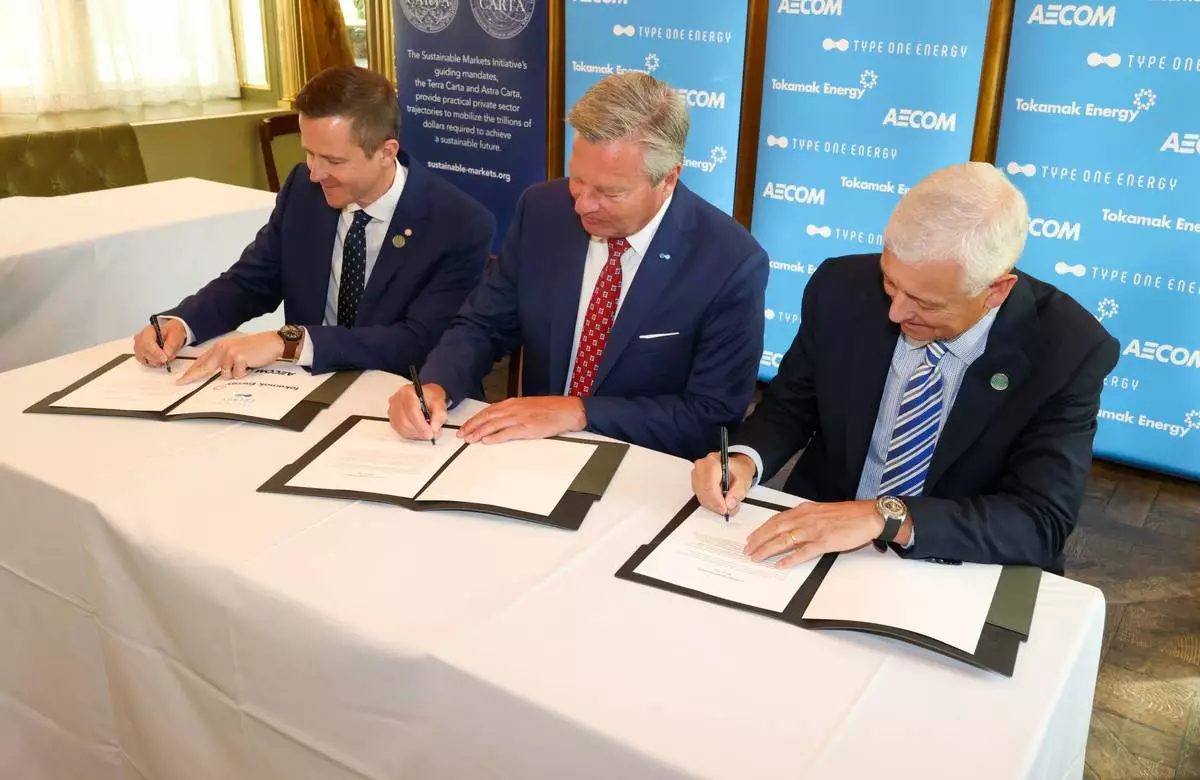
(From left to right) Warrick Matthews, CEO of Tokamak Energy; Chris Mowry, CEO of Type One Energy; and Troy Rudd, Chairman and CEO of AECOM sign the UK Infinity Fusion Consortium during His Majesty King Charles III’s visit to New York City.