Residents in the war-torn Gaza Strip are struggling to make ends meet following years of brutal conflict which has devastated the enclave, with the recent Labor Day holiday only throwing the growing labor crisis into sharper focus as a lack of jobs leaves many in peril.
While much of the world marked the International Workers' Day on May 1, residents in the Gaza Strip had nothing to celebrate - instead, they face dire job market realities, with most people having lost their source of income.
More than two years of conflict has nearly wiped out all local job opportunities, leaving about 80 percent of the working population without pay.
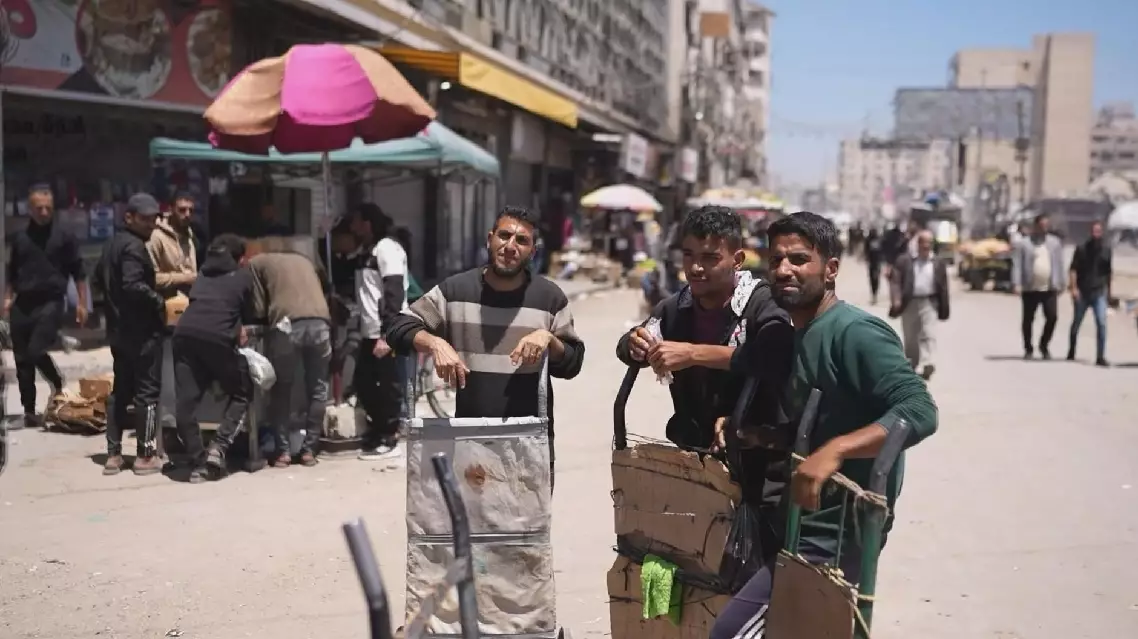
On a holiday that should have belonged to workers, many are seen waiting on the streets in the hope of picking up any odd jobs that may come their way.
Such scenes have sadly become the norm in the bombarded Gaza City, where several workers gather at a dusty intersection early each day. Standing there for hours on end, they watch people and vehicles passing by, praying that some opportunity may arise.
Among them is Mahmoud Al Jarousha, who pushes his dilapidated handcart here each morning, hoping to haul some cargo and simply earn enough money to cover a meal for the day.
"I come here every day just to scrape together enough for the day's living expenses. We don't have a Labor Day here. Labor Day only exists in the outside world," he said.
The conflict has completely shattered the dreams of many of Gaza's promising workforce.
Fidaa Abed graduated from the University of Palestine with a degree in information technology in 2014 and went on to found his own business. Sadly, he was forced to abandon this endeavor after the conflict erupted in October 2023.
He became displaced alongside his wife and five children, with the family still living crammed into a single tent to this day.
Following the temporary ceasefire, he partnered with others to set up a stall selling nuts, barely scraping by, but business has been dismal.
"Life is about working day in and day out just to get a little food. If you don't work, you don't eat. But in reality, there's no work and business is terrible," he said.
According to data updated by the International Labour Organization earlier this year, the unemployment rate in Gaza has reached some 80 percent, meaning that four out of every five people of working age are jobless.
Meanwhile, up to 80 percent of Gaza's industrial facilities, shops, and manual workshops have been reduced to rubble during the conflict.
Even during the ceasefire, Gaza continues to face severe energy shortages, with supplies of clean water and imported raw materials virtually cut off. Without electricity, gas, or cement, any form of production is impossible.
According to a joint assessment released by the United Nations Trade and Development (UNCTAD) and the World Bank in early 2026, Gaza's economy has contracted by at least 80 percent, and the poverty rate has soared to over 90 percent.
As of this month, the United Nations Relief and Works Agency for Palestine Refugees in the Near East (UNRWA) and the United Nations Office for the Coordination of Humanitarian Affairs (OCHA) confirmed that nearly all of Gaza's population is in need of humanitarian assistance, with about 95 percent of the population relying entirely on food and cash aid for survival due to the loss of their livelihoods.
In addition, a World Bank assessment indicates that clearing the tens of millions of tonnes of rubble in Gaza could take between three to five years. Until the rubble is cleared, large-scale reconstruction is out of the question, and it may take decades for Gaza's economy to return to pre-war levels, according to the assessment .
Labor Day with no labor: Gaza haunted by unemployment
Labor Day with no labor: Gaza haunted by unemployment
Labor Day with no labor: Gaza haunted by unemployment