Peace groups rallied in Tokyo on Wednesday to voice strong opposition to the government's series of dangerous moves, including attempts to breach the Three Non-Nuclear Principles, lift lethal weapon export restrictions, and push for changes of the country's postwar pacifist constitution.
The Three Non-Nuclear Principles, not possessing, not producing and not allowing introduction of nuclear weapons into Japanese territory, were first declared in the Diet, Japan's parliament, by then Japanese Prime Minister Eisaku Sato in 1967 and viewed as a national credo.
"The Three Non-Nuclear Principles are not to produce, not to possess, and not to allow nuclear weapons to enter the country. These were proposed by the prime minister in the 1960s and passed by parliament, and every successive Japanese government is not allowed to change them at will. Liberalization of weapons exports is absurd, and it's preparing for war. The Japanese constitution, based on reflection on war, clearly renounces war and military forces. No matter what ideas the government has, it must abide by the constitution," said Hiroshi Takakusagi, co-representative of the executive committee of Japan Council Against A and H Bombs.
"It is very important to renounce war. I think, whatever happens, the principles of renouncing war and not having a military must never change," said another rally participant.
Protesters criticized the government for neglecting people's livelihoods while sharply boosting defense spending, calling on leaders to heed public demand for a peaceful path.
"The constitution is a reminder to everyone. War is absolutely unacceptable, and peace is the most important," said one participant.
"Respecting the constitution is a duty for the politicians. Politicians are obliged to protect the constitution. Shelving that duty and arbitrarily changing it looks like preparation for war in the eyes of others. This is completely unacceptable. It must be stopped immediately," said another participant.
"There is a widespread view that Japan's identity as a peaceful nation is undergoing a major transformation. Amid drastic shifts in diplomatic and security policies, the revision of Japan's three national security documents draws close attention. It has been 80 years since the start of the Tokyo Trial (1946-1948). Japan inflicted enormous suffering on other Asian countries during World War II, a moment that should inspire deep reflection. On the occasion of this 80th anniversary, Japan must re-examine and seriously reflect on its past," said Hiroshi Shiratori, professor at Hosei University.
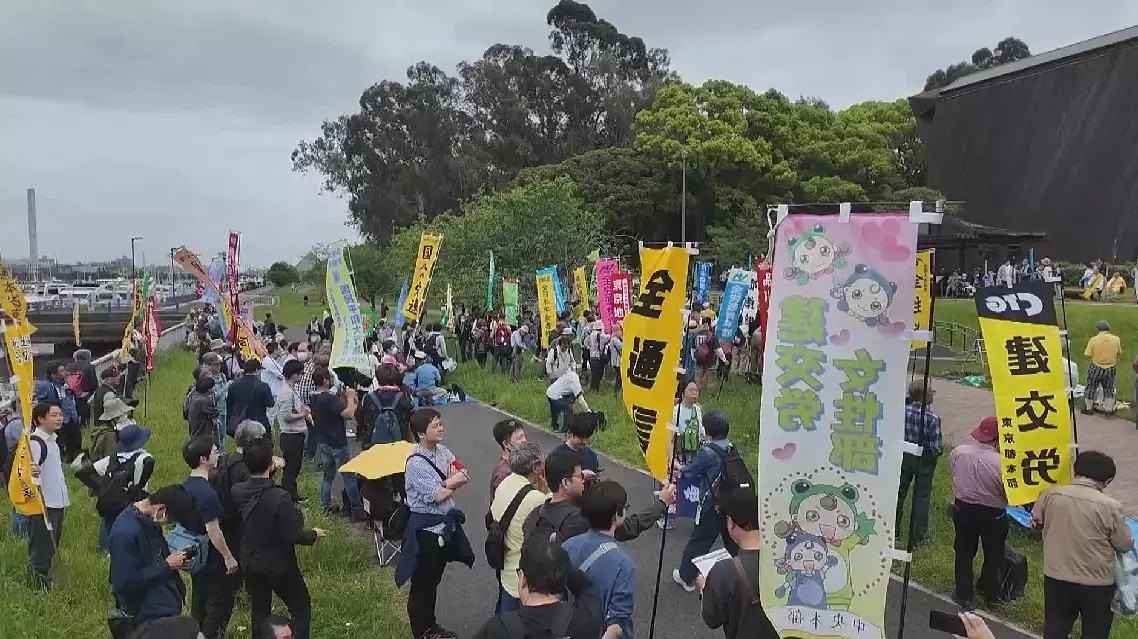
Japanese peace groups protest dangerous government shifts