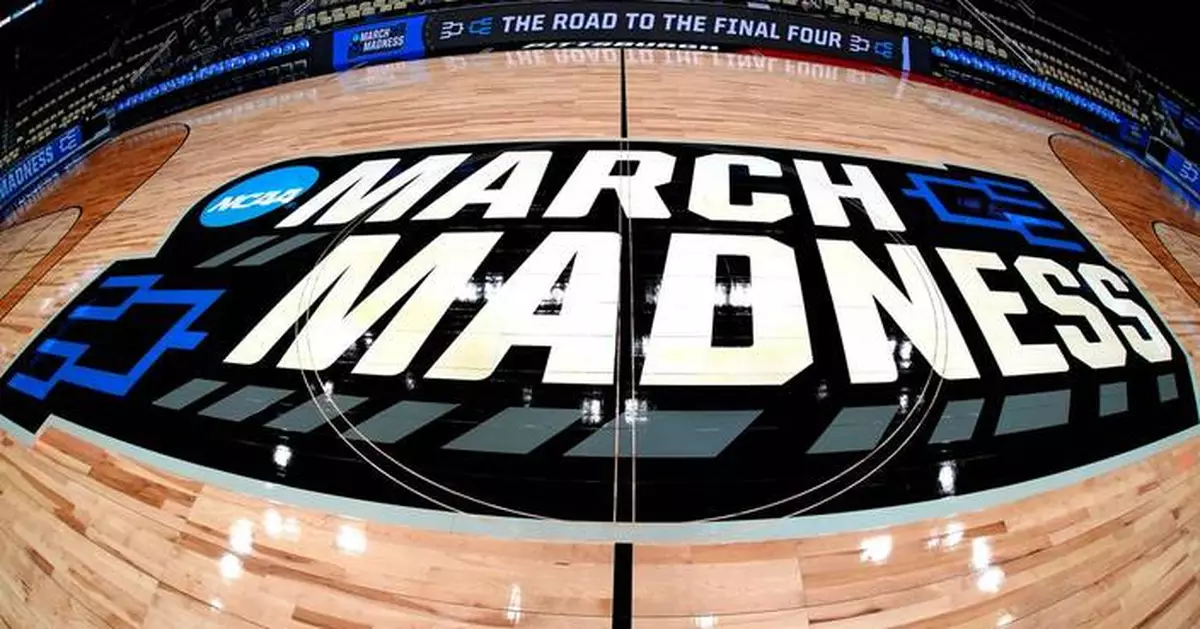
The NCAA announced Thursday that it will expand its two March Madness tournaments by eight teams each next season, a long-expected move that will drop more games into the first week of the highly popular and lucrative showcase without substantially changing its overall form.
The new, 76-team brackets will jam eight extra games — for a total of 12 involving 24 teams — into the front half of the first week of the men's and the women's tournaments. It will turn what’s now known as the First Four into a bigger affair that will now be called the “March Madness Opening Round.”
The 12 winners will move into the main 64-team bracket that will begin, as usual, on Thursday for the men and Friday for the women.
It is the first expansion of the tournaments in 15 years, when they were bumped to 68 teams each.
The NCAA said it will distribute more than $131 million in new revenue to schools that make the tournament. That money will come via expanded TV advertising opportunities for alcohol, the likes of which were previously restricted. It said the value of the rights agreement will increase $50 million each year on average over the course of the six years.
Most of the eight new slots are expected to go to teams from the power conferences that were already commanding the lion's share of entries in the bracket. Two years ago, the Southeastern Conference placed a record 14 teams in the men’s bracket. Last season, the Big Ten had nine.
Keith Gill, the chairman of the Division I men's basketball committee, called the expansion “a nice way to create some access but make sure we have the bracket we all love when we start Thursday at noon.”
The move is a product of the times, which includes massive expansion — the Atlantic Coast Conference, for instance, has grown from nine to 17 teams since 1996 — and the reality that mid-major schools with top-notch players will often see them plucked away by programs with bigger budgets and the ability to pay them through revenue sharing.
Cinderella? There will still be room for those stirring runs in the tournaments, though not a single mid-major advanced past the first weekend of either tournament the last two seasons.
This is hardly a concern of the decision-makers anymore, who will point to TV ratings that traditionally spell out fans’ preference for the likes of Duke and North Carolina over St. Peter’s and San Diego State, especially once the Sweet 16 starts.
What matters more to the biggest schools is that their teams have a chance to compete in what remains the best postseason in college sports and that they aren't iced out by lower conference champions who earn automatic bids.
“You’ve got some really, really good teams who are going to end up in that 9, 10, 11 (seed) category that I think should be moved into the” 64-team bracket, SEC commissioner Greg Sankey said last year in discussing how he favored expansion.
Also, the money. The new beer and wine money will add to what the NCAA can distribute in “units” that are earned for placing teams in the bracket and then for every round those teams advance. Last year, that amounted to about $350,000 per unit for the men’s tournament. The Big Ten made nearly $70 million from both tournaments, won by conference members Michigan (men) and UCLA (women).
Leaders in the SEC, Big Ten, Big 12 and ACC have all acknowledged that smaller programs help make March Madness what it is, all the while steadily expanding their own power in NCAA decision-making. That brings with it the tacit threat of fracturing the single thing the NCAA does best — the basketball tournament.
This move might forestall that. What it isn't expected to do is drastically change the TV deal beyond the advertising.
The current deal for the men's tournament is worth $8.8 billion and runs through 2032. Adding a few extra games between mid-level Power Four teams on Tuesday and Wednesday won't change that much.
One of reason this took as long as it did was the NCAA negotiations with CBS and TNT, which themselves have been in negotiations over their own ownership.
The more drastic option of expanding the tournament to 96 teams or beyond would involve adding an extra week to a tournament that has thrived in part because of the symmetry of a six-round bracket that gets whittled down over three weeks.
That basic shell began in 1985, with only slight tweaks, the latest of which came in 2011 when it was upped to 68.
AP March Madness: https://apnews.com/hub/march-madness

FILE - A basketball goes throw the net before an Elite Eight game between Iowa and Illinois in the NCAA college basketball tournament Saturday, March 28, 2026, in Houston. (AP Photo/Eric Gay, File)
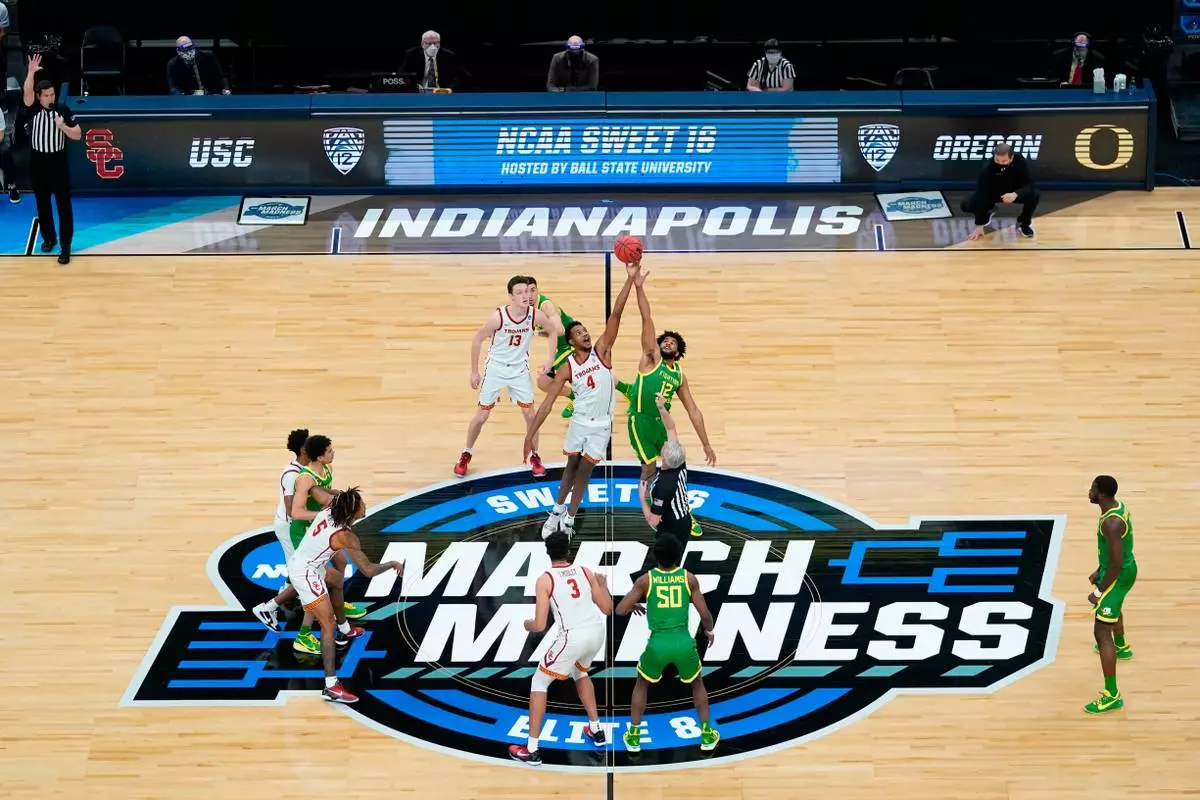
FILE - Southern California forward Evan Mobley (4) fights for the opening tipoff with Oregon guard LJ Figueroa (12) during the first half of a Sweet 16 game in the NCAA men's college basketball tournament, March 28, 2021, in Indianapolis. (AP Photo/Darron Cummings, File)

FILE - March Madness logo sis displayed at center court during the opening rounds of the NCAA college basketball tournament in Pittsburgh, Wednesday, March 20, 2024. (AP Photo/Gene J. Puskar, File)
NASHVILLE, Tenn. (AP) — Tennessee Gov. Bill Lee signed a new U.S. House map into law Thursday that carves up a majority-Black district in Memphis, reshaping it to the GOP’s advantage as part of President Donald Trump’s strategy to hold on to a slim majority in the November midterm elections.
Lee’s signature came quickly after the Republican-led legislature gave final approval to the redistricting plan despite loud, angry protests at the Capitol.
Tennessee is the first state to pass new congressional districts since a U.S. Supreme Court ruling last week significantly diminished federal Voting Rights Act protections for minorities. But more Southern states could follow. Republicans in Louisiana, Alabama and South Carolina also have taken steps toward redistricting.
Tennessee is represented in the House by eight Republicans and one Democrat, Steve Cohen, a white lawmaker who represents the majority-Black 9th Congressional District. The new map splits Memphis’ home of Shelby County among three Republican-leaning districts.
THIS IS A BREAKING NEWS UPDATE. AP’s earlier story follows below.
NASHVILLE, Tenn. (AP) — Republican lawmakers in Tennessee approved a new U.S. House map Thursday that carves up a majority-Black district in Memphis, reshaping it to the GOP’s advantage as part of President Donald Trump’s strategy to hold on to a slim majority in the November midterm elections.
The final vote came amid protests and chaos. As demonstrators chanted loudly in the galleries and hallways, Democratic state Sen. Charlane Oliver stood on her desk in the Senate chamber, holding a banner denouncing the redistricting as a “Jim Crow” effort, then clapping and dancing. Other Democratic senators linked arms in the front of the chamber. Republican leadership quickly adjourned the special session, sending the new map on to Republican Gov. Bill Lee to be signed into law.
Protesters in the galleries also had disrupted the Republican-led House as it voted for the new map — yelling, chanting and blowing air horns. In the hallways, other shouting protesters were held back Tennessee state troopers.
Tennessee is the first state to pass new congressional districts since a U.S. Supreme Court ruling last week significantly weakened federal Voting Rights Act protections for minorities. But more Southern states could follow. Republicans in Louisiana, Alabama and South Carolina also have taken steps toward redistricting. More legal challenges are expected.
The Supreme Court ruled that Louisiana relied too heavily on race when creating a second Black-majority House district as it attempted to comply with federal law. The high court's decision altered a decades-old understanding of the law, giving Republicans grounds to try to eliminate majority-Black districts that have elected Democrats.
Louisiana has postponed its congressional primary to give time for state lawmakers to craft a new House map. Legislation awaiting a final vote in Alabama also would upend the state’s congressional primaries if courts allow the state to change its U.S. House districts. In South Carolina, meanwhile, Republican lawmakers urged on by Trump are considering adding congressional redistricting to their agenda.
The states are the latest to join an already fierce national redistricting battle. Since Trump prodded Texas to redraw its U.S. House districts last year, eight states have adopted new congressional districts. From that, Republicans think they could gain as many as 13 seats while Democrats think they could gain up to 10. But some competitive races mean the parties may not get everything they sought in the November elections.
As a first step to adopting new House districts, Tennessee lawmakers gave final approval Thursday to legislation — quickly signed into law by Lee — that repealed a state law prohibiting mid-decade redistricting. They then passed a bill that would reopen candidate qualifying until May 15 to allow time for new people to enter the U.S. House primaries and existing candidates to switch districts or drop out.
The new House map would break up Tennessee’s lone Democratic-held district, centered on the majority-Black city of Memphis, creating a ripple effect of alterations to districts throughout the western and central parts of the state. The geographically compact 9th District that includes Memphis — currently represented by Steve Cohen, who is white — would stretch a couple hundred miles eastward before reaching north toward the Nashville suburbs.
Unlike in Louisiana — where lawmakers had crafted a second majority-Black district to try to comply with the federal Voting Rights Act — Memphis has long been the base of its own congressional district.
Republican House Speaker Cameron Sexton said the new districts were drawn based on population and politics, not racial data.
But Democrats dismissed such assertions.
“These maps are racist tools of white supremacy at the behest of the most powerful white supremacist in the United States of America, Donald J. Trump,” said state Rep. Justin Pearson, a Black Democrat from Memphis who is running for the U.S. House.
Republican state Sen. John Stevens defended the new districts he sponsored by noting that Democrats in Illinois, Massachusetts and other states also had drawn congressional districts to their advantage.
“This bill represents Tennessee’s attempt to maximize our partisan advantage,” he said.
It does so at the expense of both Memphis residents and democracy, said Sen. London Lamar, a Democrat from Memphis.
“You cannot take a majority Black city, fracture its voting power and then tell us race has nothing to do with it," she said.
Democrats noted that the state Supreme Court in April 2022 rejected a challenge to the current congressional map, finding it was too close to the election to make changes. This year, there’s even less time before the Aug. 6 primary, raising the potential of confusion for both candidates and voters, Democrats said.
Protesters watching an Alabama legislative committee Thursday erupted in shouts of “shame” as Republican lawmakers advanced legislation to authorize special congressional primaries if the state can put a new congressional map in place for the November midterms.
In the wake of the Supreme Court decision arising from Louisiana, Alabama is seeking to overturn a court injunction that created a second U.S. House district with a substantial percentage of Black voters. That map led to the 2024 election of Rep. Shomari Figures, a Black Democrat. Republicans want instead to use a 2023 map drawn by state lawmakers that would give the GOP an opportunity to reclaim Figures’ district.
If a court grants Alabama's request, the legislation under consideration would ignore the May 19 primary results for congressional seats and direct the governor to schedule a new primary under the revised districts.
The House passed the legislation on a party-line vote Thursday after four hours of fiery debate. A final vote in the Senate is expected Friday.
The South Carolina Senate could take up a resolution Thursday giving lawmakers permission to return later, after their regular work ends, to redraw congressional districts that could eliminate the state’s only Democratic-held district. The proposal, which passed the House on Wednesday, needs a two-thirds vote in both chambers.
Republican House leaders said after the vote that they plan to introduce a new map Thursday and hold committee meetings on Friday. But during debate Wednesday, Republicans fended off specific questions from Democrats, including why they were willing to stop the June 9 U.S. House primary elections well after candidates filed and how much a rescheduled primary could cost.
Democratic Rep. Justin Bamberg said he felt sorry for Republicans who, he said, were giving up their principles to follow the whims of Trump.
“The president of the United States is a very powerful man, wields a heavy, heavy thumb — Truth Social, X, Meta, Instagram. To be honest, I don’t envy our Republican colleagues,” Bamberg said.
Chandler reported from Montgomery, Alabama; Collins from Columbia, South Carolina; and Lieb from Jefferson City, Missouri. Associated Press reporter Kristin M. Hall contributed.

Rep. Caleb Hemmer, D-Nashville, and Rep. Sam McKenzie, D-Knoxville, walk to the House chamber arm in arm for a special session of the state legislature to redraw U.S. Congressional voting maps Thursday, May 7, 2026, in Nashville, Tenn. (AP Photo/George Walker IV)
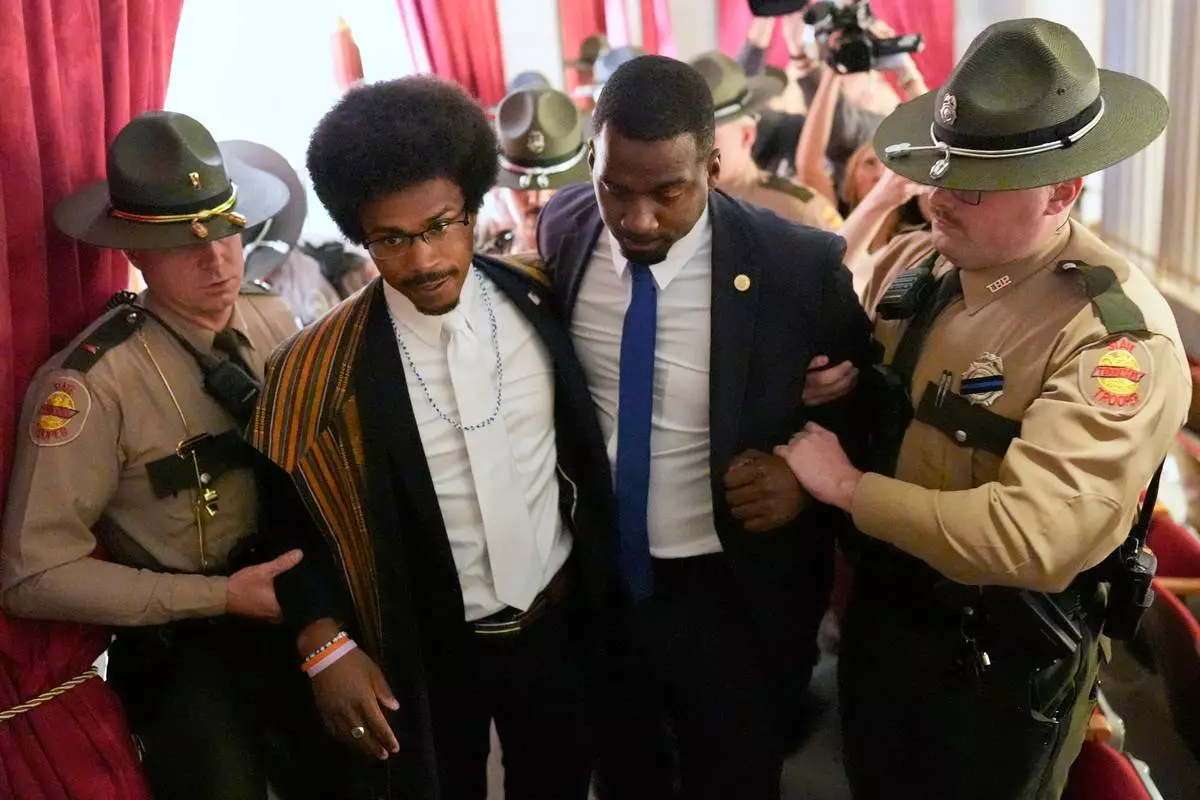
Rep. Justin J. Pearson, D-Memphis, second from left, walks with his brother KeShaun Pearson, as he is arrested and removed from the House gallery during a special session of the state legislature to redraw U.S. Congressional voting maps Thursday, May 7, 2026, in Nashville, Tenn. (AP Photo/George Walker IV)
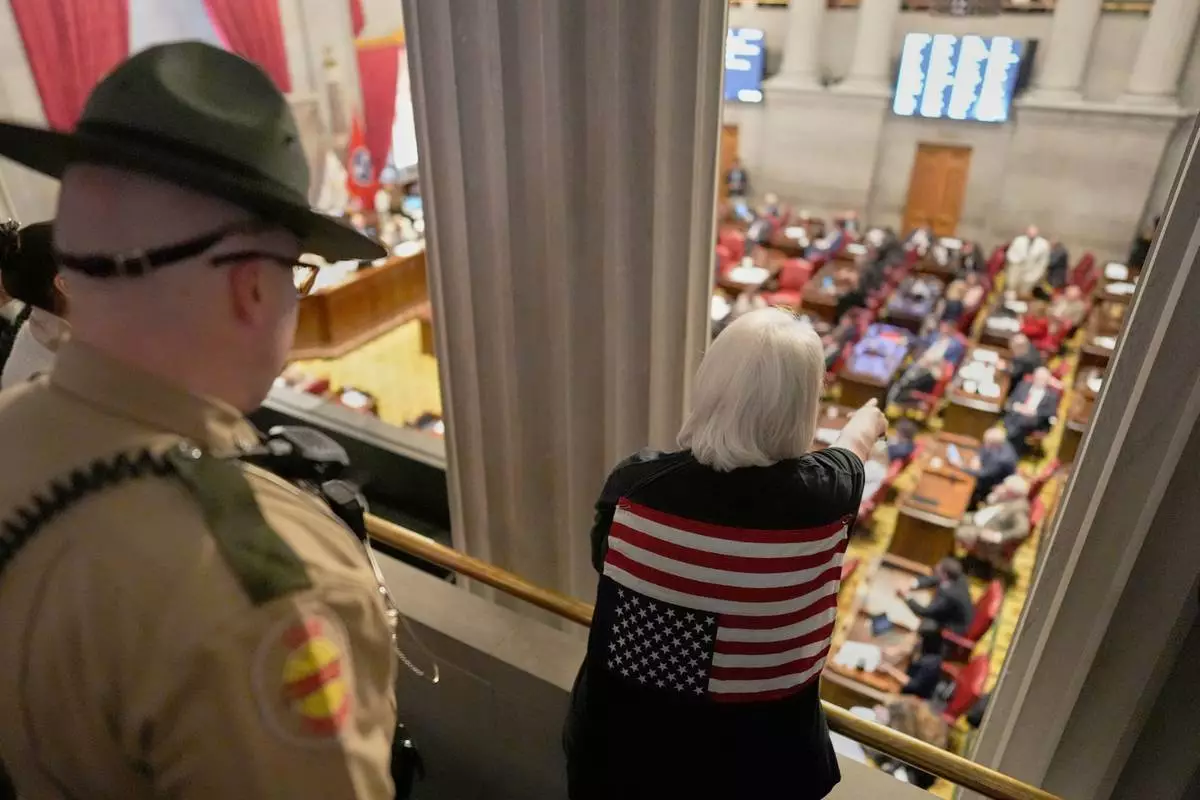
A woman yells down to the House floor as the gallery is cleared by state troopers during a special session of the state legislature to redraw U.S. Congressional voting maps Thursday, May 7, 2026, in Nashville, Tenn. (AP Photo/George Walker IV)
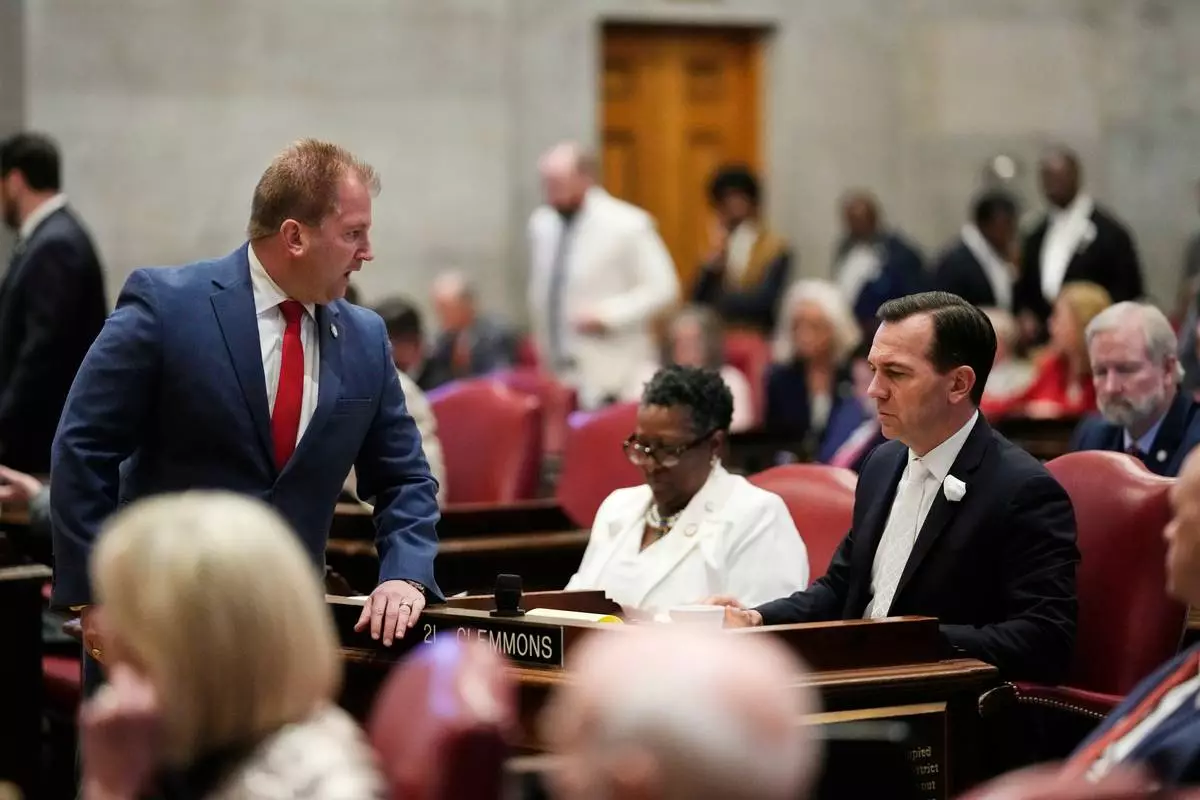
Rep. William Lamberth, R-Portland, left, speaks with Rep. John Ray Clemmons, D-Nashville, right, during a special session of the state legislature to redraw U.S. Congressional voting maps Thursday, May 7, 2026, in Nashville, Tenn. (AP Photo/George Walker IV)

A woman protests outside the House chamber before a special session of the state legislature to redraw U.S. Congressional voting maps Thursday, May 7, 2026, in Nashville, Tenn. (AP Photo/George Walker IV)
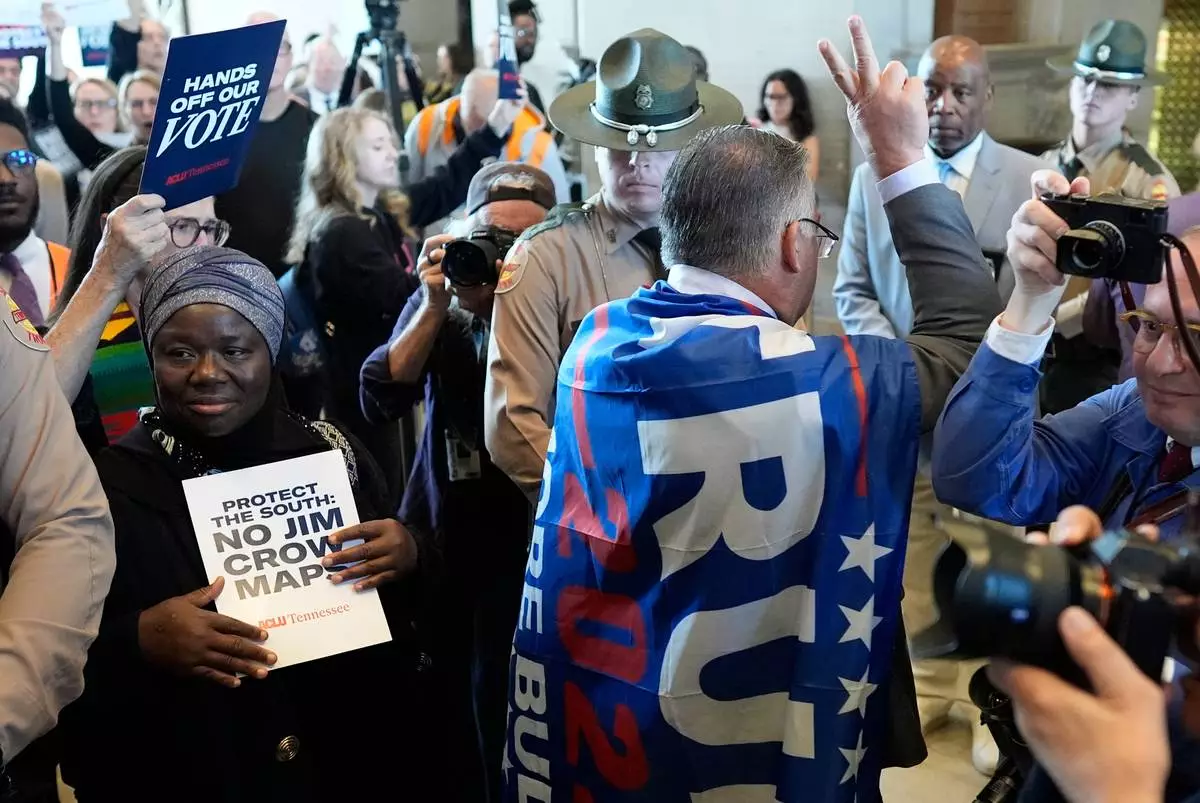
Rep. Todd Warner, R-Chapel Hill, arrives to the House chamber wearing a Trump flag for a special session of the state legislature to redraw U.S. Congressional voting maps Thursday, May 7, 2026, in Nashville, Tenn. (AP Photo/George Walker IV)

House Speaker Cameron Sexton, R-Crossville, sits alone after a House committee meeting during a special session of the state legislature to redraw U.S. Congressional voting maps Wednesday, May 6, 2026, in Nashville, Tenn. (AP Photo/George Walker IV)

State troopers clear a House committee meeting after it was disrupted by protesters during a special session of the state legislature to redraw U.S. Congressional voting maps Wednesday, May 6, 2026, in Nashville, Tenn. (AP Photo/George Walker IV)
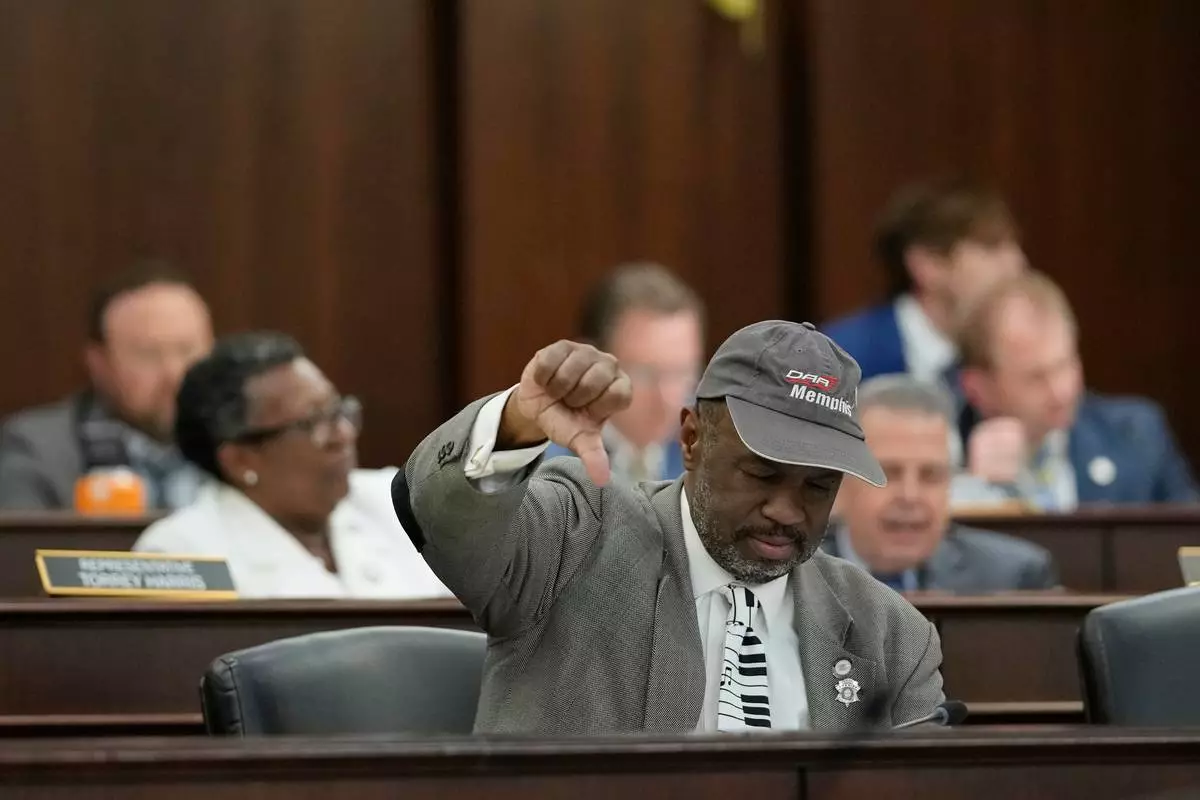
Rep. Joe Towns Jr., D-Memphis, gestures during procedural vote in a House committee meeting of a special session of the state legislature to redraw U.S. Congressional voting maps Wednesday, May 6, 2026, in Nashville, Tenn. (AP Photo/George Walker IV)