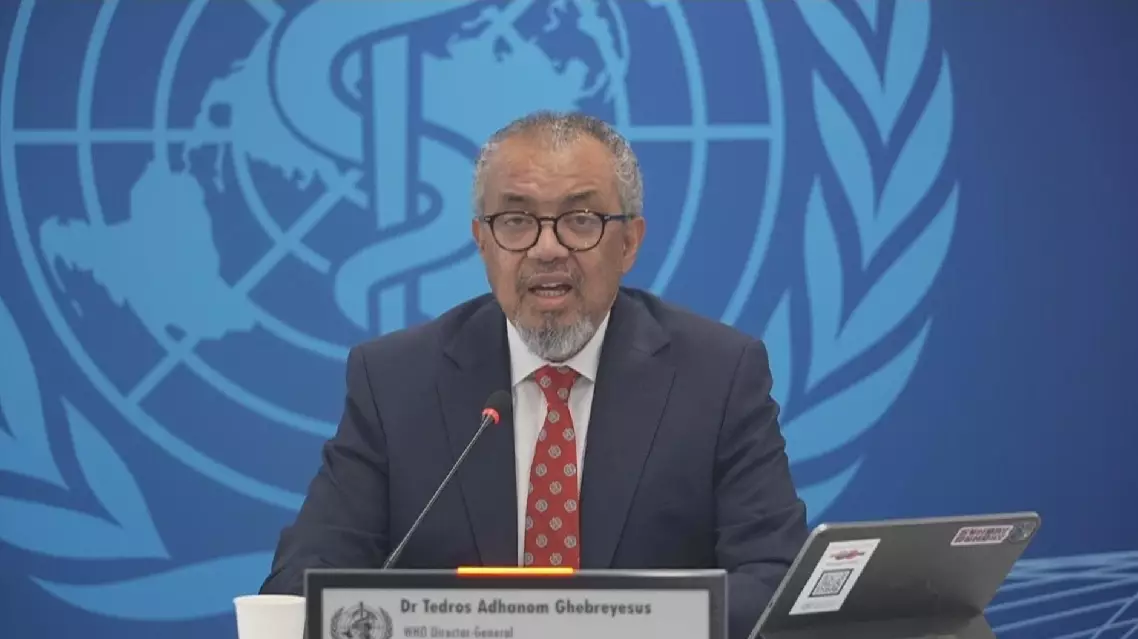
Five of the eight cases reported from the cruise ship MV Hondius were confirmed as hantavirus infection, and the virus involved is the Andes virus, said World Health Organization (WHO) Director-General Tedros Adhanom Ghebreyesus on Thursday.
The outbreak aboard the cruise ship has infected eight people and resulted in three deaths, Tedros told a press conference.
"So far, eight cases have been reported, including three deaths. Five of the eight cases have been confirmed as hantavirus, and the other three are suspected," he said.
The virus involved is the Andes virus, according to Tedros.
"The species of hantavirus involved in this case is the Andes virus -- which is found in Latin America and is the only species known to be capable of limited transmission between humans," he said.
The Andes virus, a rare hantavirus found mainly in South America, is a rodent-borne virus capable of limited human-to-human transmission. Previous outbreaks showed transmission typically occurred through close and prolonged contact, particularly among household members and healthcare workers.
Tedros noted that given the incubation period for the Andes virus, which can be up to six weeks, "it's possible that more cases may be reported."
But he stressed that, "While this is a serious incident, WHO assesses the public health risk as low."
The ship is currently sailing for the Canary Islands. Passengers abroad have been asked to remain in their cabins while being disinfected. Anyone who develops symptoms will be isolated immediately.
The director-general noted that the WHO is aware of reports of other people with symptoms who may have had contact with one of the passengers, and each case remains in close contact with the relevant authorities.
"Our priorities are to ensure the affected patients receive care, that the remaining passengers on the ship are kept safe and treated with dignity, and to prevent any further spread of the virus," he said.
Hantavirus outbreak on cruise ship involves Andes virus: WHO

The deadly hantavirus outbreak aboard the cruise ship in the Atlantic Ocean poses a low global public health risk and the ship is currently sailing for the Canary Islands, the World Health Organization (WHO) and the United Nations said on Thursday.
Three people have died and several others have fallen ill aboard the Dutch-flagged MV Hondius, prompting a major international public health response involving countries across Europe, Africa and Latin America.
The first alert came from the United Kingdom, which notified WHO of the outbreak after passengers aboard the vessel developed severe respiratory illness during the trip from Argentina to Cabo Verde.
Briefing journalists in Geneva, WHO Director-General Tedros Adhanom Ghebreyesus said eight cases had been reported so far, including five laboratory-confirmed infections and three suspected cases linked to the rare Andes strain of hantavirus.
Hantaviruses are zoonotic viruses carried by rodents and are usually transmitted to humans through contact with infected animals or their urine, saliva or droppings.
The Andes strain, found in parts of Latin America, is the only known hantavirus capable of limited human-to-human transmission.
Tedros warned that additional cases may still emerge because the incubation period for Andes hantavirus can be up to six weeks.
Maria Van Kerkhove, the WHO's chief of Epidemic and Pandemic Preparedness and Prevention, stressed at a press conference in Geneva that this outbreak is not the 2020 COVID pandemic which killed millions worldwide.
The outbreak has triggered action under the International Health Regulations, the global framework designed to coordinate responses to cross-border health threats.
WHO said it is working closely with authorities in Cabo Verde, Spain, the Netherlands, South Africa, the United Kingdom and Argentina, alongside the European Centre for Disease Prevention and Control.
Spain has agreed to allow the vessel to dock in the Canary Islands, an autonomous Spanish community, after Cabo Verde declined the request because of public health concerns.
Stephane Dujarric, spokesperson for the UN secretary-general told a daily briefing Thursday that the ship is currently sailing for the Canary Islands, and the United Nations is coordinating with other countries to conduct medical assessments, patient transfers, and shipboard disease control.
"The World Health Organization and the UN team have also supported with tracking and investigating cases, guidance to health professionals, infection prevention measures on board the ship, lab investigations and the provision of medical supplies to the vessel," he said.
Meanwhile, medical professionals have boarded the ship to conduct further assessments of those on board.
"A WHO expert boarded the ship in Cabo Verde and has been joined by two doctors from the Netherlands and an expert from the European Centre for Disease Prevention and Control. They will stay aboard the ship until it reaches its next destination in the Canary Islands. They are conducting medical assessment of everyone on board and gathering information to assess the risk of infection," Dujarric said.
According to WHO, transmission generally requires close and prolonged contact, particularly among household members, intimate partners or healthcare workers.
Passengers abroad have been asked to remain in their cabins while being disinfected. Anyone who develops symptoms will be isolated immediately.
Cruise ship hantavirus poses low global public health risk: WHO