Skip to Content Facebook Feature Image

Iran rejects US-Bahrain draft on Hormuz, calls resolution "flawed"

China

China

China

Iran rejects US-Bahrain draft on Hormuz, calls resolution "flawed"

2026-05-08 12:43 Last Updated At:18:37

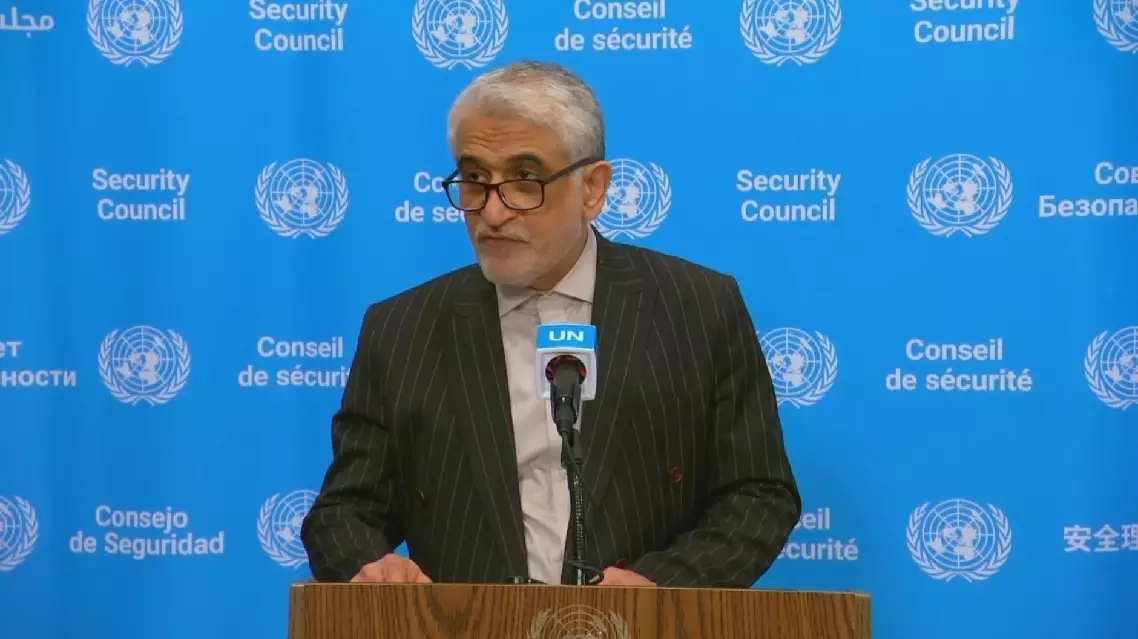
Iran on Thursday rejected a United Nations (UN) draft resolution tabled by the United States and Bahrain on the Strait of Hormuz, emphasizing that it fails to address the root cause of the crisis.

Iran's UN envoy Amir-Saeid Iravani dismissed the draft resolution as "flawed" and "politically motivated," stressing that the way forward in the Strait of Hormuz is not coercive Security Council action but a permanent end to the war, removal of the maritime blockade, and restoration of normal passage through the strait.

He added that the draft resolution seeks to legitimize U.S. actions against Iran in the Persian Gulf and the Strait of Hormuz with an excuse of "freedom of navigation."

"Iran's position is clear. The only viable solution in the Strait of Hormuz is a permanent end to the war, the lifting of maritime blockade, and the restoration of normal passage. Instead, the U.S. is pushing a flawed, politically-motivated draft resolution under the pretext of freedom of navigation to advance its political agenda and legitimize unlawful actions, not to resolve the crisis," said Iravani.

Iravani said that the immediate cause of the crisis in the Strait of Hormuz is the illegal war launched by the U.S. and Israel against Iran since Feb 28.

Iran opposes accusations in the draft resolution regarding its violation of the ceasefire, attacks on vessels, and placement of sea mines, Iravani said, adding that the U.S. actions constitute substantial violations of the ceasefire and the freedom of navigation.

"The sponsors of the draft selectively evoke international law, including the United Nations Convention on the Law of the Sea, while disregarding the United States' own egregious violations," said Iravani.

Earlier on Thursday, U.S. and representatives of Gulf countries held a press conference at the UN headquarters, saying the draft resolution condemns Iran's actions in the Strait of Hormuz and warned Iran of sanctions if it does not lift restrictions on the vital waterway.

Iran's rejection comes amid a fragile April 8 ceasefire that followed more than 40 days of fighting sparked by U.S. and Israeli strikes on Iranian cities in late February.

Iran tightened its grip on the Strait of Hormuz beginning Feb 28, when it barred safe passage to vessels belonging to or affiliated with Israel and the United States following their joint strikes on Iranian territory.

The United States imposed its blockade on the Strait of Hormuz, preventing ships traveling to and from Iranian ports from transiting the waterway, after post-ceasefire negotiations with Iran in Pakistan's capital Islamabad on April 11 and 12 failed to lead to an agreement.
Iran rejects US-Bahrain draft on Hormuz, calls resolution "flawed"
Iran rejects US-Bahrain draft on Hormuz, calls resolution "flawed"

Japanese Prime Minister Sanae Takaichi's political stunts both at home and abroad cannot whitewash Japan's World War II (WWII) aggression, but instead expose the schemes of the country's far-right forces to incite bloc confrontation and promote remilitarization, says a China Media Group commentary published on Sunday.

An edited English version of the commentary is as follows:

In recent days, Takaichi has faced fierce criticism both domestically and internationally.

Her political stunt of kneeling in front of the Tomb of the Unknown Australian Soldier to lay flowers at the Australian War Memorial in Canberra during her visit to Australia further exposed her multiple political calculations to the international community.

Choosing to kneel in front of a tomb in Australia, Takaichi was not regretting for Japan's aggression and atrocities during World War II.

This act not only reveals the distorted world outlook of Japanese politicians, but also exposes their attempts to mislead public opinion, whitewash the crimes of WWII aggression, instigate bloc confrontation, and push for military buildup.

From "fawning diplomacy" during her U.S. visit in March to the recent kneeling show during her visit to Australia in May, Takaichi has been trying to cultivate a friendly image towards the West.

Geopolitically speaking, Japan's far-right forces are trying to expand their military and breach from the restraints of the pacifist constitution by exaggerating external threats. To this end, they are making every effort to exploit geopolitical conflicts and draw neighboring countries, especially Western countries, into bloc confrontation.

Since the end of WWII, Japanese leaders have never apologized to the people of victim countries such as China, the Republic of Korea, and the Democratic People's Republic of Korea. Many Japanese politicians have even tried every means to justify the war crimes.

In particular, Takaichi has questioned the 1995 Murayama Statement, denied the Nanjing Massacre, visited the notorious Yasukuni Shrine annually for many consecutive years, and revived military rank titles during WWII, such as "taisa."

On the issue of Japan's history of aggression, Takaichi's insidious move cannot deceive the world.

Takaichi's political stunts both at home and abroad are a provocation against WWII victim countries in Asia and other regions.

This cannot conceal Japan's remilitarization attempt or the reality that " neo-militarism" is spreading and becoming a threat.

All countries that have suffered from Japanese militarist aggression should remain highly vigilant and united, and work together to safeguard the outcomes of WWII victory, so that historical tragedies never repeat themselves.

Takaichi's political stunts cannot whitewash Japan's history of aggression, remilitarization attempt: commentary

Takaichi's political stunts cannot whitewash Japan's history of aggression, remilitarization attempt: commentary

Recommended Articles