More than 120 defense officials, experts, scholars and representatives from over 40 countries and international organizations are gathering at the Beijing Xiangshan Forum Navigator Meeting to discuss international and regional security hotspots and the future of global governance.
Representatives from Brazil, Germany, France, Russia, Cambodia, Malaysia, and other countries participated in the meeting, themed "Global Security Governance: Challenges and Approaches."
Following the opening ceremony on Friday morning, there were the roundtable discussions focusing on four topics: "International Order and International Rule of Law," "New Security Challenges in the Asia-Pacific," "Responsibility for Safeguarding International Common Security" and "Risk Control in the Military Application of Emerging Technologies."
As the second edition following its successful launch last year, the Navigator Meeting has attracted more guests from more countries and will lay the foundation for the 13th Beijing Xiangshan Forum, scheduled to be held this autumn.
This year marks the 20th anniversary of the Beijing Xiangshan Forum.
A commemorative session titled "The Role of International Forums in Global Security Governance" will be held on Friday afternoon.
The session will invite representatives from globally renowned defense and security think tanks to review the 20-year journey of the Xiangshan forum and discuss the unique value of international security forums in facilitating equal dialogues, building consensus, and bridging differences.
Held from Thursday to Saturday, the Navigator Meeting is co-hosted by the China Association for Military Science and the China Institute for International Strategic Studies.
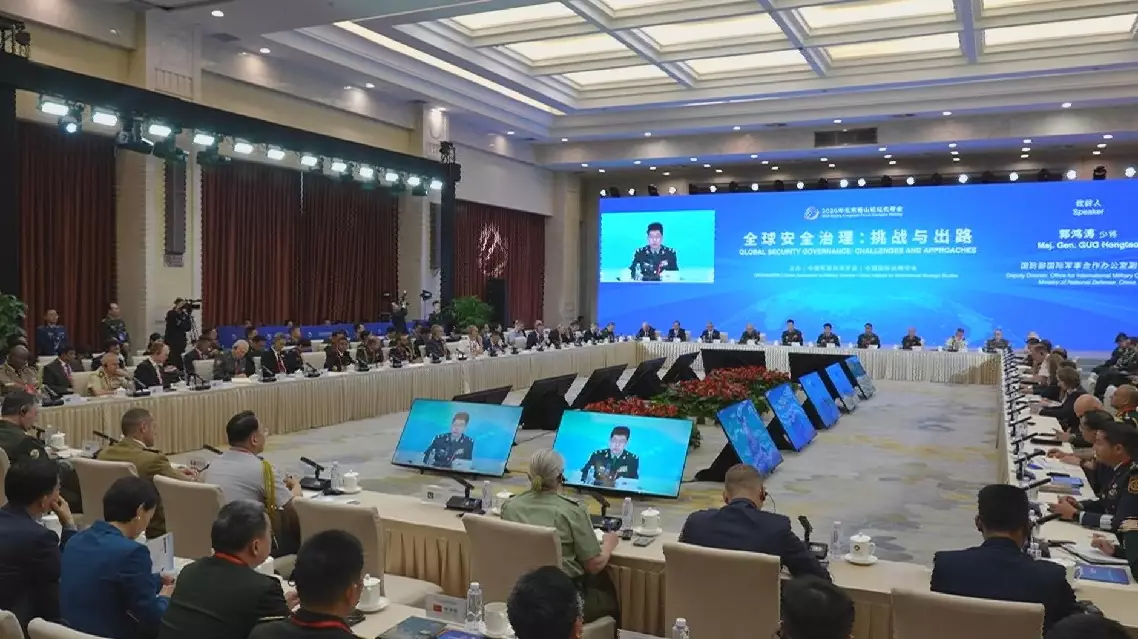
Chinese military organizations hold int'l security meeting with over 40 country representatives
Japanese Prime Minister Sanae Takaichi's political stunts both at home and abroad cannot whitewash Japan's World War II (WWII) aggression, but instead expose the schemes of the country's far-right forces to incite bloc confrontation and promote remilitarization, says a China Media Group commentary published on Sunday.
An edited English version of the commentary is as follows:
In recent days, Takaichi has faced fierce criticism both domestically and internationally.
Her political stunt of kneeling in front of the Tomb of the Unknown Australian Soldier to lay flowers at the Australian War Memorial in Canberra during her visit to Australia further exposed her multiple political calculations to the international community.
Choosing to kneel in front of a tomb in Australia, Takaichi was not regretting for Japan's aggression and atrocities during World War II.
This act not only reveals the distorted world outlook of Japanese politicians, but also exposes their attempts to mislead public opinion, whitewash the crimes of WWII aggression, instigate bloc confrontation, and push for military buildup.
From "fawning diplomacy" during her U.S. visit in March to the recent kneeling show during her visit to Australia in May, Takaichi has been trying to cultivate a friendly image towards the West.
Geopolitically speaking, Japan's far-right forces are trying to expand their military and breach from the restraints of the pacifist constitution by exaggerating external threats. To this end, they are making every effort to exploit geopolitical conflicts and draw neighboring countries, especially Western countries, into bloc confrontation.
Since the end of WWII, Japanese leaders have never apologized to the people of victim countries such as China, the Republic of Korea, and the Democratic People's Republic of Korea. Many Japanese politicians have even tried every means to justify the war crimes.
In particular, Takaichi has questioned the 1995 Murayama Statement, denied the Nanjing Massacre, visited the notorious Yasukuni Shrine annually for many consecutive years, and revived military rank titles during WWII, such as "taisa."
On the issue of Japan's history of aggression, Takaichi's insidious move cannot deceive the world.
Takaichi's political stunts both at home and abroad are a provocation against WWII victim countries in Asia and other regions.
This cannot conceal Japan's remilitarization attempt or the reality that " neo-militarism" is spreading and becoming a threat.
All countries that have suffered from Japanese militarist aggression should remain highly vigilant and united, and work together to safeguard the outcomes of WWII victory, so that historical tragedies never repeat themselves.

Takaichi's political stunts cannot whitewash Japan's history of aggression, remilitarization attempt: commentary