THE HAGUE, Netherlands (AP) — Countries around the world are preparing to deal with the 140 passengers and crew members on board a hantavirus-stricken cruise ship headed for the Canary Islands.
The vessel is expected to reach the Spanish island of Tenerife, off the coast of West Africa, early Sunday morning.
At least three passengers have died, and several other people have been infected.
Hantavirus is usually spread by the inhalation of contaminated rodent droppings. Symptoms usually show between one and eight weeks after exposure. The World Health Organization says the risk to the wider public from the outbreak is low, but the Andes virus implicated in the cruise ship outbreak may be able to spread between people in rare cases.
Authorities and the cruise operator have been providing updates, but some key information is still lacking.
Here's what we don't know:
Argentine investigators suspect a Dutch couple may have first contracted the virus while on a bird-watching trip before they boarded the cruise ship in Argentina on April 1. But no organization has confirmed where or how they acquired the disease.
Argentina’s Health Ministry has zeroed in on the nation's southernmost town, Ushuaia. Officials plan to travel there in the coming days according to a written statement to The Associated Press. No explanation was given for the delay.
Spanish authorities are preparing to receive the remaining passengers and crew members on Tenerife. Officials said Friday that once the ship reaches Tenerife, passengers will be evacuated in small boats to buses only once their repatriation flights are ready to take them.
The United States has agreed to send a plane to the Canary Islands to pick up its citizens, as will the British government. Other countries have not yet made their plans public and it is not clear for how long passengers on the boat will have to wait for their flights.
Virginia Barcones, Spain’s head of emergency services, said on Friday the country had requested medically equipped planes for passengers experiencing symptoms but it wasn't known if those would be available.
According to cruise operator Oceanwide Expeditions, the MV Hondius departed Ushuaia on April 1 and made two stops before the outbreak occurred.
Six more passengers boarded at the remote island of Tristan da Cunha. The ship then made a stop at the island of St. Helena, where 30 passengers disembarked, including a Dutch woman and the body of her deceased husband. The nationalities of two of those 30 passengers are unknown. They are thought to be Chileans who boarded at Tristan da Cunha, according to the company.
Stephen Doughty, the U.K. minister of overseas territories, said on Friday that a resident of Tristan da Cunha has been hospitalized with symptoms of hantavirus. It is not clear if this person was a passenger on the ship.
Initial figures provided by Oceanwide Expeditions said the ship left Argentina with 114 passengers and an unknown number of crew members onboard. Later figures provided by Oceanwide Expeditions say the ship had 61 crew members from 12 countries, but it’s not known if any of the crew changed during the ship’s journey.
Oceanwide Expeditions was forced to update the number and nationalities of the passengers who disembarked on St. Helena after discovering a discrepancy in their initial figures. Their number is lower than the Dutch Foreign Ministry's estimate, and the reason for the difference is unknown.
Many of the passengers who disembarked at St. Helena traveled on to other countries, including the Dutch woman whose husband died on board. She flew to Johannesburg then briefly boarded a plane preparing to fly to Amsterdam. She was removed because she was too ill to travel, and later died.
South African and Dutch authorities are trying to trace the whereabouts of anyone who had contact with the deceased woman during her travels. A flight attendant, who had contact with the woman, has tested negative for hantavirus after reporting symptoms.
Some governments, like the United Kingdom, have confirmed the whereabouts of their citizens who left the boat. According to U.K health officials, two are self-isolating at home, four remain on St. Helena, and one “has been traced outside of the U.K..” However, U.K. officials do not know or have not made public how many others they have come into contact with since.

FILE - Health workers in protective gear evacuate patients from the MV Hondius cruise ship into an ambulance at a port in Praia, Cape Verde, May 6, 2026. (AP Photo/Misper Apawu, File)
The Virginia Supreme Court on Friday struck down a voter-approved Democratic congressional redistricting plan, delivering another major setback to the party in a nationwide battle against Republicans for an edge in this year's midterm elections.
The court ruled 4-3 that the state's Democratic-led legislature violated procedural requirements when it placed the constitutional amendment on the ballot to authorize the mid-decade redistricting. Voters narrowly approved the amendment April 21, but the court's ruling renders the results of that vote meaningless.
Writing for the majority, Justice D. Arthur Kelsey wrote that the legislature submitted the proposed constitutional amendment to voters “in an unprecedented manner.”
“This violation irreparably undermines the integrity of the resulting referendum vote and renders it null and void," he wrote.
Democrats had hoped to win as many as four additional U.S. House seats under Virginia's redrawn U.S. House map as part of an attempt to offset Republican redistricting done elsewhere at the urging of President Donald Trump. That ruling, combined with a recent U.S. Supreme Court decision severely weakening the Voting Rights Act, has supercharged the Republicans' congressional gerrymandering advantage heading into this year's midterm elections.
Richard Hudson, chairman of the National Republican Congressional Committee said the ruling was another sign of GOP momentum heading into the midterms.
"We’re on offense, and we’re going to win,” he said in a statement.
Legislative voting districts typically are redrawn once a decade after each census to account for population changes. But Trump started an unusual flurry of mid-decade redistricting last year when he encouraged Republican officials in Texas to redraw districts in a bid to win several additional U.S. House seats and hold on to their party's narrow majority in the midterm elections.
California responded with new voter-approved districts drawn to Democrats' advantage, and Utah's top court imposed a new congressional map that also helps Democrats. Meanwhile, Republicans stand to gain from new House districts passed in Florida, Missouri, North Carolina, Ohio and Tennessee. They could add even more after the U.S. Supreme Court's ruling in the Voting Rights Act case, which has prompted some other Republican states to consider redrawing their maps in time for this year’s elections.
Virginia currently is represented in the U.S. House by six Democrats and five Republicans who were elected from districts imposed by a court after a bipartisan redistricting commission failed to agree on a map after the 2020 census. The new districts could have given Democrats an improved chance to win all but one of the state's 11 congressional seats.
Under the Demcoratic-drawn map, five districts would have been anchored in the Democratic stronghold of northern Virginia, including one stretching out like a lobster to consume Republican-leaning rural areas. Revisions to four other districts across Richmond, southern Virginia and Hampton Roads would have diluted the voting power of conservative blocs in those areas. And a reshaped district in parts of western Virginia would have lumped together three Democratic-leaning college towns to offset other Republican voters.
The state Supreme Court’s seven justices are appointed by the state legislature, which has toggled back and forth between Democratic, Republican and split control over recent years. Legal experts say the body doesn’t have a set ideological profile
The case before the court focused not on the shape of the new districts but rather on the process the General Assembly used to authorize them.
Because the state’s redistricting commission was established by a voter-approved constitutional amendment, lawmakers had to propose an amendment to redraw the districts. That required approval of a resolution in two separate legislative sessions, with a state election sandwiched in between, to place the amendment on the ballot.
The legislature’s initial approval of the amendment occurred last October — while early voting was underway but before it concluded on the day of the general election. The legislature’s second vote on the amendment occurred after a new legislative session began in January. Lawmakers also approved a separate bill in February laying out the new districts, subject to voter approval of the constitutional amendment.
Judicial arguments focused on whether the legislature’s initial approval of the amendment came too late, because early voting already had begun for the 2025 general election.
Attorney Matthew Seligman, who defended the legislature, argued that the “election” should be defined narrowly to mean the Tuesday of the general election. In that case, the legislature’s first vote on the redistricting amendment occurred before the election and was constitutional, he told judges.
An attorney for the plaintiffs, Thomas McCarthy, argued that an “election” should be interpreted to cover the entire period during which people can cast ballots, which lasts several weeks in Virginia. If that’s the case, he told justices, then the legislature’s initial endorsement of the redistricting amendment came too late to comply with the state constitution.
In January, a judge in rural Tazewell County, in southwestern Virginia, ruled that lawmakers failed to follow their own rules for adding the redistricting amendment to a special session last fall. Circuit Judge Jack Hurley Jr. also ruled that lawmakers failed to initially approve the amendment before the public began voting in last year’s general election and that the state had failed to publish the amendment three months before the election, as required by law. As a result, he said, the amendment is invalid and void.
The Virginia Supreme Court placed Hurley’s order on hold and allowed the redistricting vote to proceed before hearing arguments on the case.
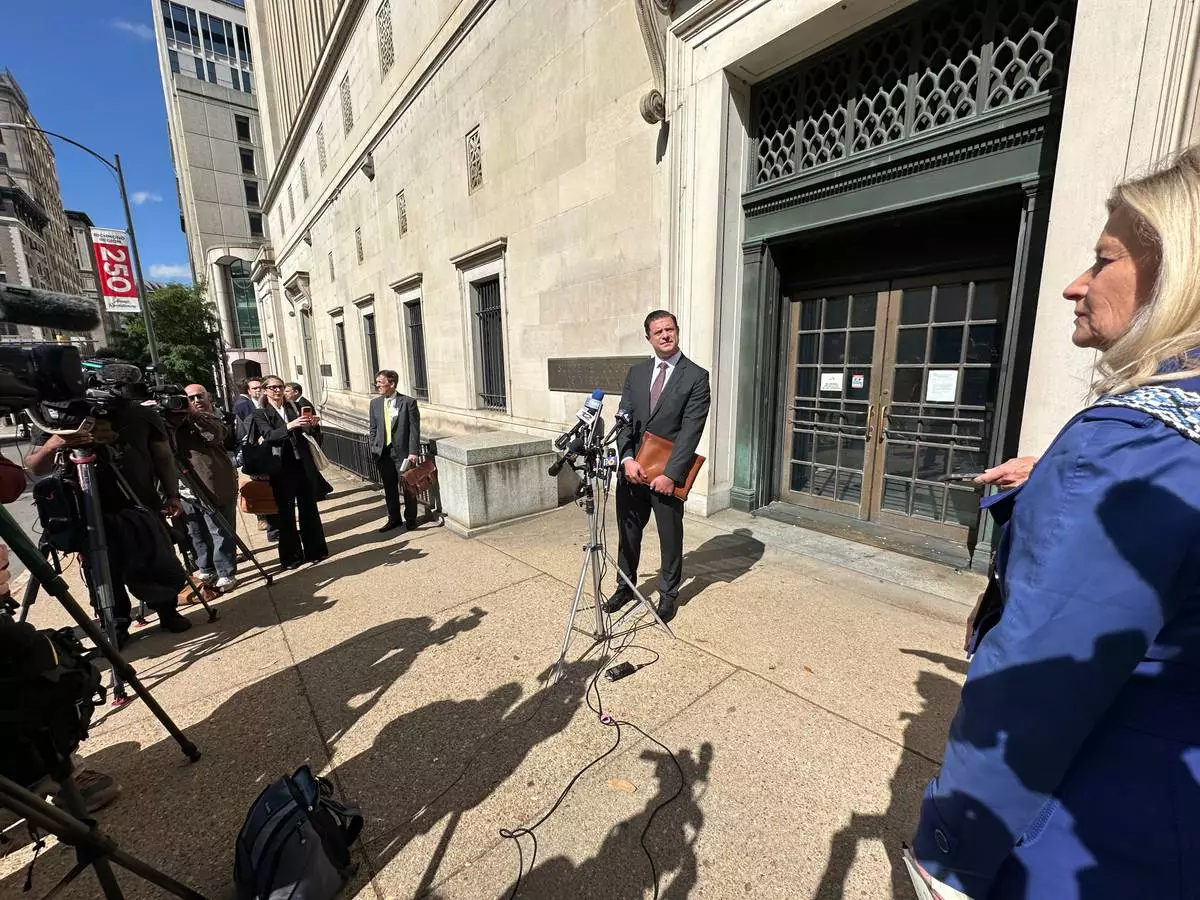
Attorney Matthew Seligman, representing Democratic state legislators, speaks with the media following a hearing on new congressional maps before the state Supreme Court in Richmond, Va., on Monday, April 27, 2026. (AP Photo/Allen G. Breed)

State Senate Minority Leader Ryan McDougle, center, speaks outside the Supreme Court of Virginia after arguments were heard in a redistricting-related case at the court in Richmond, Va., on Monday, April 27, 2026. (AP Photo/Allen G. Breed)