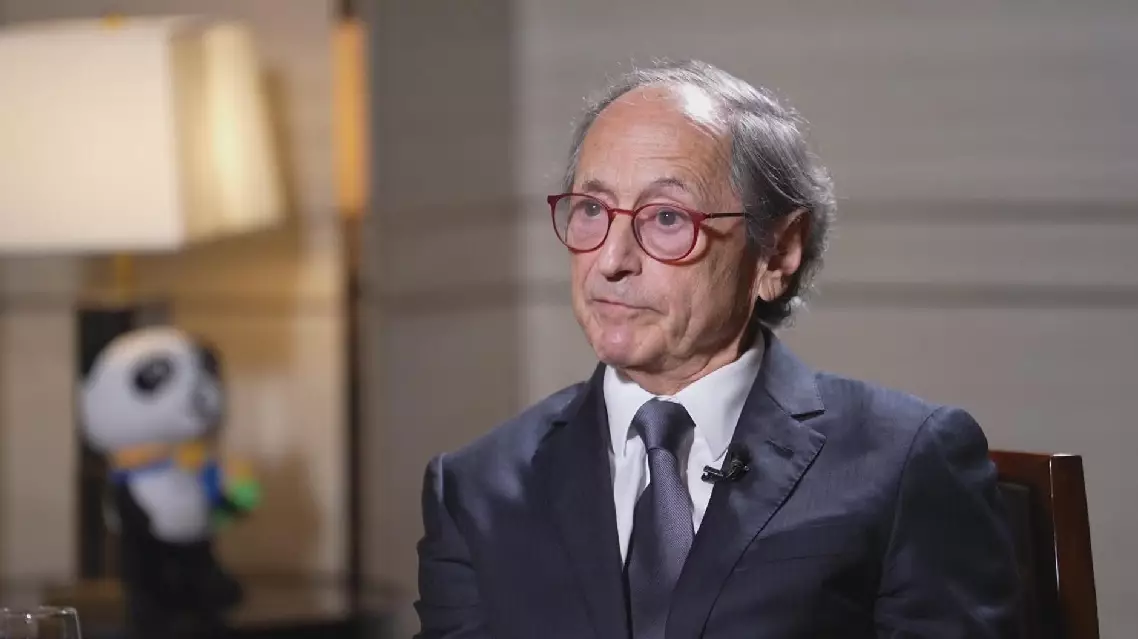
Artificial intelligence (AI) will not fully replace humans because their individuality and unconventional thinking remain vital, just as seen in literary works like "The Three-Body Problem," said Nobel Prize-winning chemist Michael Levitt.
In an interview with the China Media Group (CMG) aired Friday, Levitt, 2013 Nobel laureate in chemistry, said that for the foreseeable future, the unique thinking and individuality of humans, combined with AI, will be more powerful than either alone.
"I believe that for the foreseeable future, AI and humans will be better than humans alone and AI alone. Humans are very special and we think sometimes in strange ways. And the strange way is very important. I can give you an example. I'm sure you've read the book San-Ti, The Three-Body Problem. So in that book, the people who are having to find a way to avoid invasion are not normal. They're not the normal thinkers. And what I have found myself is when I use AI, it's very different than how my wife uses AI or how my sons use AI. Everyone uses AI in a very personal way and they get a combination of AI and themselves. That is also unique," said Levitt.
As for the future of AI, Levitt warned that questions of responsibility, including data dependence and the "black box" problem, must be addressed.
"So I think it's an existing issue even without AI. I think responsibility definitely needs to be balanced with rapid progress. If I steal something, then they might come to you and say 'did you steal it?' And you will say 'no, I can prove I was here' and so on. But if a program steals something, we don't, so we need to find a way that every computer chip, every program and every output program has ID. Responsibility is who is responsible, right? From my global point of view, I don't think any country has the perfect solution. And I think we need to learn, I think we need to realize that we need to improve. I am very happy that it is not one country, but it is several countries. So things will balance. Balance is very important and diversity is super important," said Levitt.
AI not to fully replace humans in foreseeable future: Nobel winner