China's commissioning of "five essentials for aircraft carriers" marks a a significant achievement of the People's Liberation Army (PLA) Navy’s accelerated transformation and development, said Jiang Bin, spokesman for the Ministry of National Defense, at a press conference in Beijing on Saturday.
The "five essentials" refer to stealth carrier-based fighters, multirole catapult-assisted carrier-based fighters, fixed-wing carrier-based early warning aircraft, fixed-wing electronic warfare aircraft, and anti-submarine helicopters.
"The package, or what media have dubbed the 'five essentials for aircraft carriers,' is a vital link in forming the systematic combat capability of aircraft carrier formations and a significant achievement in the PLA Navy’s accelerated transformation and development. Building a strong PLA Navy embodies the Chinese nation's long-cherished aspiration of striving to be a strong naval power and serves as an important guarantee for realizing national rejuvenation. In the new era, under the firm leadership of the CPC Central Committee, the Central Military Commission and President Xi, the modernization of the PLA Navy has become increasingly solid and powerful. From the air to the sea, from coastal waters to the open ocean, the types and functions of various weapons platforms have been continuously improved, achieving leapfrog development and innovative breakthroughs, providing stronger guarantees for safeguarding national sovereignty, security and development interests," he said.
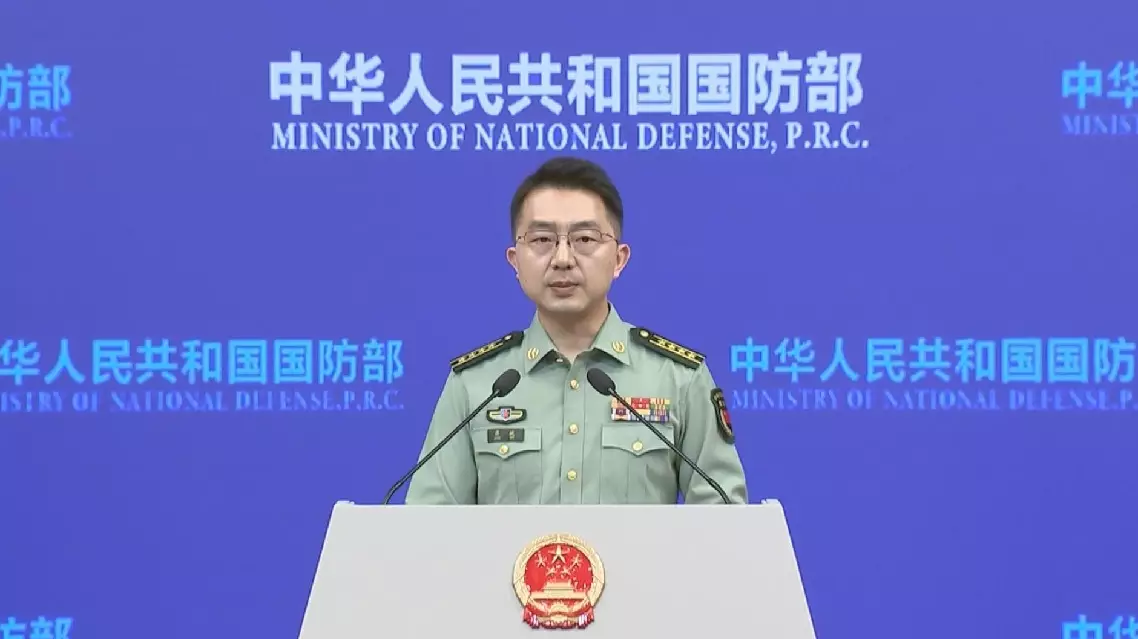
Spokesman confirms commissioning of 'five essentials' for carriers
Nicaragua's co-foreign minister Valdrack Jaentschke has warned that militarism must never be allowed to rise again, as Japan's recent moves to lift its arms export ban and revise the pacifist Constitution continue to draw international concern.
This year marks the 80th anniversary of the opening of the Tokyo Trials, where Japan's Class-A war criminals from World War II were brought to justice.
In an interview with China Global Television Network (CGTN), Valdrack Jaentschke voiced his concern that today's world order is being undermined by interventionism and other challenges.
"It is necessary for us to remember that after the end of World War II, countries worked hard to build a new international order based on international law. However, regrettably, more than 80 years later, we are seeing that this once explored and attempted order is being challenged by interventionism, a confrontational mindset, and tendencies like 'might makes right.' These are precisely the conditions that gave rise to fascism and militarism in the past, which ultimately led to the tragedy of World War II," he said.
He said the international community has a responsibility to pursue a new international order -- one fundamentally grounded in peace.
"Looking back at the history more than eight decades ago and comparing it with today's reality, it is our responsibility to recognize that the world should, and must, build a new international order that is more just, fairer, rooted in international law, based on a logic of mutual benefit and shared success, and fundamentally grounded in peace," said the minister.
"Today, as we revisit the Tokyo Trials, it is meant to remind the world that such a tragedy must never be repeated -- and that we must do everything in our power to prevent it from happening again. We must stop that dark world -- born from militarism, interventionism, and fascism -- from ever returning," he said.

Nicaraguan FM warns of militarism revival