China is preparing for the launch of the Tianzhou-10 cargo spacecraft, which will deliver a new generation of extravehicular spacesuits to the Tiangong space Station.
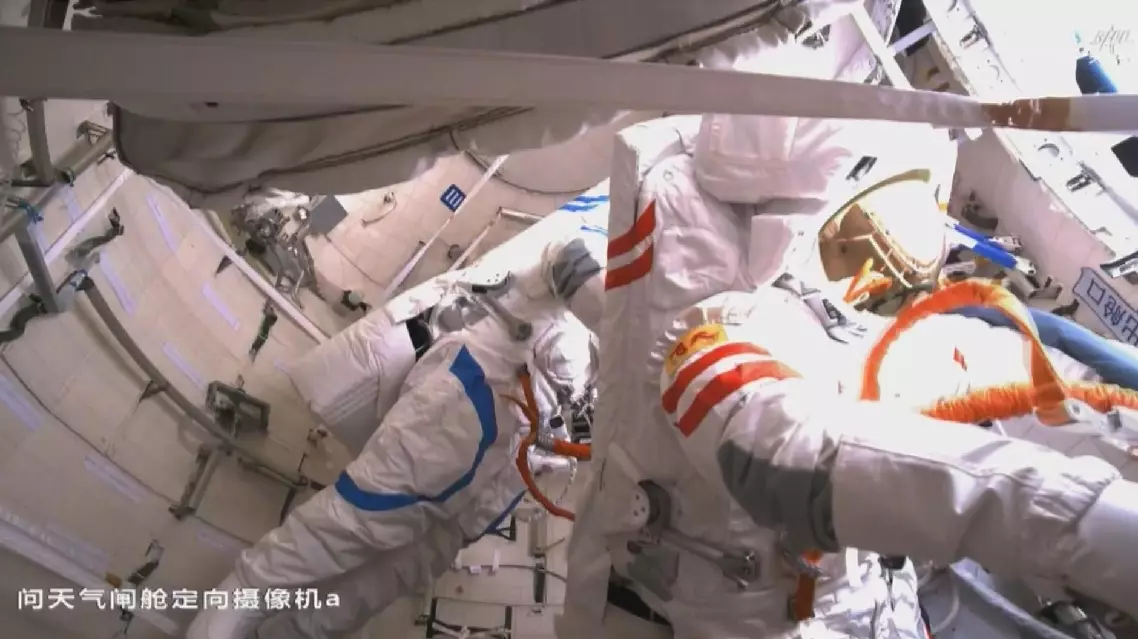
The new extravehicular spacesuit F, has its operational lifespan extended from the previous 15 extravehicular activities (EVAs) over three years to 20 EVAs over four years.
Building on the design of the second-generation Feitian spacesuits, the new generation adopts airtight bearings at the elbow and knee joints, significantly improving joint durability and flexibility.
The suit also features a more robust life-support system, enhanced thermal protection, and higher reliability.
To facilitate on-orbit maintenance, the new suit adopts a modular design that improves testability and repairability. Under this design, components that reach their lifespan or malfunction can be replaced in orbit, extending the overall service life of the entire suit.
While ensuring safety and reliability, the new model has also been optimized in terms of thermal comfort, human-machine interface, and operational safety, making it more comfortable and convenient for astronauts to wear.
"The new-generation spacesuit F maintains technical baseline consistency with its predecessors D and E. We have continuously optimized the design to make it more comfortable for astronauts during EVAs," said Zheng Zehao, a staff member at the Astronaut Center of China.
The space station's D and E extravehicular spacesuits were delivered into space by the Tianzhou-9 cargo spacecraft on July 15, 2025 as part of the second-generation Feitian spacesuit series.
Currently, the two spacesuits D and E have successfully supported three EVAs by the Shenzhou-21 crew.
The combination of the Tianzhou-10 cargo craft and a Long March-7 carrier rocket was vertically transferred to the launch site on Friday, according to the China Manned Space Agency (CMSA).
The cargo spacecraft will be launched at a proper time in the near future, the CMSA said.
China's Tianzhou-10 cargo spacecraft to deliver new generation spacesuits to Tiangong space station