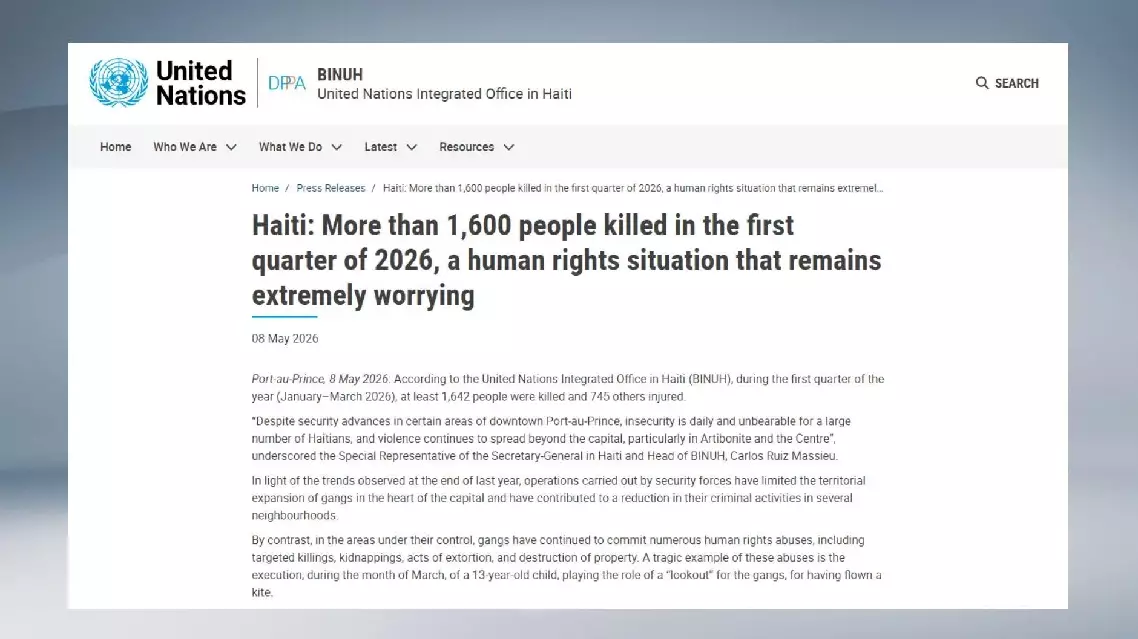
Continued gang violence and security force operations in Haiti caused at least 1,642 deaths and 745 injuries in the first quarter of 2026, according to a report released by the United Nations Integrated Office in Haiti (BINUH) on Friday.
The report said that "during the quarter, gang members were responsible for 27 percent of those killed and injured," while more than 69 percent of those killed or injured were "the result of operations carried out by security forces against gangs."
BINUH estimated that 4 percent of the casualties should be attributed to "self-defense groups targeting gang members and people suspected of collaborating with them."
The report said that "of all the victims of drone strikes, 69 were members of the population, including five children."
While security force operations have partially contained gang expansions in the heart of the capital, "in the areas under their control, gangs have continued to commit numerous human rights abuses, including targeted killings, kidnappings, acts of extortion, and destruction of property," according to the report.
Child trafficking also remains a serious concern in gang-controlled areas, said the report.
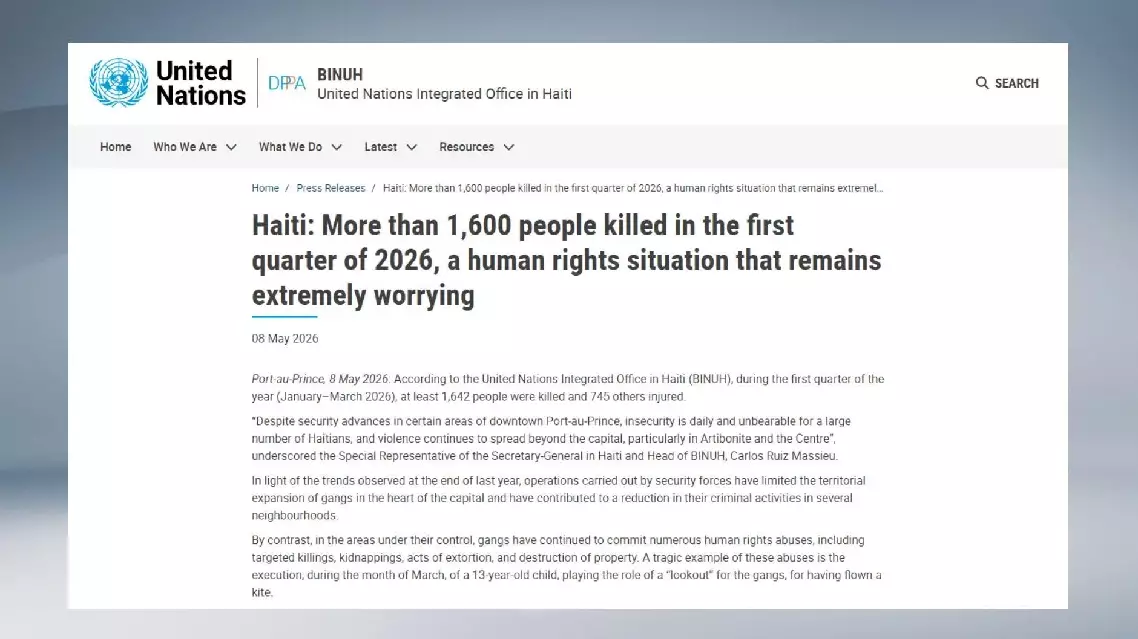
1,642 killed in Haiti violence in first quarter of 2026
After 156 days at sea and a journey spanning more than 40,000 kilometers, the Chinese scientific research ship Tansuo-1 returned to Guangzhou City, south China's Guangdong Province, on Sunday with major deep-ocean discoveries.
The vessel carried the deep-sea manned submersible Fendouzhe (Striver), which completed 63 dives, including 50 deeper than 6,000 meters, during a groundbreaking Pacific expedition and conducted the first China-Chile joint crewed exploration of the Atacama Trench.
Scientists from six countries, namely China, Chile, Germany, Denmark, Canada and Spain, collected rare biological and geological samples and captured stunning high-definition footage from some of the deepest places on Earth.
Among the key discoveries was the first finding of an ecosystem supported by geological fluid in the sunless deep sea of the southern hemisphere, providing crucial evidence for the "global chemosynthetic life corridor" hypothesis.
The team also recorded a rich variety of hadal organisms, including at least three types of snailfish, and large numbers of benthic creatures, many of which are believed to be previously unknown species.
In addition, researchers identified seabed fault-rupture structures linked to historic major earthquakes, offering in-situ evidence for understanding how seismic activity shapes deep-sea landforms and affects marine habitats.
Chinese research vessel Tansuo-1 returns with major deep-sea discoveries