As China prepares to launch the Tianzhou-10 cargo spacecraft, the Long March-7 carrier rocket assigned to the mission has been equipped with an intelligent fault-diagnosis system known as "Bianque."
Named after the legendary ancient Chinese physician Bian Que (407–310 BC), the system marks a significant step toward intelligent, self-correcting spaceflight.
Developed to support China's space station cargo resupply missions, the Long March-7 is a new-generation medium-lift launch vehicle renowned for its high reliability, enhanced safety protocols, and environment friendly propellants. This latest upgrade integrates the Bianque system directly into the rocket's architecture, enabling it to detect and respond to engine anomalies in real time -- potentially preserving mission success even in case of critical components malfunction.
The system is designed to ensure safe and reliable intelligent flight under engine-failure conditions, laying crucial technological groundwork for the next generation of smart, adaptive rockets.
"In case of an engine failure, it's highly likely to lead to mission failure. But for a rocket, a single engine malfunction does not necessarily mean the vehicle has completely lost its ability to continue performing its mission. The Bianque fault diagnosis system carried aboard the Long March-7 Y11 carrier rocket features three core functions: fault diagnosis, trajectory replanning, and guidance/attitude control reconfiguration. During flight, the Bianque system proactively diagnoses engine faults, receives flight status parameters like position, velocity, attitude and overload from the control system, then produces scientific diagnostic conclusions after data fusion. Our tests show that the online diagnosis process operates in the hundreds of milliseconds range," said Zhao Yongzhi, a member of China Aerospace Science and Technology Corporation.
This millisecond-level response capability allows the rocket to assess damage, recalculate its flight path, and adjust its guidance and attitude control systems autonomously -- functions previously managed primarily from ground control.
Looking ahead, Zhao highlighted how this technology aligns with broader industry trends.
"Reuse and intelligent flight represent two key technological traits of next-generation rockets. The Bianque fault diagnosis and response system loaded on this mission serves as a critical technology demonstration and verification flight for intelligent flight. It could lay an essential technological foundation for realizing intelligent flight in future-generation rockets," he said.
The combination of the Tianzhou-10 cargo craft and a Long March-7 carrier rocket was vertically transferred to the launch site on Friday, according to the China Manned Space Agency (CMSA).
The cargo spacecraft will be launched at a proper time in the near future, the CMSA said.
Currently, the facilities and equipment at the Wenchang Spacecraft Launch Site in the southern island province of Hainan are in good condition, and comprehensive functionality checks and joint tests are scheduled to proceed as planned ahead of the launch, the CMSA added.
The Tianzhou-9 separated from the orbiting Tiangong space station combination on Wednesday and re-entered the atmosphere under controlled conditions on Thursday. The space station has thus cleared a docking port to make room for the Tianzhou-10, the CMSA noted.

Long March-7 updated with smart fault-diagnosis system
A World Health Organization (WHO) medical epidemiologist on Sunday sought to ease public concerns over a hantavirus outbreak linked to a cruise ship, stressing that the virus is not airborne like COVID-19 and that the average person has no reason to worry.
Spain began evacuating passengers the same day from the hantavirus-stricken cruise ship MV Hondius, which had anchored earlier off the Port of Granadilla on the island of Tenerife.
The MV Hondius departed Argentina on April 1 with more than 140 passengers and crew from 23 countries on board. The ship has reported eight infections, including three deaths. Six of the cases have been laboratory-confirmed as Andes virus infections, caused by a rodent-borne hantavirus endemic to South America and the only known hantavirus strain capable of limited human-to-human transmission.
Boris Pavlin, a medical epidemiologist with the WHO, said the cruise ship affected by a hantavirus outbreak had been carefully managed by Spanish authorities and posed little risk to the general public. "This is not COVID. The average person does not need to be worried about hantavirus here in this setting. These folks are being managed very carefully, very deliberately, by the Spanish authorities; they're getting off the ship, they are getting into small boats, they are being spaced apart in the buses so there's no risk to one another. Even if one were to become symptomatic -- we know that none of them were symptomatic as they have been leaving the ship -- they're going straight to their aircraft and they're being taken to their respective national jurisdictions," he said.
Pavlin said the exact source of exposure remained under investigation, but the initial cases appeared to be linked to a pre-cruise land excursion in South America.
"From what we understand of the initial cases, there was -- as one does often on a cruise -- there was a land-side excursion before the cruise in which places were visited that are home to these specific rodents that are associated with the Andes hantavirus. These are not worldwide rodents; the long-tailed rice rat is very specific to the Andes Cordillera region of South America, and that's where people who are exposed to the rodents were. So it was in one of those places they were exposed. We don't know exactly because there are several possibilities, and I believe that the Argentinian authorities are actually even going to look at that and try to do some animal sampling to get to the very bottom of it. But that part's not unexpected at all," he said.
The official praised Spanish authorities' handling of the ship and described the response as a closely coordinated international effort.
"This has been an extremely cooperative, collegial international effort. The Spanish authorities are very diligent and deliberate about what's happening here. There's nothing that would surprise us. I think that somebody might become exposed; we want to obviously make sure that people who are coming off the ship are not newly exposed to one another as they get off and go to their respective places, and we're not seeing that," Pavlin said.
But while the immediate disembarkation process had gone smoothly, he emphasized that health officials were not letting their guard down.
"However, the contact tracing and follow-up of every person who has been in even the lightest contact with the patients will continue until a maximum incubation period. In any case, there are contingency plans should someone become ill, and we know that it doesn't just spread like wildfire, so even if they were to become ill, we don't expect a large outbreak after this," the official said.
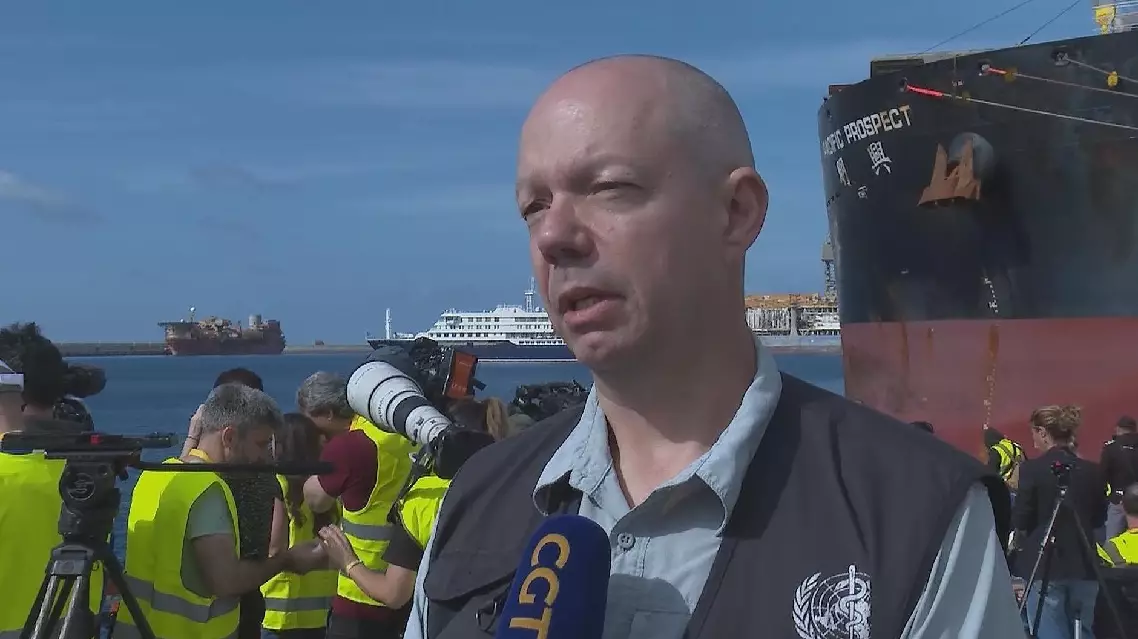
Cruise ship hantavirus outbreak "not COVID," poses low public risk: WHO expert