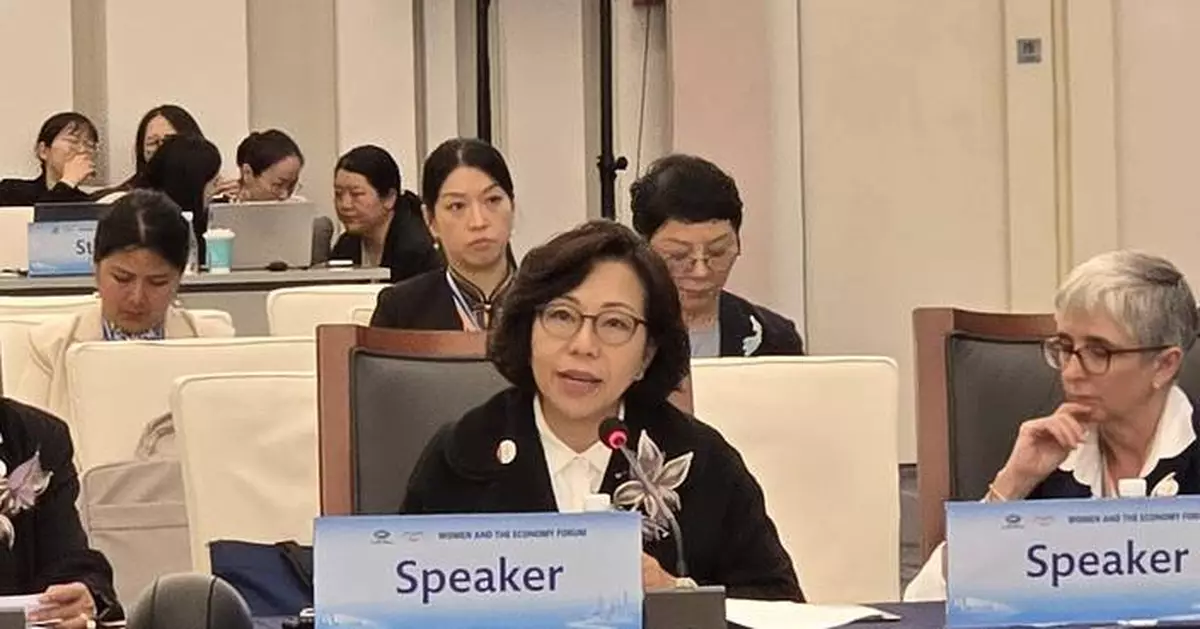
Speech by SHYA at 2026 APEC Women and Economy Forum Public-Private Dialogue on Women and Economy Panel on "Advancing Economic and Trade Cooperation"
Following is the speech by the Secretary for Home and Youth Affairs, Miss Alice Mak, at the 2026 Asia-Pacific Economic Cooperation (APEC) Women and the Economy Forum Public-Private Dialogue on Women and the Economy Panel on "Advancing Economic and Trade Cooperation" in Shanghai today (May 15):
Thank you Chair. Distinguished panelists, fellow colleagues and guests, good afternoon.
Let me begin with expressing once again our sincere appreciation to our country, the People’s Republic of China (PRC), for bringing us together for this year’s Public-Private Dialogue. The focus on advancing economic and trade co-operation is especially relevant as economies across the Asia Pacific continue to strengthen connectivity, deepen integration and explore new drivers of growth.
Hong Kong, China (HKC) stands as one of the world’s most open and dynamic economies. Our competitiveness is deeply rooted in our openness, seamless connectivity, and world-class expertise. It is no surprise that HKC's top-notch competitiveness regularly receives the highest recognition in different global studies. I am thrilled to share that our first quarter GDP (Gross Domestic Product) grew by 5.9 per cent - marking a near five-year high.
Trade has been an underlying force connecting our economies, starting from trade in the South China Sea and Northeast Asia in ancient times and across the Pacific over the past two hundred years. Throughout this history, women have played a pivotal role in weaving different trade networks into a regional community of common prosperity. They are leading micro, small and medium enterprises (MSMEs), spearheading the service sectors, and contributing to supply chain resilience. By further enhancing market access and support, capacity building and promoting inclusivity, we can create a more level playing field for women to untap economic potential.
In HKC, small and medium enterprises account for more than 98 per cent of our enterprises and employ around 45 per cent of the private sector workforce, around half of which is made up by women. We have therefore put in place targeted and result-oriented measures to support these enterprises, including many womenled enterprises, to flourish in crossborder trade.
One of HKC's APEC priorities is the promotion of inclusive growth of MSMEs. HKC runs over 70 funding schemes that support the development of our enterprises and industries in general. These include the Dedicated Fund on Branding, Upgrading and Domestic Sales, the SME Export Marketing Fund and the SME Financing Guarantee Scheme, which help our MSMEs to explore the Chinese Mainland and overseas markets, and to obtain financing. To expand global networks, the Economic and Trade Express, supported by Hong Kong's overseas economic and trade offices, connects local business to the international community, helping them to pursue business opportunities and strengthen their foothold beyond home.
Strengthening trade facilitation is equally important for supporting our enterprises. HKC has been developing the one-stop Trade Single Window for lodging import and export trade documents. Launched in 2018, and after two earlier successful phases, we have recently integrated the Road Cargo System into the Trade Single Window. It is our hope that through the implementation of the platform, we can further promote the digitalisation of trade processes and strengthen HKC's competitiveness as an international trade centre and logistics hub.
While HKC upholds a gender-neutral approach in trade policy, we spare no efforts in creating conditions that empower women to fully participate in regional trade and economic cooperation.
The Women Empowerment Fund, which I have highlighted to colleagues this morning, underlines our mission to promote women's development. With over HK$66 million allocated to date, the Fund fuels a wide spectrum of community projects designed to help women build capacities and seize opportunities in the new era. Through this Fund, we are turning potential into progress. We are equipping women with practical knowledge in digital marketing and e-commerce, ensuring their entrepreneurial dreams are well within reach. We are supporting women through career transitions through new skills training. Ultimately, the Fund creates a winwin outcome where women gain grounded skills and greater confidence to navigate a changing world, while giving our economy the full benefit of their invaluable participation.
Complementing the Women Empowerment Fund, we launched the "She Inspires" Mentorship Programme last year. By pairing seasoned women leaders with aspiring female university students, this initiative provides structured training, deep industry insights, professional networks and mentorship. I am proud to say that this first batch of mentees include international students from different APEC economies who have chosen to study in Hong Kong. So Hong Kong is not just a premier hub for international business and finance; it is also a world-class destination for higher education and endless opportunity. Driven by the overwhelming enthusiasm of the inaugural cohort, we have recently expanded the programme's scale with a 50 per cent increase in mentee quota to benefit more young women.
Meanwhile, HKC continues to actively integrate women's perspectives into policymaking through gender mainstreaming. Since 2015, all policies or major initiatives have been required to use a Gender Mainstreaming Checklist. This crucial step encourages policymakers to develop the foresight needed to evaluate the gender implications of their ideas and proposals from the very beginning. By the end of last year, we had completed about 2,000 of these checks, making absolutely sure that the distinct needs of women are never an afterthought.
Beyond government initiatives, our business community is also taking meaningful steps to promote a more enabling environment for women's participation. The Hong Kong Exchanges and Clearing Limited amended its rules in 2022, making it the first major global exchange to prohibit single-gender boards. By now, more than 99 per cent of listed companies in Hong Kong have at least one female director. In 2025, more than 60 per cent of newly listed issuers appointed two or more female board directors, making a remarkable progress in boardroom diversity. Such diversity enhances innovation and competitiveness, which is essential for success in regional trade.
Speaking of the stock exchange, Hong Kong reclaimed its crown of the number one initial public offering market in the world last year. And we are keeping this momentum through and through. About 40 companies have raised about US$13 billion in the first quarter - a 450 per cent increase from the same period in 2025. And who are leading this charge behind the scene? The CEOs of our stock exchange and the Securities and Futures Commission are both women. It is a testament that Hong Kong is a city of endless opportunity, where leadership knows no gender.
The suite of measures that we have rolled out underscore HKC's steadfast commitment to enhancing women's economic and trade participation. Building on these practical efforts, I wish to put forward thre key priorities as food of thoughts for our joint endeavours in furtherance of driving regional progress.
First: to improve women's access to markets, supply chain and business opportunities. In the highly integrated Asia-Pacific economy, access to markets is access to opportunity. HKC will continue to press ahead with the SME support initiatives and relevant trade facilitation measures, alongside the sustained efforts in advancing women’s development.
Second: to embed women's voices and influence across various trade and economic activities. Women should not only benefit from trade and growth; they should also shape the rules, institutions and partnerships that govern them. HKC will continue to support women's participation in policy discussions, so that their perspectives are better reflected in the development of our economic and trade agenda.
Third: to deepen publicprivate partnership to mainstream gender in trade policies and business activities, which is why we are all gathered here today. Governments cannot do this alone. By working together, we turn policy principles into real opportunities for women in every sector.
Ladies and gentlemen, as we look towards the longterm goal of realising the Free Trade Area of the AsiaPacific in line with the APEC's Putrajaya Vision 2040, women's participation will be essential in ensuring that regional integration is both sustainable and equitable. Together, let us break barriers, expand opportunities, and build a more connected, resilient, and prosperous Asia Pacific for all. Thank you.
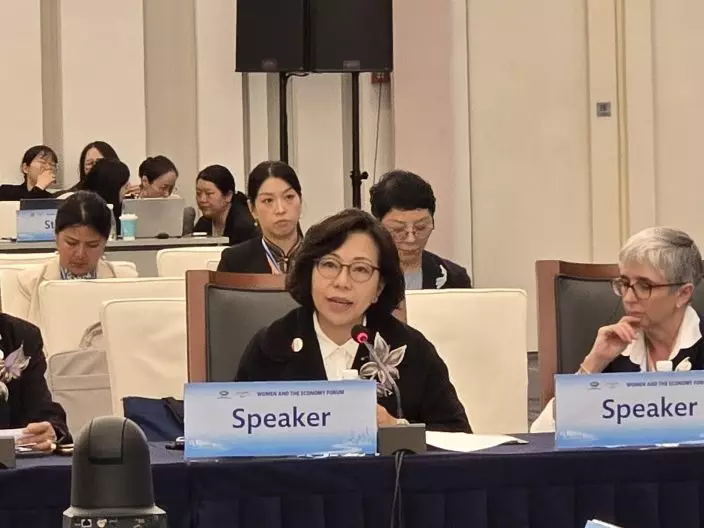
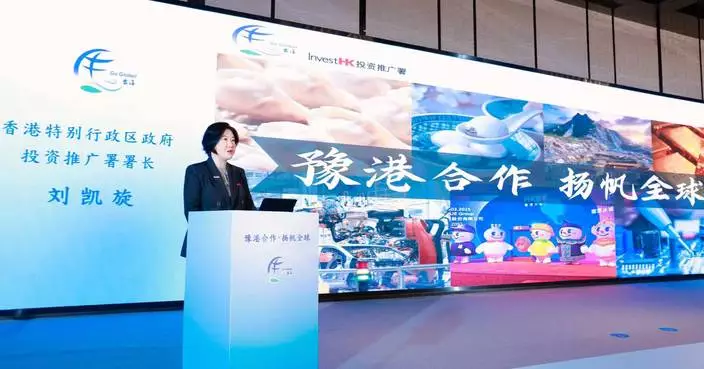
The Secretary for Home and Youth Affairs, Miss Alice Mak, attended the Asia-Pacific Economic Cooperation Women and the Economy Forum in Shanghai today (May 15). Photo shows Miss Mak delivering a speech in the panel discussion on "Advancing Economic and Trade Cooperation" under the Public-Private Dialogue on Women and the Economy in the afternoon. Source: HKSAR Government Press Releases