VATICAN CITY (AP) — Pope Leo XIV has created a study group on artificial intelligence, the Vatican said Saturday, as he gears up to release his first encyclical that is expected to emphasize the need for an ethics-based approach to the technology that prioritizes human dignity and peace.
The Vatican said Leo had decided to create the in-house study group because of the acceleration in AI's use, “its potential effects on human beings and on humanity as a whole (and) the church’s concern for the dignity of every human being.”
The announcement came a day after Leo signed his encyclical, 135 years to the day after his namesake, Pope Leo XIII, dated his most important encyclical, “Rerum Novarum,” or Of New Things. That document addressed workers’ rights, the limits of capitalism, and the obligations that states and employers owed workers as the Industrial Revolution was underway.
It became the foundation of modern Catholic social thought, and the current pope has already cited it in relation to the AI revolution, which he believes poses the same existential questions that the Industrial Revolution posed over a century ago. The new encyclical is expected to place the AI question in the context of the church's social teaching, which also covers issues such as labor, justice and peace.
“I think that the Catholic Church in many ways is going to be the adult in the room on some of these debates about how we are going to integrate AI into the rest of our society,” said Meghan Sullivan, a philosophy professor at the University of Notre Dame who directs its ethics institute. “For sure, the pope is going to be one of the most forceful advocates for human dignity in these discussions.”
Just days after his 2025 election, Leo told the cardinals who made him pope that the Catholic Church owed it to the world to offer the “treasury of its social teaching” to confront the challenges posed by AI on “human dignity, justice and labor.”
The public release of the encyclical, expected in the coming weeks, will likely become a new flashpoint between the Chicago-born Leo and the Trump administration, which has made the rapid development of AI a matter of vital national economic and security strategy. The United States has strongly rejected international regulatory efforts to rein in AI and the Trump administration has removed bureaucratic roadblocks slowing its development domestically.
The flurry of Vatican activity came as U.S. President Donald Trump wrapped up a visit to China that included AI business. Traveling with Trump on Air Force One were, among others, Elon Musk, whose social media platform X features his AI chatbot Grok, and Nvidia CEO Jensen Huang, who recently secured federal approval to sell H200 AI chips to Chinese buyers.
Since the AI boom kicked off with ChatGPT’s debut, the technology’s breathtaking capabilities have amazed the world. Tech companies have raced to develop better AI systems even as experts warn of its risks, from existential but far-off threats like rogue AIs running amok to everyday problems like bias in algorithmic hiring systems.
The United Nations last year adopted a new governance architecture to rein in AI after previous multilateral efforts, including AI summits organized by Britain, South Korea and France resulted only in nonbinding pledges. In 2024, the EU adopted its own Artificial Intelligence Act, applying a risk-based approach to its AI rules.
The Vatican has sought to add its voice to the debate, offering ethical guidelines for the application of AI in sectors from warfare to education and healthcare. The underlying call has been that the technology must be used as a tool to complement, and not replace, human intelligence.
The Vatican has also warned of the environmental impact of the AI race, noting the “vast amounts of energy and water” required by AI data centers and computational power.
“There are almost a billion and a half Catholics in the world, so that alone is reason to pay attention,” said Thomas Harmon, theology professor at the University of St. Thomas in Houston. “But beyond the numbers, the Catholic Church has a deep and sophisticated tradition of thinking through what it means to be human.”
In 2020, the Vatican enlisted tech companies to sign on to an AI pledge, known as the Rome Call for AI Ethics, which, among other things, outlined core principles for AI regulation, including inclusiveness, accountability, impartiality, and privacy. Microsoft, IBM and Cisco were among the private sector companies that signed on.
In his final years, Pope Francis called for an international treaty to regulate AI, saying the risks of technology lacking human values of compassion, mercy, morality and forgiveness were too great to merely trust in the morality of AI researchers and developers.
He also brought his authority to bear on the Group of Seven, addressing a special session on the perils and promises of AI in 2024. There, Francis said politicians must take the lead in making sure AI remains human-centric, so that decisions about when to use weapons or even less-lethal tools always remain made by humans. He called ultimately for a ban on the use of lethal autonomous weapons, colloquially known as “killer robots.”
In-house, Leo has warned priests against using AI to write their homilies. But the math major pope, who does spend free time scrolling on his phone, has also raised his voice on the broader implications of AI on world peace, labor and the very meaning of reality.
For the Augustinian pope, generative AI’s ability to misinform and deceive through deepfake imagery is particularly worrisome, given that the search for truth is a fundamental element of his religious order's spirituality.
In a June 2025 speech to an AI conference, Leo acknowledged generative AI’s contributions to healthcare and scientific discovery. But he questioned “its possible repercussions on humanity’s openness to truth and beauty, on our distinctive ability to grasp reality.”
Leo, who has emphasized a constant appeal for peace, has also called for monitoring how AI is being used and developed in warfare in the Middle East and Ukraine, where automated weapons systems are using everything from aerial drones and maritime and ground platforms.
“What is happening in Ukraine, in Gaza and the Palestinian territories, in Lebanon and in Iran illustrates the inhuman evolution of the relationship between war and new technologies in a spiral of annihilation,” he said this past week at La Sapienza, Europe’s largest university.
AP Technology Writer Matt O'Brien in Providence, R.I. contributed to this report.
Associated Press religion coverage receives support through the AP’s collaboration with The Conversation US, with funding from Lilly Endowment Inc. The AP is solely responsible for this content.
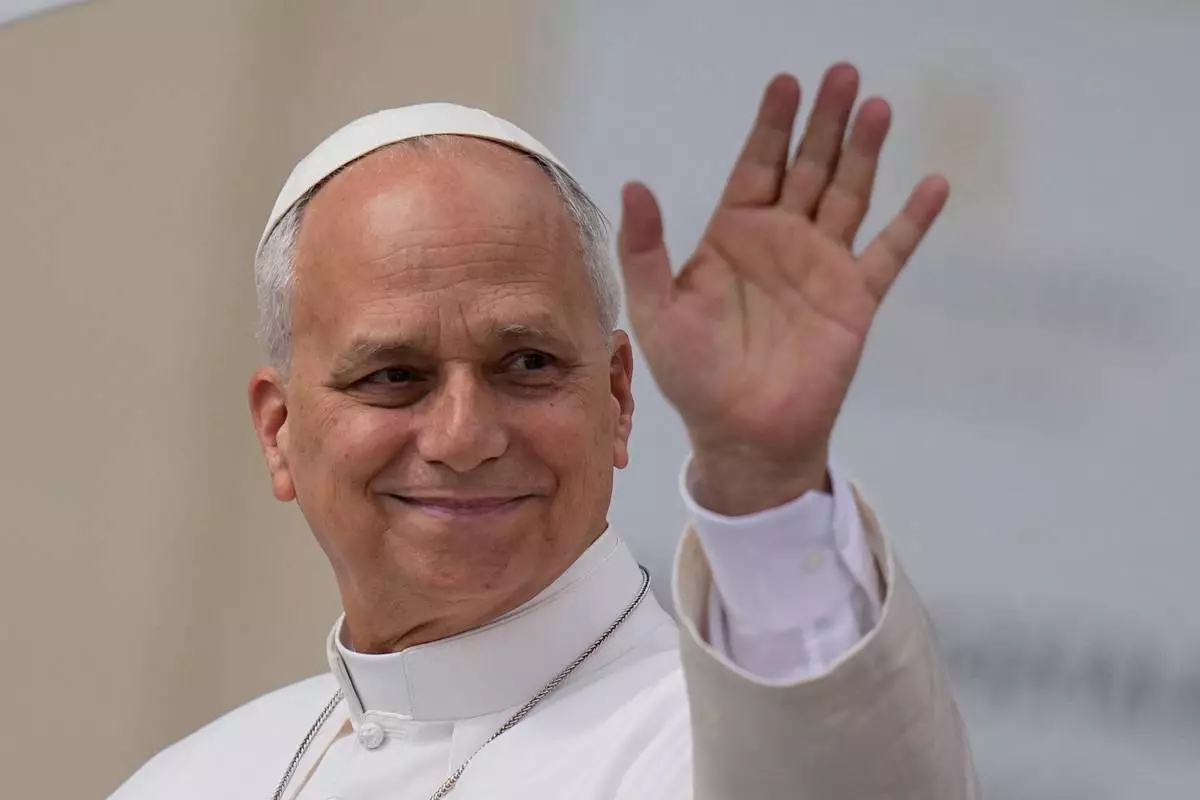
Pope Leo XIV arrives for his weekly general audience in St. Peter's Square, at the Vatican, Wednesday, May 13, 2026. (AP Photo/Alessandra Tarantino)
The final of the Eurovision Song Contest got underway Saturday with tight security and rainy weather failing to dent the enthusiasm of the fans — or that of the critics who think Israel shouldn’t have been invited to the party.
After a week’s buildup, acts from 25 countries took the stage at the Wiener Stadthalle arena in Vienna to battle for the continent’s pop crown. Millions of viewers around the world will cast judgment on a fiery Finnish violinist, a Moldovan folk rapper, a Serbian metal band and many more at Eurovision’s 70th anniversary event.
The contest has been clouded for a third year by calls for Israel to be excluded over its conflicts in Gaza and elsewhere, with five longtime participants — Spain, the Netherlands, Ireland, Iceland and Slovenia — boycotting in protest.
Here is the latest:
Croatia’s Lelek channeled something ancient and powerful with their goth-y folk “Andromeda.” Their stacked harmonies were only emboldened by their physical appearance: The women wore marks on their face and body meant to look like the same used to repel the Ottoman Empire.
The U.K.’s Look Mum No Computer with its “Eins, Zwei, Drei” was a thoughtful critique of the mundanity of labor but also catchy, synth-pop and goofy. Their stage design was also one of the most fun: soulless rectangular desks became imaginative platforms, like an alternative universe nightclub in space.
From France, Monroe’s “Regarde!” was strong on classism over all and judging by the cheers in the room – an effective one.
After the halfway mark, with just 10 performances remaining, Moldova’s rapper Satoshi performed the cheekily patriotic “Viva, Moldova!” with his full heart, in several languages, in a chorus so addictive it almost recalls the anthemic work of anthemic Irish hip-hop trio Kneecap.
Ukrainian singer Leléka offered the ethereal, beautiful “Ridnym,” and Australian star Delta Goodrem showed what a diva should be like with her slick midtempo ballad “Eclipse” — and a bravura performance that saw her raised into the air above a glittery piano. Id she wins, a European country would likely host for Australia next year.
Serbian metal band Lavina provided a dramatic change of pace with the angst “Kraj Mene.”
Aidan’s big-feelings “Bella,” Malta’s Eurovision entry, was all about romance: strings, big belts, swooning instrumentation. It was also one of few Eurovision entries from Malta to feature the Maltese language.
The Czech Republic put their hopes in Daniel Žižka’s “Crossroads,” a restrained pop ballad that builds to a triumphant chorus. Bulgaria’s Dara, a veteran pop performer at this stage, delivered an up-tempo pop banger “Bangaranga,” easily one of the most animated tracks of the bunch this year. And on stage, it was a mood elevator.
Even before the show’s halfway mark, there was already fire, smoke, animal prints and lots of sunglasses worn inside. Lavina, a metal band from Serbia, performed in a digital rainfall as well as burst of flames in studded leather, “Mad Max”-looking costumes.
Albania’s Alis used a smoke-filled stage with digital wings and a clock, inviting a woman depicting a mother onto the stage in a traditional folk dress for his driving, gloomy track, “Nân.” Sarah Engels of Germany added pyrotechnics to her “Fire,” naturally, and Delta Goodrem of Australia added a shimmering golden piano, fire and enough wind machines to power a small town.
Greece’s Akylas was playful with his pounding house track “Ferto,” dressed in tiger-striped shorts and a knit hat and using a scooter to glide along the stage, adding human statues. Ukraine needed only beams of light, a blowing curtain effect and Leleka’s powerhouse vocals as she delivered “Ridnym.”
Denmark’s all-Danish-language Eurovision entry was first with Søren Torpegaard’s “Før Vi Går Hjem,” which he delivered with the specific skillset of someone who has starred as Tony in “West Side Story,” Angel in “Kinky Boots” and Romeo in “Romeo & Juliet.”
Sarah Engels followed, representing her home country of Germany with “Fire.” As the second performer of the night, she took the opportunity to bring pyrotechnics to the stage.
Then came Noam Bettan’s “Michelle” — Israel’s inclusion in Eurovision, which has drawn criticisms. Spain, Ireland, the Netherlands, Slovenia and Iceland withdrew from the competition this year, choosing not to participate to protest Israel’s inclusion.
Most recently, Bettan’s performance was disrupted by protesters during the first semifinal on Tuesday; chants of “Stop the genocide!” were heard in the crowd. At the final, it wasn’t immediately clear if that continued.
Belgium’s Essyla took the stage with “Dancing on the Ice” — a cool ride with its chilly vocal performance and Billie Eilish-informed production, followed by Albania’s Alis.
Protesters called for Israel to be excluded from Eurovision demonstrated near the contest arena ahead of the final. Several hundred marched, with chants of “all of Vienna hates the ESC,” a reference to the Eurovision Song Contest.
They were kept well away from the venue which lies behind a police security cordon.
Demonstrator Echo Vinasha Lex said it was “important to protest against that idea that the song contest is not political. The song contest is a very political event.”
At the start, a filmed opening montage showcased Austria’s majestic scenery as a paper boat made its way to Vienna — a reference to 2025 Eurovision winner JJ’s storm-tossed performance of “Wasted Love.”
The show opened with a performance by last year’s winner, the operatically trained Austrian singer JJ, and an Olympic-style flag parade of the 25 finalists. Then it was on to performances by the musicians, who have just 3 minutes to win over millions of viewers who, along with national juries of music professionals, pick the winner.
The hosts for the extravaganza on Saturday are Michael Ostrowski, an Austrian actor best known for German-language comedy films, and Victoria Swarovski, a model, singer, TV presenter and heir to the Swarovski crystal and luxury goods business.
The head of the Eurovision Song Contest has urged viewers to put politics aside and enjoy the “brilliant, wonderful, heartfelt show” that is the competition’s grand final.
As the contest turns 70 with calls for Israel to be kicked out over the conduct of its war in Gaza and a five-country boycott, Eurovision director Martin Green said the contest is a chance for a few hours to “close the curtains to the outside world and dream that something else is possible.”
He told a news conference that for 70 years Eurovision has given “voice to the voiceless” and celebrated marginalized communities.
“Here’s to the next 70 years,” he said.
Demonstrators protest against Israel ahead of the Grand Final of the 70th Eurovision Song Contest in Vienna, Austria, Saturday, May 16, 2026. (AP Photo/Martin Meissner)
Satoshi from Moldova performs the song "Viva, Moldova!" during the dress rehearsal for the Grand Final of the 70th Eurovision Song Contest in Vienna, Austria, Friday, May 15, 2026. (AP Photo/Martin Meissner)
Delta Goodrem from Australia performs the song "Eclipse" during the dress rehearsal for the Grand Final of the 70th Eurovision Song Contest in Vienna, Austria, Friday, May 15, 2026. (AP Photo/Martin Meissner)
Linda Lampenius and Pete Parkkonen from Finland perform the song "Liekinheitin" during the first semifinal of the 70th Eurovision Song Contest in Vienna, Austria, Tuesday, May 12, 2026. (AP Photo/Martin Meissner)
Demonstrators protest against Israel ahead of the Grand Final of the 70th Eurovision Song Contest in Vienna, Austria, Saturday, May 16, 2026. (AP Photo/Martin Meissner)