Bilateral relations between Russia and China are progressing and driving mutual economic growth, Russian Economic Development Minister Maxim Reshetnikov said in an interview with China Global Television Network (CGTN) aired on Sunday.
The two countries have engaged in cooperation across a range of fields, with bilateral trade value projected to reach about 240 billion U.S. dollars in both 2024 and 2025, the minister said. He added that China and Russia are major trade partners for one another.
"The leaders of China and Russia maintain friendly relations and stay in close communication on a wide range of issues. Their high attention has consistently boosted the growth of bilateral economic and trade links. China-Russia trade value has remained stable at around 240 billion US dollars for the past two years with mild fluctuations, while economic and trade cooperation keeps expanding and upgrading," he said.
"Both nations undoubtedly occupy an important position in each other’s economic development. China stands as Russia’s top supplier, and Russia ranks among China’s top five suppliers with prominent influence across various fields. For instance, Russia’s agricultural product exports to China have surged by over 20 percent, and China supplies Russia with a large number of mechanical equipment," Reshetnikov said.
The minister praised China's advancements in high-tech sectors, particularly its automotive industry.
"China is witnessing vigorous progress in high-tech sectors, and its automotive industry is tapping into the Russian market with innovative products, just as it enters markets in Western countries and beyond," he said.
Reshetnikov also noted that the two countries are launching joint high-tech production projects ranging from aerospace to pharmaceuticals.
"More importantly, bilateral cooperation has achieved qualitative leaps. Beyond simple trade exchanges, the two sides are shifting focus to investment cooperation and launching an increasing number of joint high-tech manufacturing projects. Such cooperation helps deliver faster and better results than separate efforts, covering aerospace, aviation, nuclear energy, pharmaceuticals and more. These efforts lay a solid foundation for future development, enabling mutual progress and shared benefits for both countries," he said.

Russia-China bilateral ties progressing, driving mutual economic growth: minister
Scientists in Peru and Chile are racing to reverse the sharp decline of Humboldt Penguins, a warm-climate species uniquely adapted to the Pacific coast, as climate change and avian influenza threaten its survival.
Peru and Chile are home to the Humboldt penguin, named after the cold water current which flows from Antarctica up the Pacific coast of both countries. It is one of the very few penguin species in the world that lives in a warm climate. Scientists call them a sentinel species -- thermometers of the overall health of the ecosystem.
The penguins nest in Punta San Juan, a small national reserve in southern Peru. They are one species among many marine predators that rest and reproduce here in huge numbers. Biologist Susana Cardenas leads a team that is monitoring and researching these animals and birds. What the researchers have seen in recent years is a dramatic population decline in all species, but particularly penguins, and they are trying to find out why.
"In the last few years, we've seen a decline in the Humboldt penguin population. So, we can go back to 2022 in Punta San Juan, there were about 2,500 Penguins -- that was the size of our colony. And then, well, we had avian influenza that has hit wildlife really hard in Peru and in different places of the world," said Cardenas.
But the impacts didn't stop there for the penguins, which are classed as having vulnerable conservation status, Cardenas explained.
"After that, unfortunately, an El Nino in March of 2023 started and the marine conditions changed and the food availability was not the same. And the penguins, they were getting ready for their breeding season and that's when the marine conditions changed and they did not come back to breed," she said.
In Punta San Juan, penguin numbers dropped from 2,500 to 400 just as Peru's population plummeted from 15,600 to 5,000 all across the birds' range in Peru and Chile, according to Cardenas. That's why continuous data collection is key to maintain the decades of research.
Interns like Sandra Alcantara keep a daily count of the number of nesting penguins and chicks.
"I come here at 6 a.m. to conduct a penguin census. I count all the penguins in a specific age group: adults, juveniles, fledglings, and chicks. Right now, we're in the breeding season, so most of them are adults. So far, I've only seen two juveniles. As the weeks go by, I'll be able to see chicks and then, later on, fledglings," said Alcantara.
The penguins naturally make burrows in the guano, sea bird droppings which build up over decades. Field coordinator Kevin Farfan checks to see if there are any birds in the burrows.
"We are now observing in real time a gradual increase in the number of adult individuals resulting from successful reproduction -- a rise that is slow but steady -- and that gives us great cause for celebration," he said.
These animal populations, while apparently abundant in Punta San Juan, are also highly sensitive to change. Without the tireless dedication of these scientists and volunteers, Peru and the world could lose one of its iconic birds.
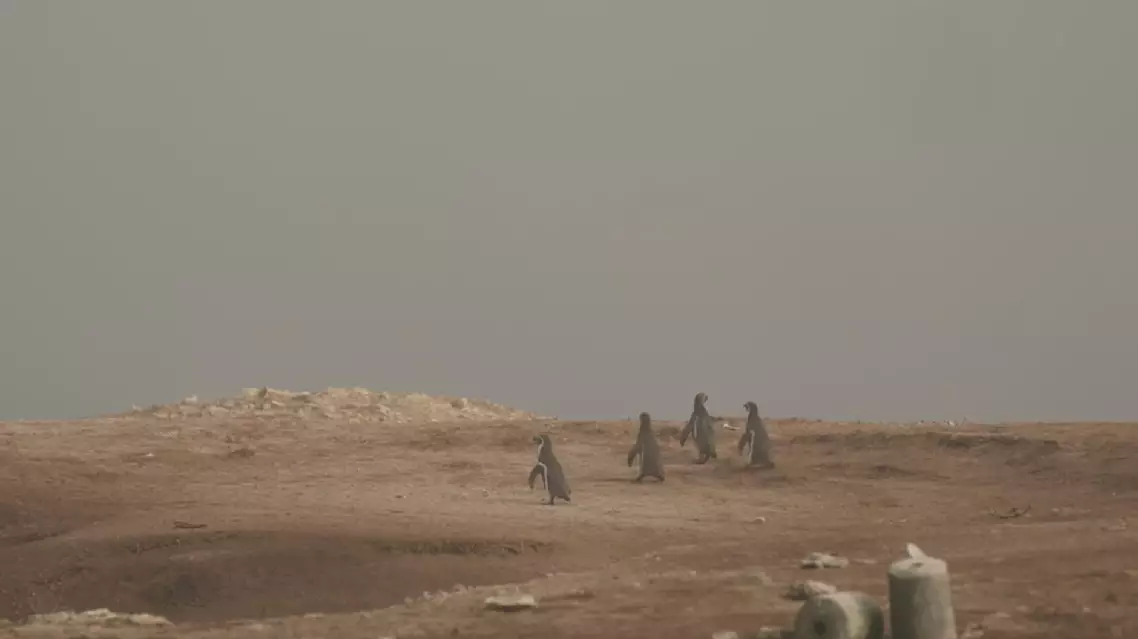
Researchers work to reverse population decline of Humboldt penguins