China's traditional dragon boats are driving the economic growth of Jiujiang Town of Foshan City in the southern province of Guangdong.
Known as "the town of dragon boats" and "the place with the fastest dragon boat rowing," Jiujiang is attracting a growing number of clients and tourists with its exquisite craftsmanship of boat making and thrilling racing events.
In many dragon boat factories in the town, workers are racing against time to keep up with the rising orders from home and abroad ahead of the Dragon Boat Festival which falls on June 19 this year.
"Our annual production capacity now is up to 1,000 dragon boats. Right now, we are working overtime every day to make the boats. We have orders not only from neighboring cities but also from Southeast Asia and Europe. At the same time, we have another 500 or 600 carbon fiber paddles to deliver simultaneously. Our races and training services have been scheduled into July," said Wu Pengjian, president of a local sports equipment company.
The boats manufactured in Wu's company are specifically designed for professional 22-person races, measuring 18.4 meters long and weighing 280 kilograms.
Beyond boat making, the company also provides one-stop services ranging from equipment rentals to event operations for dragon boat races.
Wu said the dragon boat events arranged throughout the year have already boosted the local culture-tourism industry.
The massive influx of visitors brought by dragon boat races has significantly promoted local catering and accommodation businesses.
"Whenever there's a dragon boat race, many people would come to have coffee and enjoy the scenic views. Then our coffee sales will easily double those in normal times," said Lai Zicong, a local cafe owner.
Nestled next to an ecological reserve home to egrets in Jiujiang, Wu Kaining runs a distinctive homestay. She said whenever a dragon boat race is held, she will receive a flood of booking calls two weeks in advance.
"Our rooms are very popular among tourists from Hong Kong and Macao. Plus I myself am a returnee to start business in Jiujiang from Macao, I know quite well that such unique waterside environment and ecological vitality here are exactly what they prefer. Many clients have already reached out to us in advance to book rooms for the Dragon Boat Festival and the summer vacation," Wu said.

Dragon boats boost Foshan town's economy
Scientists in Peru and Chile are racing to reverse the sharp decline of Humboldt Penguins, a warm-climate species uniquely adapted to the Pacific coast, as climate change and avian influenza threaten its survival.
Peru and Chile are home to the Humboldt penguin, named after the cold water current which flows from Antarctica up the Pacific coast of both countries. It is one of the very few penguin species in the world that lives in a warm climate. Scientists call them a sentinel species -- thermometers of the overall health of the ecosystem.
The penguins nest in Punta San Juan, a small national reserve in southern Peru. They are one species among many marine predators that rest and reproduce here in huge numbers. Biologist Susana Cardenas leads a team that is monitoring and researching these animals and birds. What the researchers have seen in recent years is a dramatic population decline in all species, but particularly penguins, and they are trying to find out why.
"In the last few years, we've seen a decline in the Humboldt penguin population. So, we can go back to 2022 in Punta San Juan, there were about 2,500 Penguins -- that was the size of our colony. And then, well, we had avian influenza that has hit wildlife really hard in Peru and in different places of the world," said Cardenas.
But the impacts didn't stop there for the penguins, which are classed as having vulnerable conservation status, Cardenas explained.
"After that, unfortunately, an El Nino in March of 2023 started and the marine conditions changed and the food availability was not the same. And the penguins, they were getting ready for their breeding season and that's when the marine conditions changed and they did not come back to breed," she said.
In Punta San Juan, penguin numbers dropped from 2,500 to 400 just as Peru's population plummeted from 15,600 to 5,000 all across the birds' range in Peru and Chile, according to Cardenas. That's why continuous data collection is key to maintain the decades of research.
Interns like Sandra Alcantara keep a daily count of the number of nesting penguins and chicks.
"I come here at 6 a.m. to conduct a penguin census. I count all the penguins in a specific age group: adults, juveniles, fledglings, and chicks. Right now, we're in the breeding season, so most of them are adults. So far, I've only seen two juveniles. As the weeks go by, I'll be able to see chicks and then, later on, fledglings," said Alcantara.
The penguins naturally make burrows in the guano, sea bird droppings which build up over decades. Field coordinator Kevin Farfan checks to see if there are any birds in the burrows.
"We are now observing in real time a gradual increase in the number of adult individuals resulting from successful reproduction -- a rise that is slow but steady -- and that gives us great cause for celebration," he said.
These animal populations, while apparently abundant in Punta San Juan, are also highly sensitive to change. Without the tireless dedication of these scientists and volunteers, Peru and the world could lose one of its iconic birds.
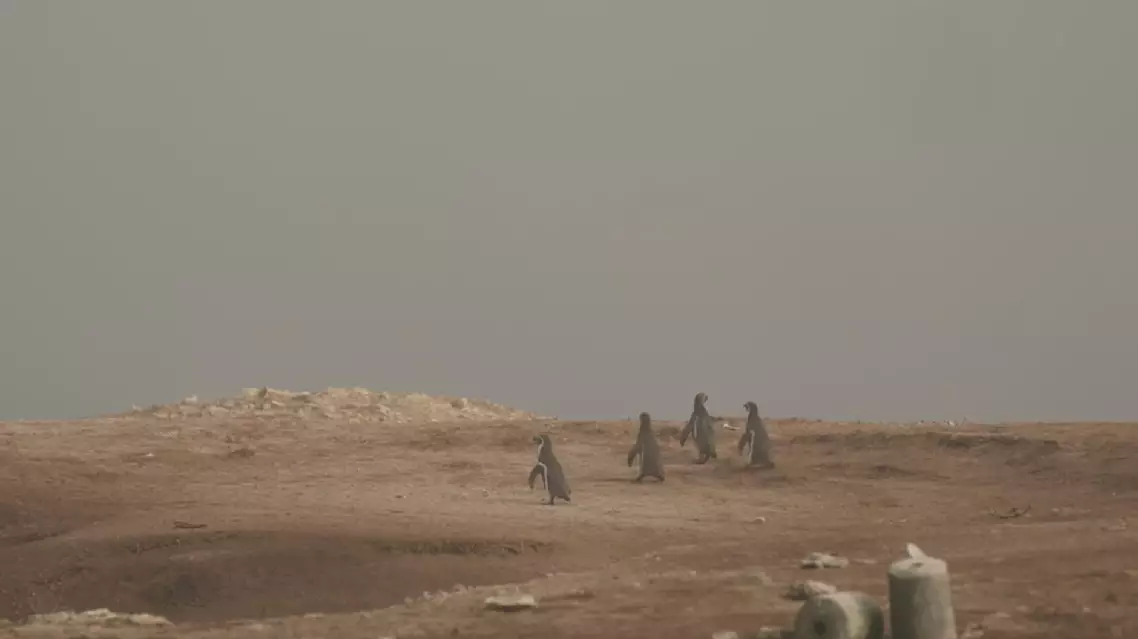
Researchers work to reverse population decline of Humboldt penguins