Ducklings of the Chinese merganser, a species under the first-class state protection, have entered a crucial stage of growth in northeast China's Jilin Province.
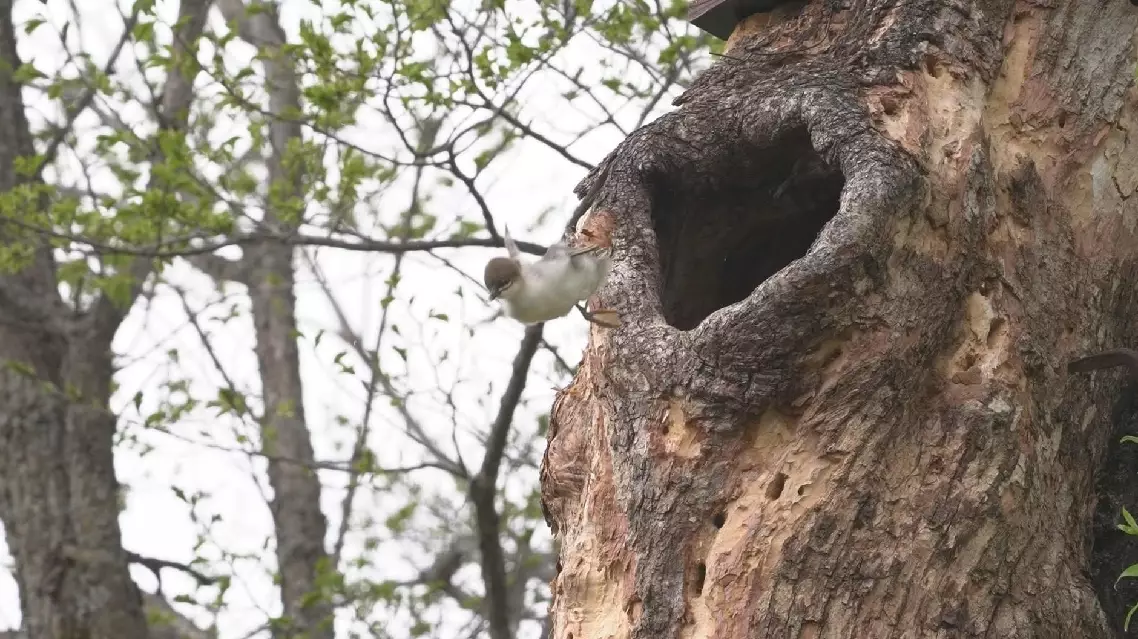
They have made a daring first leap from tree-hole nests more than 10 meters above the ground to begin life in the wild, as conservation workers step up patrols and targeted protection measures during the breeding season.
On Wednesday morning, a female Chinese merganser was found circling in the air. After carefully checking the surrounding environment, she let out a series of rapid calls, summoning her ducklings and signaling that it was relatively safe.
The ducklings followed the mother's signal and made the first jump of their life with remarkable courage.
Their nest sits more than 10 meters above the ground, and the ducklings hit the ground heavily but remained unharmed.
The timing of when they leap out of the tree hollow and leave the nest is decided by the mother duck, who makes an independent judgment after weighing various environmental factors.
After their landing, the young ducklings quickly huddled together and closely followed their mother, beginning to learn survival skills.
However, the yellow-throated martens, also a protected animal in China, often move through the forest in search of prey.
They may even break into tree-hole nests to devour bird eggs, posing a serious threat to the breeding and survival of the Chinese merganser population.
"The yellow-throated marten is a species under the second-class state protection. We cannot harm them in order to protect a species under the first-class state protection. Because the yellow-throated martens have soft pads on their claws, we set up some anti-weasel spikes which can repel the yellow-throated martens and protect the ducklings," said Wang Zhuocong, an associate research fellow with the Institute of Zoology under the Changbai Mountain Academy of Sciences.
Other disturbances from outside, environmental changes, and the birds' own development might also lead to something unexpected, like embryo death during incubation, mother ducks abandoning nests after being startled, and ducklings becoming left alone and trapped.
For example, patrol personnel found two abandoned ducklings in a tree-hole nest earlier this month.
"When the ducklings are very small, we might have to feed them manually. Then, after two or three weeks, they start to prey on their own. At that point, we put some small fish like loaches and minnows into the pond so they can practice their foraging skills. As they gradually become better at foraging and grow bigger, we release them back into the wild step by step," said Shi Guoqiang, an official with the Changbai Mountain's nature reserve management center.
Chinese Merganser ducklings make daring 1st leap in Jilin