LONDON--(BUSINESS WIRE)--May 18, 2026--
This press release features multimedia. View the full release here: https://www.businesswire.com/news/home/20260518415924/en/
The project represents the first planned deployment of a new microservices-based Cell Broadcast platform from Everbridge, designed to support scalable and resilient national public warning operations.
“Our ability to quickly inform people is improving significantly,” said Margo Klaos, Director General of the Estonian Rescue Board. “This technology was specifically designed to inform about threats: natural disasters, large-scale industrial accidents or military attacks. It can deliver threat information to smartphones in seconds, it works even in congested mobile networks, and the notification is designed to appear on the screen as a pop-up window in front of all other applications.”
The enhancement includes hybrid functionality combining Location-Based SMS (LB-SMS) and Cell Broadcast technologies to support faster, more targeted emergency communications during critical events.
“This marks an important next step in Estonia’s ongoing public warning modernization efforts,” said Mark Reeves, Senior Vice President of International Sales at Everbridge. “We are proud to support Estonia as it continues to strengthen its national alerting capabilities. This enhancement combines advanced Cell Broadcast technology with a new microservices-based architecture designed to help deliver faster, more resilient and more flexible emergency communications nationwide.”
Cell Broadcast technology enables authorities to send geographically targeted emergency alerts directly to mobile phones within seconds, even during periods of heavy network congestion. Unlike traditional SMS messaging, Cell Broadcast messages appear prominently on devices without requiring users to subscribe to a service or install a mobile application.
The enhancement is part of Estonia’s broader EE-ALARM initiative to modernize nationwide public warning capabilities.
Everbridge supports governments and mobile operators around the world in delivering fast, reliable public warnings during severe weather events, natural disasters, civil emergencies, and other critical incidents.
About Everbridge
Everbridge helps more than 6,500 enterprises and government organizations manage critical events by enabling them to know earlier, respond faster, and improve continuously. Through an all-in-one AI-powered platform, Everbridge High Velocity CEM™ is autonomous when you want it to be and human-guided when you need it to be, so every incident response is optimized. For more information, visit everbridge.com and follow us on LinkedIn.
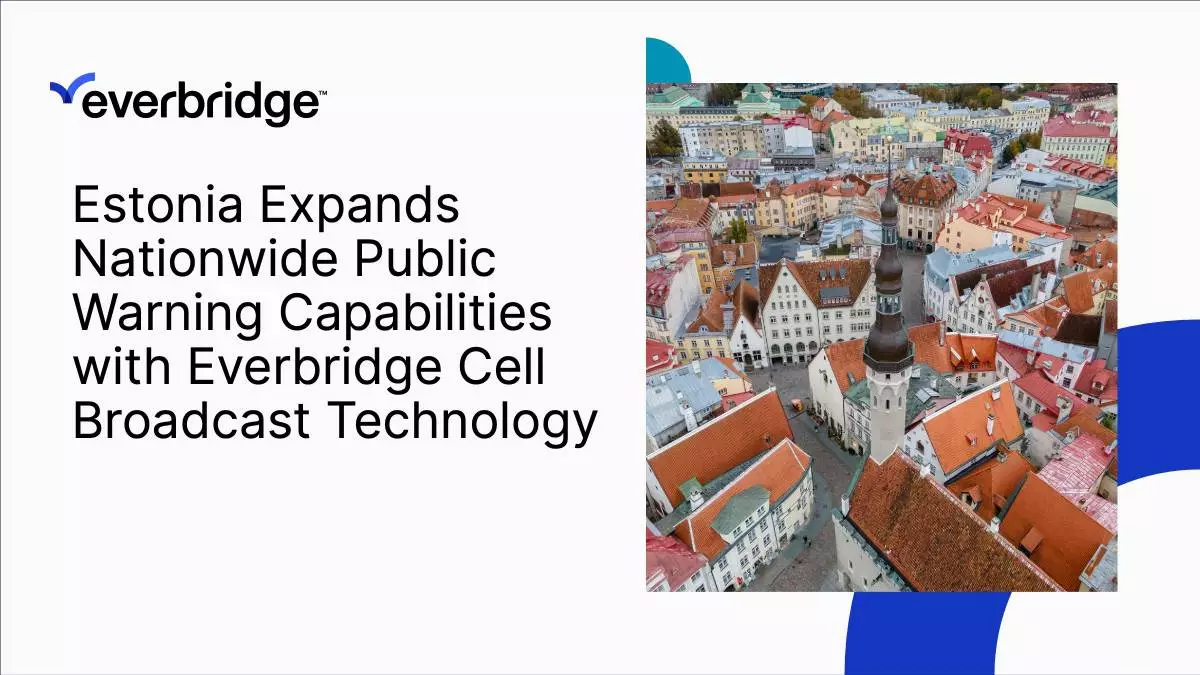
Estonia Expands Nationwide Public Warning Capabilities with Everbridge Cell Broadcast Technology
WELLINGTON, New Zealand (AP) — They call themselves the Flying Kiwis, an eclectic group of New Zealanders from around the world who, whenever their national soccer team plays a major match, assemble to provide raucous and usually outnumbered support.
The deliberate irony: Kiwis — the eponymous bird from which New Zealanders take their nickname — are flightless.
Since 2009 the Flying Kiwis have followed the New Zealand men's team at home and overseas and they'll be at the World Cup, offering a small island of loud, proud and distinctly Kiwi support.
In 2009, New Zealand played Bahrain in a two-game qualifying series, with the winner advancing to the 2010 World Cup in South Africa. After the first leg in Bahrain ended in a 0-0, New Zealand needed a win in the return match at home to qualify for the World Cup.
Matt Fejos, who was then a university student and, he admits, not a hard-core football fan, wanted to lend as much spirit as possible to the New Zealand team.
“So I got a credit card with a $1,000 limit and I bought 32 tickets for my mates and we wanted to do all we could, so we got banners and we got the coveralls saying Flying Kiwis and we got New Zealand flags,” Fejos said. “That was a pretty memorable moment for anyone who was there and for football to arrive in New Zealand a little bit.”
Now those friends are spread around the world and have brought in other friends to the Flying Kiwis.
“I had 10 years living in the UK, so with the Confederations Cup in Russia in 2017, there were 30 of us who went to that and it was kind of a special experience,” Fejos said. Russian people “organized a friendly game between our fans and their fans and it brought in another kind of meaning for me: that you’re doing it for your team but actually in far away places you might be the first New Zealanders they’ve ever met, so you’re kind of representing your country.
“To connect with the world through the global language of football is a beautiful thing and a beautiful way to travel.”
The Flying Kiwis had to find their way to their own brand of fandom. Soccer is not the major sport in New Zealand, where rugby holds sway. The soccer traditions that are firmly fixed in the culture of other countries don’t exist at home, so Fejos and his friends have made their own.
The Flying Kiwis support section is usually small in number compared with the fan bases of New Zealand’s opponents but, Fejos said, “There’s advantages to being so small — we can be really unified.”
The New Zealand team will probably need all the support it can get at the World Cup. Ranked No. 85 in the world, they are drawn in Group G against No. 9 Belgium, No. 21 Iran and No. 29 Egypt.
“There’s so much more belief (among the New Zealand team) because of where the players are playing,” Fejos said of the foreign-based national team members. “There’s so many more playing at a top, top standard and in these difficult environments, these really charged atmospheres with crazy passionate fans. So they’re used to playing under that pressure as well.”
The kiwi isn't the most intimidating of national symbols compared with other mascots such as eagles or lions.
“Sometimes it can seem a bit funny or deprecating but it’s a thing that means a lot,” Fejos said. “The Kiwi is a flightless bird but when you consider the challenges that we face: we’re so isolated, so far away from the world, the professional game is very young here, there are not many professional academies or opportunities.
“Despite that, I think it’s incredible for some of those (New Zealand) players to play in some of the best leagues of the world and to take it to the world at a World Cup."
Fejos said the “metaphor means a lot, defying expectations overseas.”
“People think of us as a rugby country, and probably as hobbits, but that allows us to go in with that underdog mentality, fearless,” he said. "We want to stamp our mark and show them something different.”
AP World Cup coverage: https://apnews.com/hub/fifa-world-cup
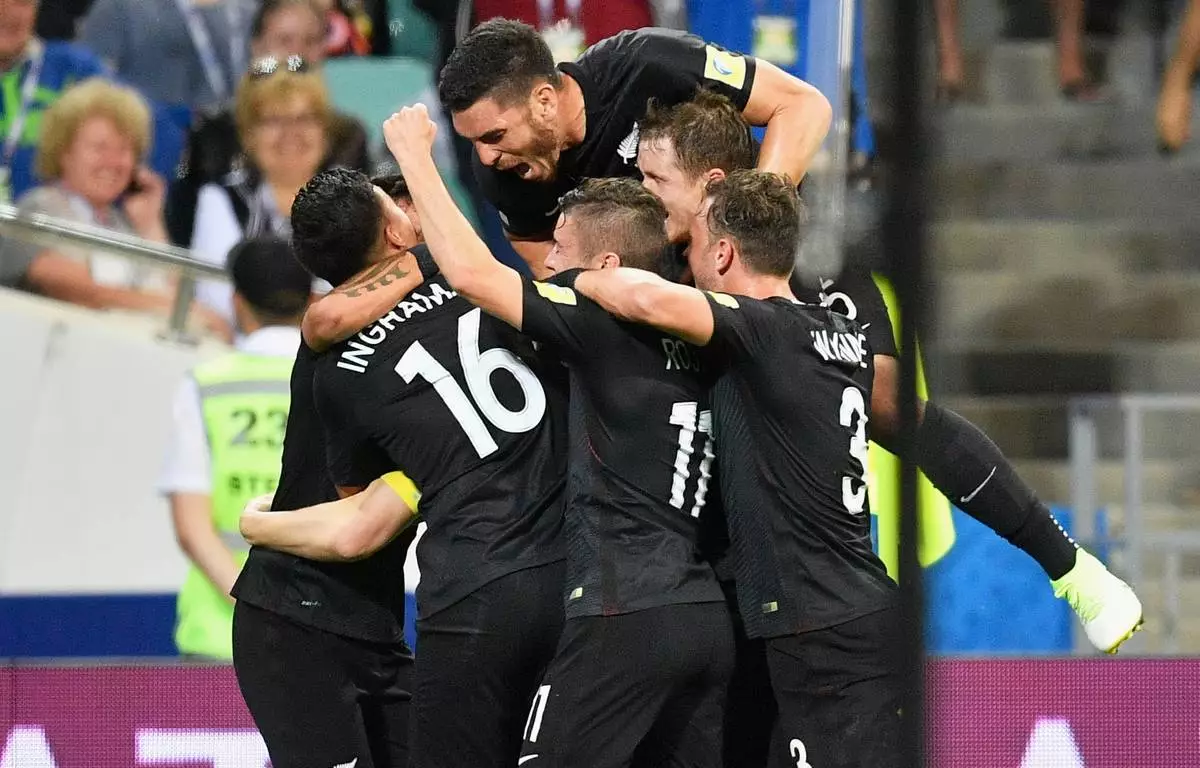
FILE - New Zealand's players celebrate after Chris Wood scored during their Confederations Cup Group A soccer match against Mexico in Sochi, Russia, June 21, 2017. (AP Photo/Martin Meissner, File)